Courts rejected the IRS mileage rate as a driver safe harbor
Cheese trades on the CME and moved 13% in one month. Under-reimbursing your drivers is a minimum wage violation, with class action mechanics attached.

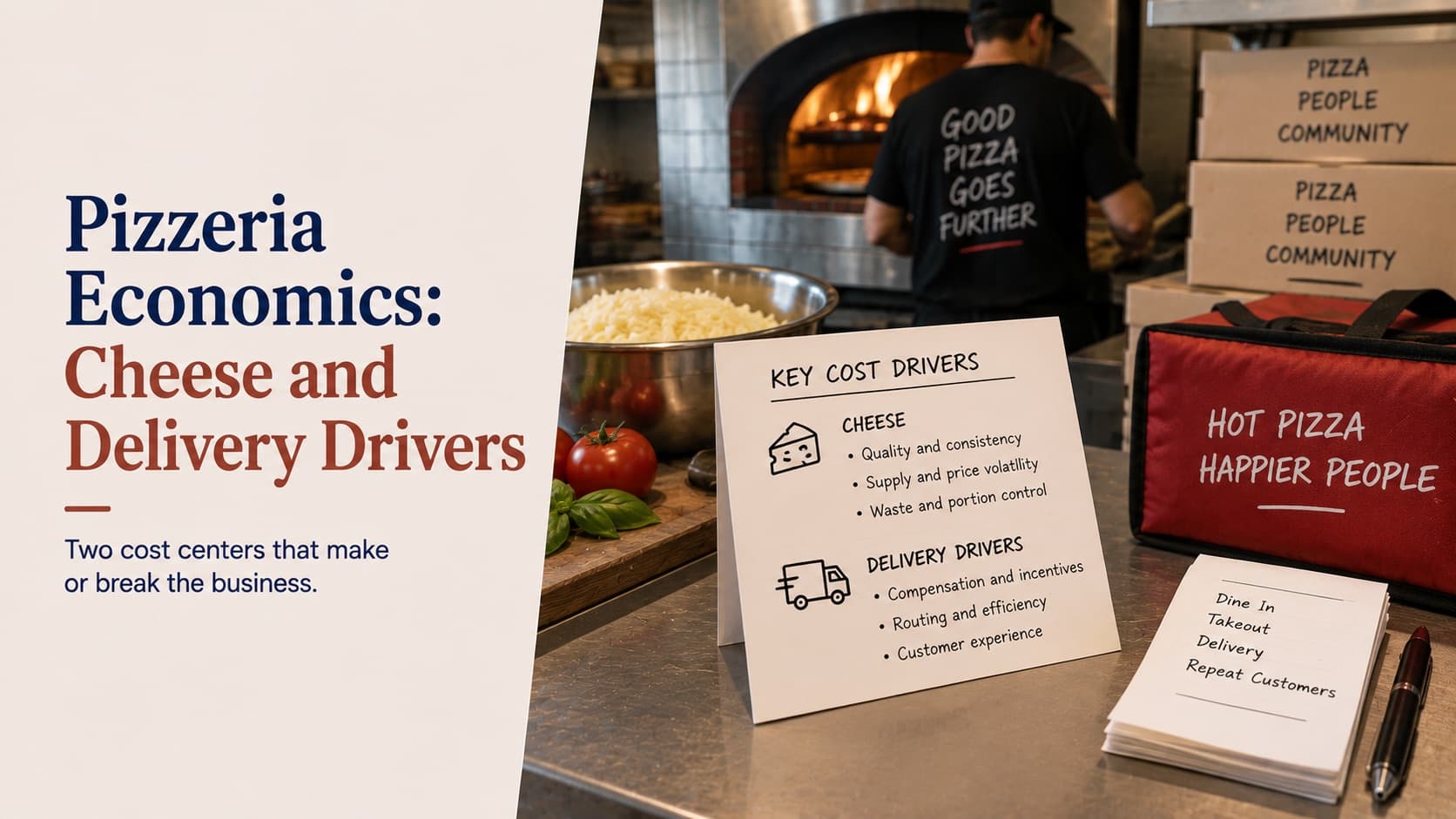
A pizzeria looks like a simple restaurant: small menu, high throughput, forgiving prep, a product that travels. That's why it's the most common independent format in the country.
It also carries two exposures no other restaurant format has in the same concentration, and neither one appears in the business plans I've seen. One is a commodity position. The other is an employment-law position, and it has produced seven-figure settlements.
You are long cheese, whether or not you meant to be
Cheese is the largest single input in a pizzeria's food cost, and it does not price like food. It prices like a commodity, because it is one: block cheddar traded on the Chicago Mercantile Exchange is the industry benchmark, and mozzarella pricing follows it.
The volatility is not theoretical. Block cheese peaked around $1.8845 per pound in February 2026 and fell to $1.6438 in March — roughly a 13% move inside a single month. The weighted average mozzarella price for the 2026 school year came in around $1.8444.
Now consider what that does to a business where cheese might be a third of plate cost on your highest-volume item. A 13% swing in your largest ingredient, arriving in a month, against menu prices you can realistically change once or twice a year. The national average for a large cheese pizza is around $16.92, with some markets past $20 — and that price does not move in March because the CME did.
Three practical responses, none of which is "watch the market nervously":
Know your exposure as a number. Compute cheese as a percentage of total food cost, not just of a pizza. If it's 25–35% of your food spend, a 13% commodity move is a 3–5% move in food cost, which is most of a bad month.
Ask your distributor about fixed-price windows. Many will quote fixed pricing for a defined period on high-volume commodity items. That's not speculation, it's removing variance you're not paid to carry. Understand what you give up — usually you pay slightly above spot for the certainty.
Watch the block price yourself. It's public. A pizzeria operator who knows where cheese is trading makes better decisions about when to take a fixed-price offer than one who finds out from an invoice.
The rest of the cost discipline is the same as any restaurant, and the method is in the food cost post. What's different is the concentration: most restaurants are diversified across many inputs. You are not.
The driver reimbursement problem has no safe harbor
This is the one I'd want every pizzeria owner who employs their own drivers to read twice.
If you require a minimum-wage employee to supply their own vehicle for work, and you don't fully cover what that costs them, the shortfall functions as an unlawful "kickback" — it reduces their effective pay below the federal minimum wage. Gas, maintenance, insurance and depreciation all count as costs of providing the vehicle.
Here's what makes this genuinely hard rather than just expensive. Employers reached for two obvious methods, and the Sixth Circuit, whose rulings bind Kentucky, Michigan, Ohio and Tennessee, rejected both:
"Reasonable approximation" was rejected. Employers argued they only needed to approximate expenses reasonably. The court said no.
The IRS standard mileage rate was rejected as the controlling standard too. The reasoning is worth understanding, because it's sound: the IRS rate is a national average built for tax deduction purposes. It overpays in low-gas-tax states and underpays in high-gas-tax ones, and it is structurally unfavourable to high-mileage drivers — which delivery drivers are, by definition.
What the court required instead is reimbursement of 100% of the actual cost of providing the vehicle. What it did not provide is a formula. There is no controlling method, which means there is no safe harbor to sit inside.
The flat rates that got litigated give you the shape of the risk: one operator paying $0.28 per mile, another paying $1 to $1.50 per delivery. Per-delivery flat rates are especially exposed, because a flat amount per delivery bears no relationship to distance — the same $1.50 covers a two-mile run and an eight-mile one.
And the scale of the downside is established. A Pizza Hut franchisee operating more than 300 locations agreed to pay $4.75 million to settle a delivery driver class action under the FLSA.
Two things follow that are specific to how restaurants are owned:
This is a class action shape. Every driver, every shift, over the limitations period. It is not a one-employee dispute.
Your entity may not protect you. FLSA liability attaches to individuals with operational control and does not require an ownership interest. The owner-operator of a single pizzeria is squarely within that description.
What to actually do: track delivery mileage per driver, and reimburse against something defensible — actual documented costs where you can get them, or a rate you can show exceeds actual cost for your market and your vehicles. Document the basis. Given that no method is blessed, the defensible position is generosity plus records, not a rate you found in an article.
The insurance gap that comes with it
Related and frequently missed: personal auto policies exclude delivery use. A driver's own policy generally will not respond to a crash that happens while delivering, which leaves the injured party looking at the business. Non-owned and hired auto coverage is the piece that addresses it, and it's one of the recurring gaps I went through in the insurance post.
Check it before your first delivery shift, not after.
Why in-house delivery at all
Given the above, the reasonable question is why not hand it all to the platforms. The answer is the arithmetic in the third-party delivery post — commissions that take a substantial share of the order, plus the loss of the customer relationship and the data.
The honest framing is a genuine trade, and it's the central strategic choice of the format:
| In-house drivers | Platforms | |
|---|---|---|
| Cost | Wages + full vehicle reimbursement + insurance | Commission per order |
| Legal exposure | FLSA reimbursement, auto liability | Largely transferred |
| Customer data | Yours | Theirs |
| Capacity ceiling | Your drivers | Effectively unlimited |
Most pizzerias end up with both, and that's usually right. What's not right is running in-house drivers without pricing the reimbursement and insurance exposure, then concluding in-house is cheaper. It may still be. It's just not as much cheaper as the wage line suggests.
What I'm not going to give you
A reimbursement rate. That's the whole point — the courts declined to bless one, and an article that hands you a number is inventing the safe harbor a federal appeals court refused to create.
A cheese cost percentage target. It moves with the market monthly. Compute your own exposure and re-compute it.
Oven advice. Deck, conveyor, and wood-fired produce genuinely different businesses in terms of labor skill, throughput and hood requirements, and I don't have sourced comparative data I'd stand behind. What I can tell you is that the choice runs straight into the hood and utility capacities that cap every kitchen, and it should be made before the space is.
The short version
Compute cheese as a share of your food spend and treat it as a commodity position you either hedge with fixed-price windows or accept consciously. If you employ drivers, track mileage, reimburse generously, and document the basis — because there is no approved method and under-reimbursement is a minimum wage violation with class action mechanics and personal exposure attached. And confirm you carry non-owned auto coverage before anyone drives.
Disclosure: I work at Katalyst, and mileage and delivery tracking are things a POS with a delivery module does — so treat the tracking recommendation with appropriate suspicion. The two items here that cost nothing are calling your distributor about fixed-price windows and calling your broker about non-owned auto.
See how Katalyst handles your service style
A 30-minute walkthrough of the platform, tuned to how your restaurant actually runs.