Three cities in one week means three separate plan reviews
Nearly every state requires a signed commissary agreement before the permit issues, and a folding prep table beside the truck can put you outside your license.

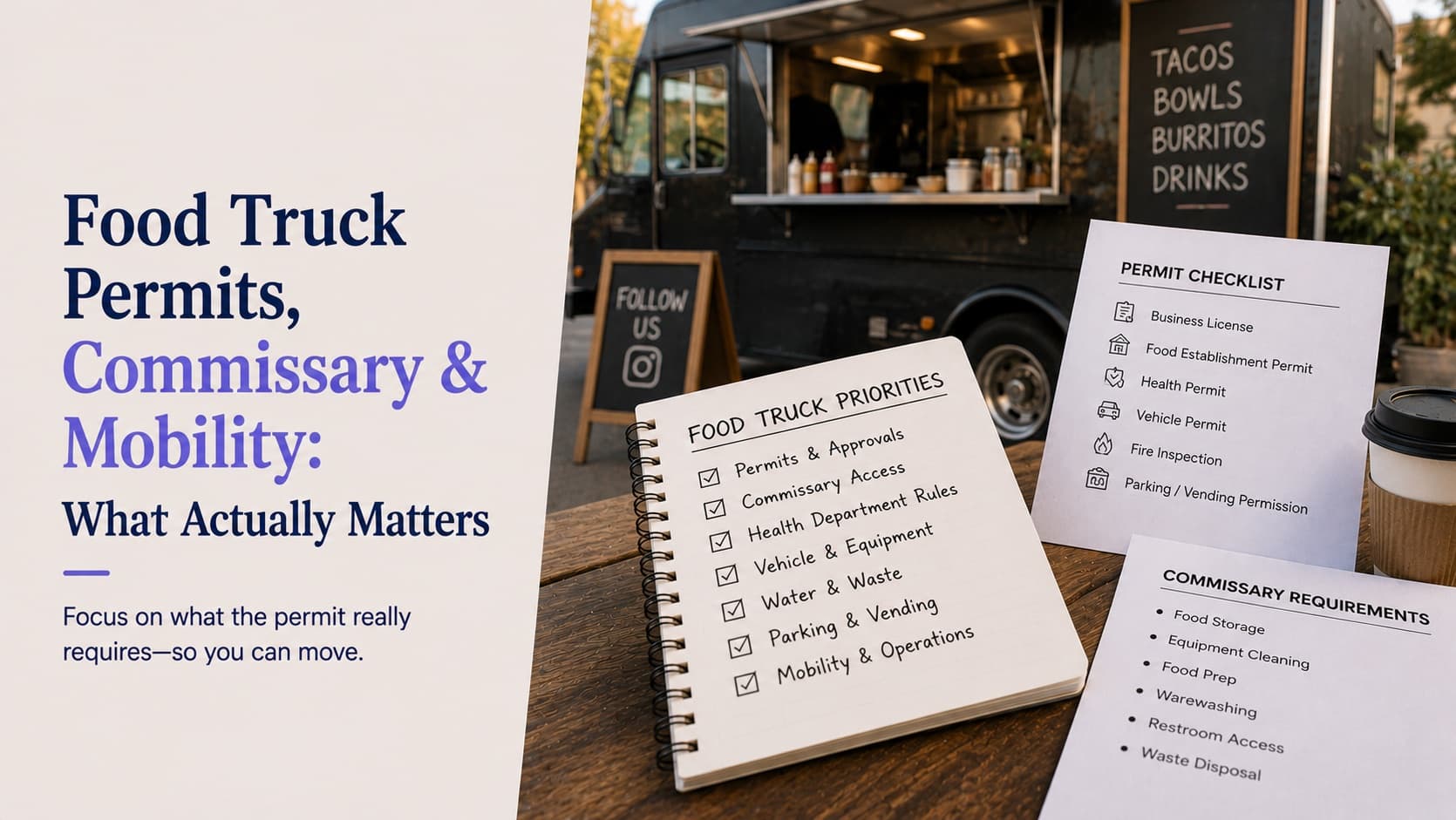
The food truck is sold as the affordable entrance to the industry: a fraction of a restaurant's build cost, no lease, and the freedom to take the business wherever the customers are.
Two of those three are true. The third — the mobility — is largely a legal fiction in most of the United States, and understanding why changes how you should plan the whole business.
Your permit stops at the city line
Mobile food permits are issued by local health departments, and in most states there is no reciprocity between jurisdictions. A permit from Houston does not cover you in Austin or Dallas. A truck working downtown Baltimore and Towson needs both a Baltimore City permit and a Baltimore County one.
The version of this that should reorganise your business plan: a truck operating in Newark, Hoboken and Jersey City on different days of the week needs three separate permits and three separate plan reviews.
Plan reviews. Not just fees — the same drawings-and-approval process a restaurant goes through, repeated per jurisdiction, each on its own schedule and its own renewal cycle. The permitting sequence post describes that process once. Multiply it by your operating radius.
So the real constraint on a food truck is not fuel or driving time. It is that each new city you serve is a fixed annual cost and an administrative relationship, and the economics only work if that city produces enough volume to carry its own permit.
Fees themselves are usually modest and wildly inconsistent — Baltimore County's annual mobile fee runs around $100 with a steep late penalty, Baltimore City charges a small application fee plus an annual license, and parking or vending permits can add anywhere from $50 to several hundred. The money is rarely the problem. The calendar and the duplicated process are.
Unless you're in a reciprocity state
A handful of states have moved deliberately against this, and if you're choosing where to launch, this is worth checking before anything else.
Reported to have some form of statewide reciprocity or reciprocal licensing for mobile vendors: Texas (legislation passed in 2023), Utah (also 2023), Connecticut (a reciprocal itinerant food vendor scheme), and Wisconsin. Florida works differently again — a state-level license from DBPR that counties then supplement rather than duplicate.
This area is changing quickly, so verify the current position with the state agency rather than with any article, including this one. But the strategic point holds: in a reciprocity state, a truck can genuinely chase demand across a metro area. In a non-reciprocity state, your service area is a set of individually licensed islands, and you should plan routes and revenue around the islands you can afford to license.
That single fact should probably influence where a mobile concept launches more than demographics do.
The business with no rent has rent
The second structural item nobody puts in the startup budget.
Nearly every state requires a signed commissary agreement before a mobile food permit will issue. Without a letter of use from a licensed commercial kitchen, you do not get the permit — it's a precondition, not a nice-to-have.
The reason is straightforward: a truck has limited space for storage, refrigeration, warewashing and prep, so the health department requires a fixed licensed facility behind it for food storage, food preparation, truck cleaning, wastewater disposal and potable water filling.
The agreement is a real contract — signed by the commissary operator, stating your access schedule, the services included, and the commissary's license number. Health departments read it.
And you cannot substitute your own kitchen at home. Prepping at home is prohibited in most states regardless of how clean your kitchen is.
Some states have begun carving out exemptions for fully self-contained units — Texas, parts of Arizona and Florida appear among them — where a truck with adequate onboard capacity can operate without a commissary. Worth investigating, because it changes the cost base materially. Worth verifying directly, because "fully self-contained" is a defined term with specific equipment requirements rather than a description.
Either way, budget the commissary as a recurring monthly cost from day one. The "no lease" advantage of a food truck is smaller than advertised; what you avoid is a ten-year lease with a personal guarantee, which is genuinely valuable — but not the same as avoiding occupancy cost.
What "mobile food unit" legally means
Worth reading your state's actual definition, because it constrains operations in ways people discover during an inspection.
Virginia's is representative: a mobile food unit is a food establishment mounted on wheels, readily moveable from place to place at all times during operation — and the unit, all operations, and all equipment must be integral to and within or attached to the unit.
Read that last clause carefully. A folding prep table beside the truck, a cooler on the ground, a separate serving station under a canopy — all of those may put you outside the definition of the thing you're permitted as. Operators do this constantly at events without realising it's a compliance question rather than a logistics one.
"Readily moveable at all times during operation" also has teeth. A truck jacked up, or with equipment that must be disassembled before it can move, may not qualify.
The other things that aren't in the startup lists
Fire suppression. If you're cooking with grease you need a suppression system over the cooking line and it needs inspection and certification, same as a restaurant hood — see the kitchen post for why grease changes everything.
Propane. Separate inspection regime, separate certification, and event organisers frequently require documentation of both.
Water tank capacity. Fresh and waste water capacities are specified by code, and waste capacity is typically required to exceed fresh. Your tanks determine how long you can trade before you must return to the commissary — which means the commissary isn't just a compliance item, it's a constraint on your service day.
Generator noise. Local noise ordinances apply at the spot where you park, and they're enforced by a different department than the one that issued your permit.
What I'm not going to give you
A national startup cost range. The published ranges span truck purchase, wrap, equipment, permits across unknown numbers of jurisdictions, and a commissary. They are not comparable to each other, let alone to your situation.
A permit checklist. The whole point of this post is that the checklist is per-jurisdiction and doesn't transfer.
Revenue per event figures. Every source I found was a vendor or an aggregator, and event revenue varies by an order of magnitude between a brewery lot on a Tuesday and a ticketed festival.
The order to do this in
- Decide your target metro, then check whether that state has reciprocity. This determines whether the business model is "one permit, wide radius" or "few locations, deeply worked."
- Find and price the commissary before you buy the truck. It's a precondition for the permit and a recurring cost, and available capacity near you may be limited.
- Read your state's mobile food unit definition and design the service flow to stay inside it, including at events.
- List every jurisdiction you intend to trade in and total the permits, plan reviews and renewal dates. That total is your real fixed cost, and it should be the input to the route plan rather than an afterthought.
- Verify the self-contained exemption if your state has one — it may remove the largest recurring cost in the model.
Disclosure: I work at Katalyst and we sell restaurant technology, which matters less here than in most of these posts — a truck's technology needs are mostly a card reader and connectivity, and connectivity is a genuine operational risk when you're trading in a field. The offline behaviour post is the relevant one, and it applies to mobile operators far more often than to restaurants.
Topics
See how Katalyst handles your service style
A 30-minute walkthrough of the platform, tuned to how your restaurant actually runs.