Wage-and-hour liability doesn't require owning the place
The trust-fund penalty reaches your personal assets, sales-tax liability is joint and several, and moving partner units needs liquor-board approval.

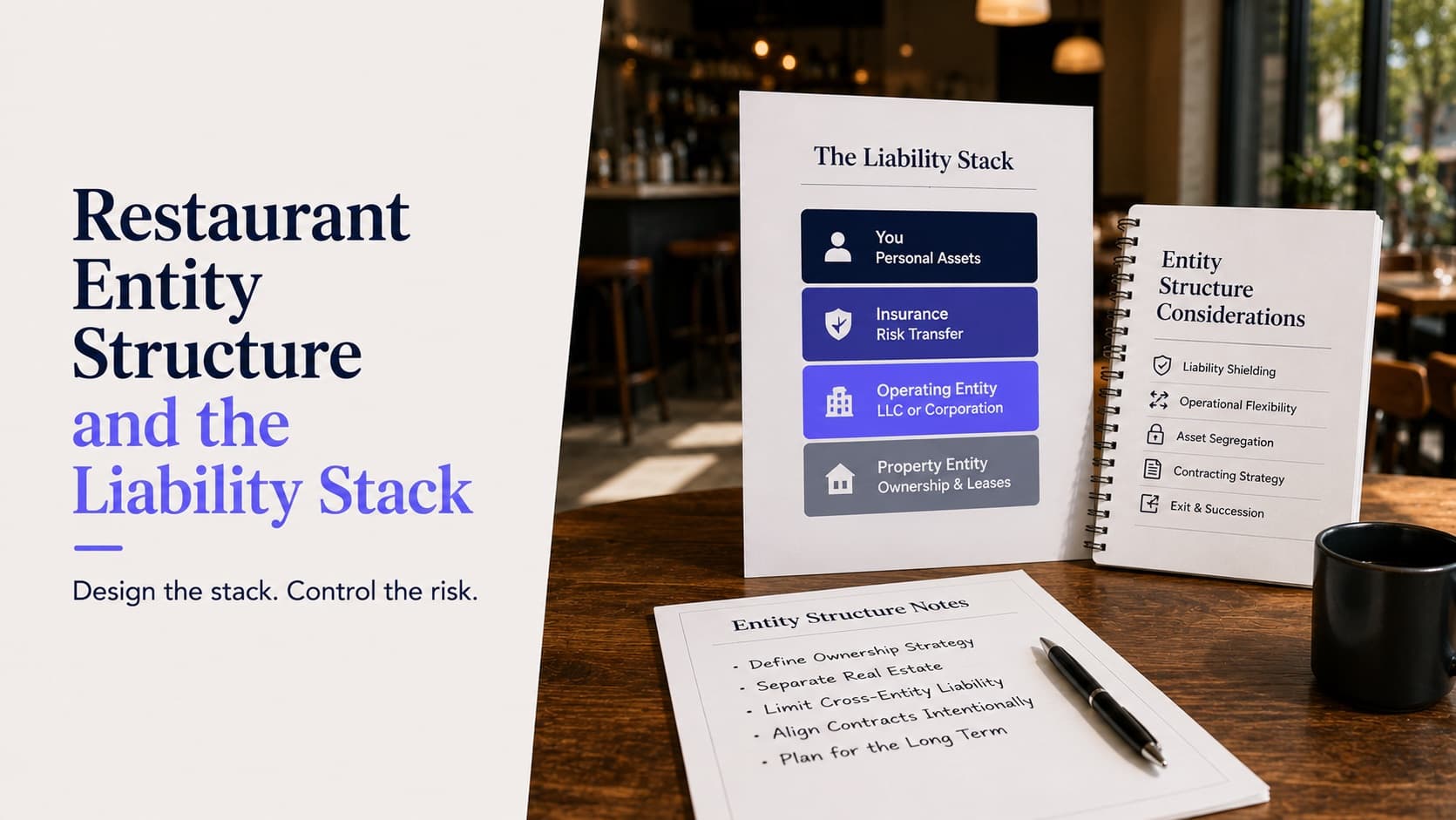
Every first-time restaurant owner asks the same question: LLC or S-corp? And every article answers it the same way — pass-through taxation, self-employment tax on distributions, reasonable compensation, liability protection for your personal assets.
That answer is fine as far as it goes. The problem is that it's aimed at the wrong risks. The three exposures that actually recur in restaurants pass straight through the entity, and none of them are the slip-and-fall the LLC gets sold on.
I'm not a lawyer or a CPA, and none of this is advice for your situation. It is the list of things I'd want to know before I walked into that conversation, so I could ask better questions than "LLC or S-corp."
Three liabilities that reach through the entity
Payroll taxes you withheld and didn't remit
When you withhold federal income tax, Social Security and Medicare from a server's check, that money is held in trust for the government. It was never yours.
Under IRC § 6672, the Trust Fund Recovery Penalty makes an individual personally liable for the willful failure to collect, account for and pay over those taxes. The test has two parts: you're a "responsible person," and the failure was "willful." Responsible person means significant — not necessarily exclusive — control over the company's finances, judged by status, duty and authority rather than title. Willful, in practice, is a low bar: knowing the taxes were owed and paying other creditors instead generally gets you there.
Paying your produce supplier before the IRS during a bad month is exactly the fact pattern. And the LLC does not stop it. This is a collection device specifically designed to reach through entity structure.
Sales tax you collected and didn't remit
Same logic, different government, and this one is worse in a way most operators never hear.
Many states impose personal liability on responsible persons for uncollected or unremitted sales tax. New York defines those persons broadly — owners, officers, directors, employers, members, partners, managers or employees under a duty to act on sales and use tax compliance. Maryland reaches the president, vice president or treasurer, LLC members who manage the business, and LLC members who don't manage it directly but direct the management.
The part that matters: a responsible person is jointly and severally liable for all of the tax owed — together with the LLC and every other responsible person. Not your share. All of it. Your partner's failure to remit is collectible from your personal assets.
Given that most sales tax errors I've seen were configuration errors rather than theft, this is worth connecting to something concrete: how your POS is set up determines what gets collected, and what gets collected determines what you owe regardless of what actually hit your bank account.
Wage-and-hour claims
The Fair Labor Standards Act defines an employer as "any person acting directly or indirectly in the interest of an employer in relation to an employee." Courts read that well past the corporate entity.
The test is an "economic reality" test looking at the totality of circumstances, and what it measures is operational control, not job title. Courts have found individuals liable where they had final authority over the terms and conditions of employment including the amount and form of wages, worked at the restaurant regularly, oversaw day-to-day operations, and hired and supervised the person running payroll.
That describes essentially every owner-operator I know.
And here is the detail that should end the "but I structured it properly" reasoning: personal liability under the FLSA does not require an ownership interest at all. A general manager with enough operational control can be an "employer." The entity isn't the variable. Control is.
Tip credit mechanics are where this most often goes wrong in restaurants specifically, and I went through those in the tip pooling post.
So what does the entity actually do?
It does real work, and I don't want to talk anyone out of forming one. Keep this part short because it's the part every other article already covers well:
- It separates business debts from personal assets for ordinary commercial liabilities — trade payables, most contract disputes, most tort claims.
- It gives you a tax election. Pass-through by default; an S-corp election can reduce self-employment tax on distributions if you pay yourself reasonable compensation. That calculation is real and it's your CPA's job, not a blog's.
- It creates a transferable ownership unit, which is what you'll eventually sell.
- It makes the books separable, which matters more than people expect when you sell the business.
The mistake isn't forming the entity. The mistake is believing it covers the three exposures above, and therefore not managing them directly.
The liquor license welds you to the entity you chose
This is the one that turns a day-one decision into a permanent one, and it's why the entity conversation should happen before the license application rather than after.
A liquor license is issued to a specific licensee, and changing the licensee is not a filing — it's a re-application. Changing the entity type at all — sole proprietor to LLC, partnership to corporation — constitutes a change in proprietorship, which typically requires a new application rather than an amendment. At the federal level, a basic permit terminates automatically on a change in actual or legal control unless an application for a new permit is filed within 30 days.
State authorities go further into your cap table than most owners expect. The New York State Liquor Authority must approve in advance changes to your corporate structure: adding or removing an officer or director, adding or removing a managing member, a change in stockholders or members, or any change in the stock or membership units held by an existing stockholder or member.
Read that last clause again. Reallocating percentages between two existing partners — no new people, no new money — is a change requiring advance approval.
The practical consequences:
- Decide your ownership split before you apply, not after. A post-approval adjustment is a regulatory event.
- Bringing in an investor later is a licensing event, not just a cap-table event, and it runs on the agency's calendar.
- A separate entity for the real estate is easier than a separate entity for the license. If you own the building, holding it in its own entity is standard practice and doesn't disturb the license. Do not attempt the reverse — moving an operating license into a new structure — casually.
In quota states the license is a separately valued asset with its own timeline on top of all this, which I covered in the buying-and-selling post.
The personal guarantee undoes it anyway
You can structure perfectly and then sign the protection away, usually three times in the first month:
The lease. Landlords routinely require a personal guarantee from first-time operators. This is the single largest number you will personally guarantee, and unlike the others it survives assignment — selling the restaurant does not release you absent a signed release from the landlord. Negotiate for a "good guy" clause or a burn-off after a defined performance period; the mechanics are in the lease negotiation post.
The merchant account. Processing agreements typically carry a personal guarantee for chargeback exposure. That's the one that bites if you close with outstanding gift card balances or unfulfilled catering deposits.
Equipment financing. Almost always guaranteed for a new business with no operating history.
None of that is avoidable for most first-timers. It's just worth knowing that after signing those three, the entity is protecting a narrower band of risk than the brochure suggested — and that the band it protects is the band your general liability policy was already covering. Which policy, and what it excludes, is a separate conversation that matters considerably more than LLC-versus-S-corp.
What I'm not going to tell you
Which entity to choose. It depends on your income, your state, how many owners there are, whether you'll take investors, and what you plan to do with the building. Anyone giving you a default answer without those facts is guessing.
A reasonable-compensation figure for an S-corp election. You will find articles offering percentages. The IRS standard is facts and circumstances, there's no safe-harbor percentage in the code, and the numbers that circulate are somebody's rule of thumb presented as a rule.
How much liability protection is "enough." That's an insurance question with an entity component, not the other way around.
What to do with this
Form the entity — it does real work. Then spend your attention on the three things it doesn't cover:
- Segregate the trust fund money. Payroll withholding and sales tax are not working capital, and treating them as a cash flow buffer is precisely the fact pattern that produces personal liability. Moving them to a separate account on collection is the cheapest protection in this entire post.
- Get the wage-and-hour mechanics right at the start — tip credit notice, overtime calculation on tipped wages, off-the-clock work. Operational control is what creates exposure, and you're going to have operational control.
- Finalize ownership percentages before the liquor application, and treat any later change as a regulatory filing with a lead time.
Disclosure: I work at Katalyst, and I'll point at the self-serving part directly: two of the three exposures above are downstream of what your POS and payroll systems record. Sales tax liability follows your tax configuration, and wage-and-hour liability follows your time records. That's a real argument for taking the setup seriously, and it's also obviously an argument a POS company benefits from making. Weigh it accordingly — but segregating the trust fund money into its own account costs nothing and doesn't require buying anything from anyone.
See how Katalyst handles your service style
A 30-minute walkthrough of the platform, tuned to how your restaurant actually runs.