Bad water voids the warranty on your espresso machine
The SCA target is 90-150 ppm TDS, and above 200 ppm scale builds in three to six months. Coffee's real difference is hours to earn rent, not cost per cup.

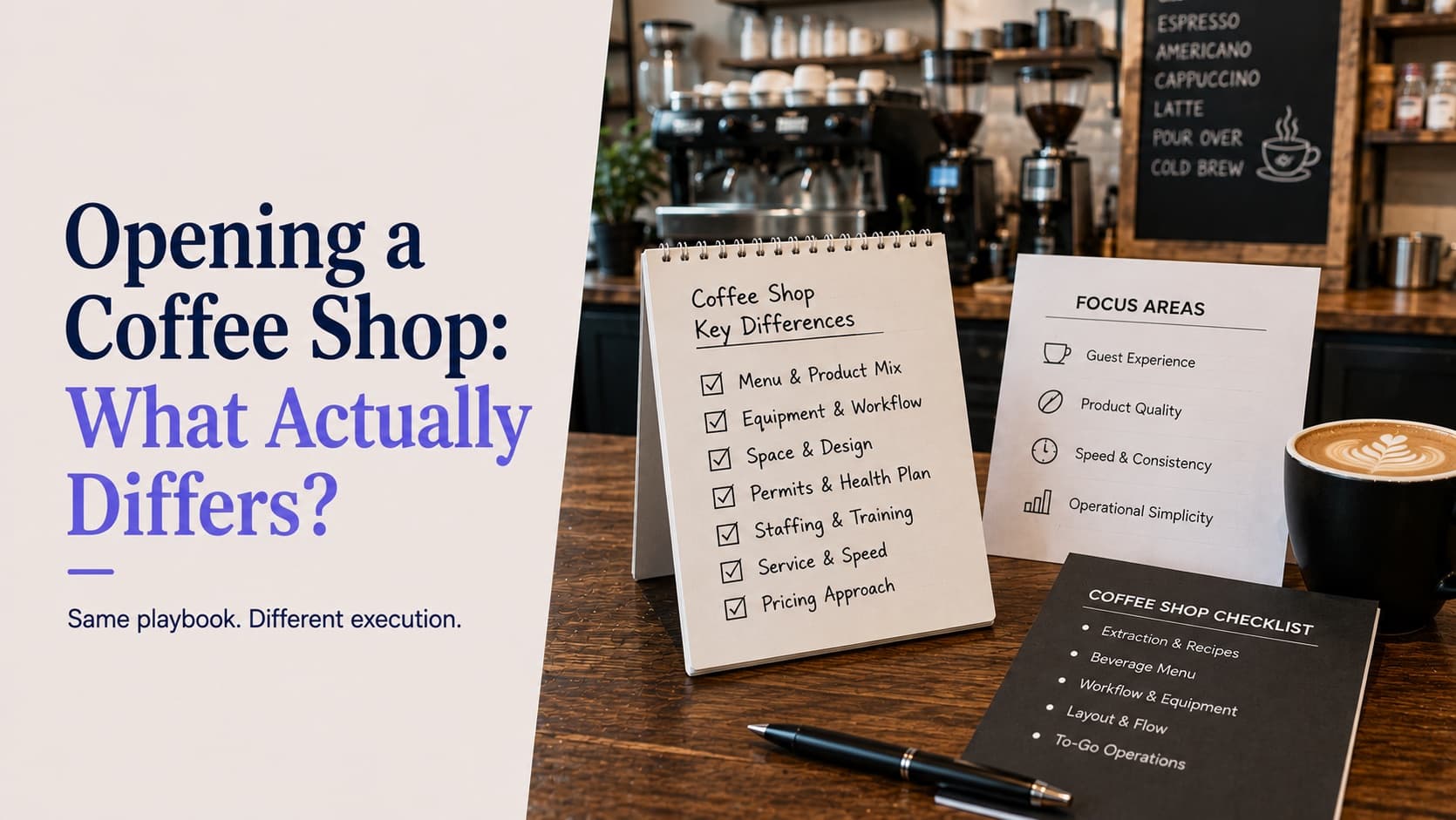
I started researching this post believing something that turns out not to be supported: that coffee shops run dramatically lower cost of goods than restaurants, and that this is the structural advantage of the model.
The published figures don't say that. The ranges I found for coffee shop COGS cluster around 25–35%, with specialty-focused sources citing 30–40%. That overlaps ordinary restaurant food cost rather than beating it. I couldn't find a credible source putting café COGS in the teens, and I'd been carrying that number around for years.
So the "coffee is a high-margin business" framing is at best unproven. What is structurally different is more interesting, and there are two things.
Difference one: you have about three hours
Coffee revenue is concentrated in the morning to a degree no restaurant experiences. Every source I looked at puts something in the range of 40–55% of the day's sales in the 7–10am window, with a smaller lunch peak and a long, thin afternoon.
I'll flag the sourcing honestly: these figures come from industry blogs and modelling sites rather than a survey I can trace, so treat the precise split as indicative. The direction is not in dispute, and it's the direction that matters, because it changes three things at once:
Labor becomes a scheduling problem, not a cost-percentage problem. You need full staffing for a three-hour surge and minimal staffing for the eight hours after it. Every hour of overstaffing in the afternoon comes straight off the morning's profit. The mechanics of costing that are in the labor cost post, but the shape of the problem is different: a restaurant has two peaks to spread fixed labor across, a café has one.
Rent is paid by a narrow window. Your rent divides by the hours that actually produce revenue, not by the hours you're open. A café paying restaurant-level rent for a location that earns half its money before 10am is buying a lot of unproductive square footage.
Afternoon revenue is the strategic problem, permanently. This is the thing operators spend their careers on — food program, retail beans, evening conversion, work-from-home seating. It's not a growth initiative; it's the core structural challenge of the format.
The practical consequence for someone choosing between a café and a restaurant: the café's advantage is not margin per unit. It's lower build cost, lower labor complexity per transaction, and faster service. Those are real. Just don't underwrite it on a food cost number that isn't there.
Difference two: your machine runs on the water supply
This is the line item that appears in no "cost to open a coffee shop" article I've read, and it can cost you the single most expensive piece of equipment in the shop.
Espresso machines are boilers. Hard water deposits scale, and scale does specific mechanical damage: it clogs solenoid valves, coats heating elements, and restricts flow through the boiler. In a hard water area — above roughly 200 ppm TDS — a machine in daily commercial use can accumulate significant limescale in three to six months.
And here's the part that turns a maintenance issue into a capital one: warranties are void where damage resulted from improper water management. Some manufacturers void coverage outright if the machine is operated without a filter in hard water conditions. So the failure mode is not "the machine needs descaling." It's "the machine failed, the warranty doesn't apply, and you're buying another one."
The targets to design against:
- The Specialty Coffee Association's brewing profile puts TDS at 90–150 ppm and hardness around 50–80 ppm as calcium carbonate.
- Other guidance runs tighter — some machine manufacturers ask for under 50 ppm hardness, and ranges of roughly 17–68 ppm appear in equipment documentation.
- The numbers differ because taste and equipment protection are not the same optimisation. Too soft is its own problem: water with almost no mineral content extracts flat coffee and can be corrosive.
Two operational points that follow:
Test the actual water at the actual address before you sign. Not the city average — the supply at that building. This belongs on the same pre-lease checklist as everything else about the address, and it's a cheap test.
Plumbed machines need a dedicated inline filter on the supply line, sized and specified for your water and your volume, with a cartridge replacement schedule someone actually owns. Put the replacement dates in the same change log you're keeping for everything else in the first quarter.
Where the money in a cup actually goes
One useful reframe from the cost breakdowns I found. A worked example of a latte: roughly $0.50 of coffee, $0.40 of milk, and $0.24 of cup and lid — about $1.14 all in.
Look at the proportions. The coffee is under half the cost of the drink. Milk is nearly as large, and disposable packaging is around a fifth of the cost of goods.
That reorders what's worth managing. Operators obsess over bean pricing because beans are the identity of the business. But a 10% improvement in your cup and lid cost, or a change in milk sourcing, moves the number about as much as a 10% improvement on beans — and the milk line gets worse as alternative milks take share, since they generally cost more per litre than dairy and are frequently upcharged at a rate that doesn't cover the difference.
If you take one pricing action from this: check whether your alternative milk upcharge actually covers the cost difference. It's a single arithmetic check, most shops set the upcharge by copying a competitor, and it applies to a growing share of drinks.
What's genuinely easier than a restaurant
To be fair to the format, three real advantages:
You may not need a Type I hood. No grease-laden vapour means no grease duct, no fire suppression system, no rooftop exhaust of the kind a fryer forces. That is one of the largest single savings available in a food build-out — the mechanics of why are in the kitchen capacities post. Add a panini press and hot food and you may re-enter that world, so decide early.
Transaction speed is a lever you actually control. In a surge-driven business, throughput at the register and the bar is directly revenue. That's a genuinely different optimisation from restaurant table turns.
Frequency makes loyalty economics work. A café guest may visit several times a week, which is a fundamentally better substrate for a loyalty program than a restaurant's monthly visit — see the loyalty post for what makes one pay for itself rather than just discount your regulars.
What I'm not going to give you
A café COGS target. I went in expecting to give you one and came out unable to source it properly. The ranges conflict and none of them trace to a survey with published methodology.
Revenue per day figures. Every source I found was a modelling tool or a blog citing another blog.
A daypart split I'd defend to a lender. See above — the direction is solid, the percentages are not.
What I'd substitute for all three: build your own model from your own drink costs, your own rent, and a deliberately pessimistic afternoon. The afternoon is where café pro formas lie.
Before you sign
Test the water at the address. Get the machine manufacturer's water specification in writing and check it against that test. Price a dedicated filtration system into the build, not into "supplies." Decide whether hot food is in the concept before you design, because it decides your hood. Cost a latte down to the lid. And model the afternoon as if it earns almost nothing, because for most of the day it very nearly does.
Disclosure: I work at Katalyst and we sell restaurant technology, including for cafés. The honest note is that the two most consequential items in this post — the water at your address and whether your alternative milk upcharge covers its cost — are a water test and a calculator, and no system sells you either one.
Topics
See how Katalyst handles your service style
A 30-minute walkthrough of the platform, tuned to how your restaurant actually runs.