If a broker quotes you earnings, check Item 19 exists
About a third of franchisors publish no earnings data at all. Item 8 can mandate your POS outright, at prices reported 10-30% above the open market.

The franchise pitch is straightforward: a proven concept, a brand people already recognise, supplier relationships you couldn't get alone, and a playbook instead of a decade of mistakes. For a lot of first-time operators that's a genuinely good trade.
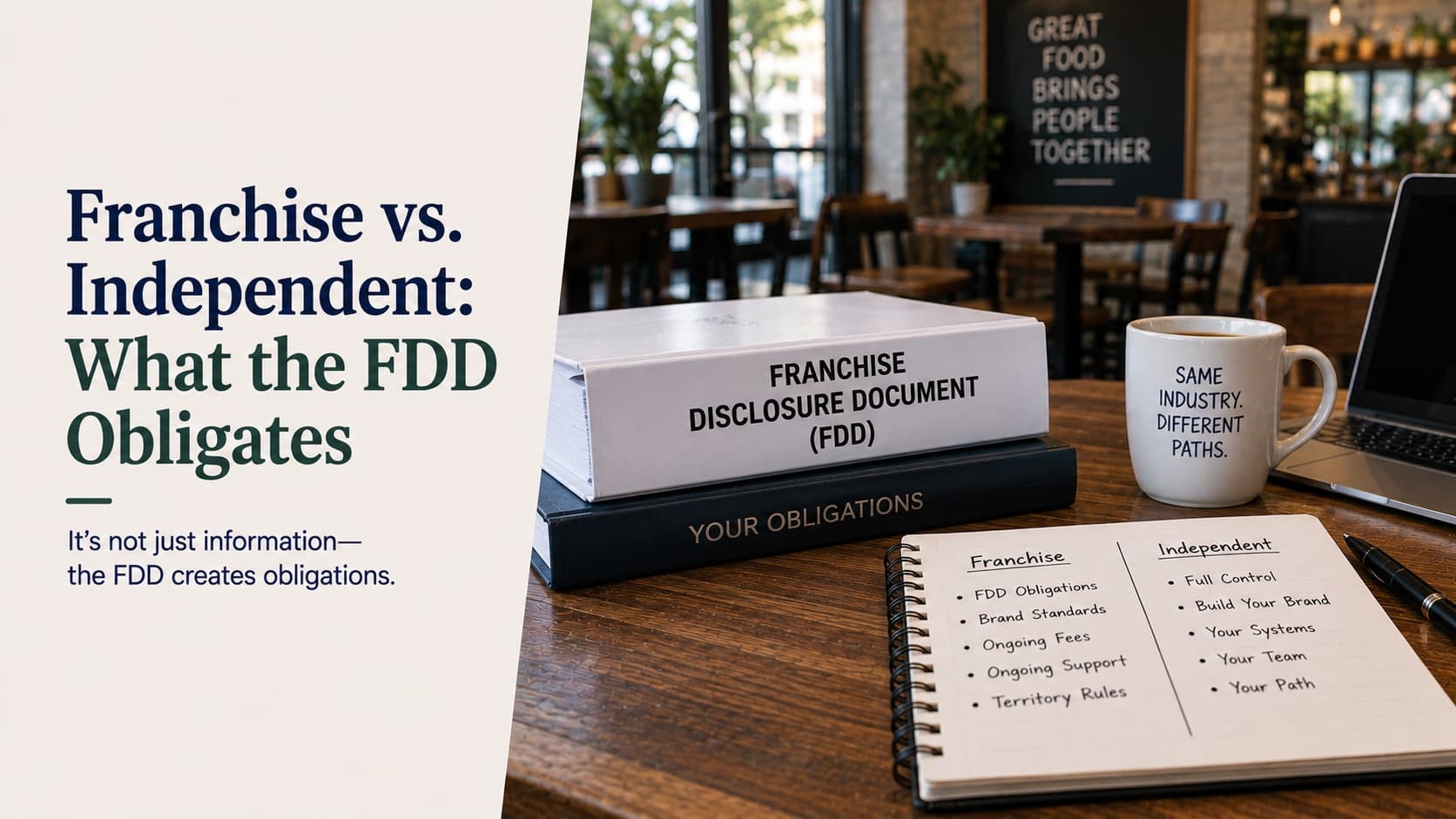
The Franchise Disclosure Document tells you what you're actually buying. It's long, it's tedious, and prospective franchisees read the wrong parts of it. Two items decide most of what matters, and one of them is optional.
Item 19 is optional, and its absence is information
Item 19 is the Financial Performance Representation — what existing units actually earn. Franchisors may include it. They are not required to. Roughly two-thirds of franchisors now do, which means about one in three prospective franchisees is asked to buy a business with no disclosed earnings data at all.
Now the part that turns this from a disappointment into a diagnostic tool.
If there is no Item 19, the franchisor may not make earnings claims anywhere. Not in a pitch deck, not on a call, not from a broker, not in an advertisement. Any claim about sales, income, gross profit or net profit has to appear in Item 19 to be permitted at all. And where a franchisor declines to make one, the FDD is required to contain an explicit statement that no financial performance representation is being made.
So you have a clean test, and it costs nothing to run:
- Check whether the FDD contains an Item 19.
- If it doesn't, and anybody in the sales process tells you what a unit makes — a range, an average, "our top performers do X," a napkin projection — you have just watched an unauthorised financial performance representation, which violates the FTC Franchise Rule.
That's not a technicality to file away. It tells you how this organisation behaves when the rules are inconvenient, before you've signed anything. I would treat it as disqualifying.
The corollary matters too: get every number in writing and check it against Item 19. If it isn't in there, it isn't a number you're entitled to rely on, and it isn't one you should underwrite with.
Related, because it connects to how the loan actually gets decided: if there's no Item 19, you have no historical earnings basis for the concept, and a lender is being asked to underwrite projections at the exact moment the SBA is tightening its position on projections.
Item 8 is the one nobody reads
Item 8 — Restrictions on Sources of Products and Services — is where the franchisor tells you what you must buy and from whom. It is routinely skimmed, and it determines a large share of your operating cost for the life of the agreement.
For restaurants this reaches further than food. Technology stacks are commonly mandated outright. Perkins Restaurant & Bakery's disclosure, for example, specifies Micros POS by Oracle, and requires Olo for digital ordering and delivery dispatch. Outside restaurants the pattern is the same — F45 Training's 2026 FDD mandates Mindbody with no disclosed alternative suppliers.
Two consequences:
You are not choosing a POS. Everything I've written about evaluating POS contracts and choosing by business type is inapplicable inside a franchise with a mandated stack. That's worth stating plainly given who's writing this: if you buy into a system that mandates its POS, you cannot buy ours, and you also cannot leave a vendor that treats you badly. The evaluation happened before you arrived.
Mandated pricing is not market pricing. Technology fees in franchise systems are commonly reported in the range of $200 to $2,000 per month depending on the stack, and franchise attorneys report that mandated supplier prices frequently run 10% to 30% above what the same franchisee could get on the open market. I'd flag that those figures come from practitioner commentary rather than a published survey — but the mechanism is not in dispute, and it's the reason approved-supplier programs exist.
When you model unit economics, take the Item 8 supply costs at the mandated price, not at what you could negotiate. You can't negotiate them.
The other items worth your attention
Item 7 — Estimated Initial Investment. Required, and it's the number to compare against independent cost-to-open ranges. Read what it excludes as carefully as what it includes; working capital assumptions in Item 7 are frequently thin.
Item 12 — Territory. The question is not whether you get a territory. It's whether it's exclusive, and whether it protects against the franchisor's own channels — delivery apps, ghost kitchens, grocery products, a company-owned unit. Non-exclusive territories are common and they are not the same product.
Item 6 — Other Fees. Where the recurring costs live beyond royalty: advertising fund contributions, technology fees, transfer fees, renewal fees, audit fees. Total them as a percentage of projected sales and add that to royalty before you compare against an independent's cost structure.
Item 20 — Outlets and Franchisee Information. The table showing openings, closures, terminations, non-renewals and transfers by year. This is the closest thing to an outcomes dataset in the whole document. A system with steady transfers and terminations is telling you something Item 19 might not.
And it contains a list of current and former franchisees with contact information. Call the former ones. That is the single highest-value hour available to a prospective franchisee, and most people skip it because it's uncomfortable.
The 14-day rule exists for a reason
Under the FTC Franchise Rule you must receive the FDD at least 14 calendar days before you sign any binding agreement or pay any money.
The rule is a floor, not a target. Fourteen days is not enough time to read a document of that length properly, have a franchise attorney review it, call former franchisees, and model the unit economics with Item 8 pricing. Take longer. Pressure to sign at the fourteen-day mark is itself information.
What the comparison actually comes down to
Stripping out the sales material on both sides:
| Franchise | Independent | |
|---|---|---|
| Concept risk | Transferred, if Item 19 is real | Yours |
| Operating freedom | Constrained by the agreement | Yours |
| Supply cost | Set by Item 8 | Negotiable |
| Recurring cost | Royalty + ad fund + tech fees | Your own overhead |
| Exit | Transfer subject to approval and fees | Sell to anyone |
| Financing | Often easier — brand history helps | Harder |
The genuine franchise advantage for a first-timer is that a large portion of the decisions I've spent the last dozen posts describing — menu, pricing, layout, systems — arrive pre-made and pre-tested. If you don't have strong opinions about those, that's worth paying for.
The genuine cost is that it stays pre-made afterwards, including when you develop opinions.
What I'm not going to give you
A royalty benchmark. Rates vary by system and the headline rate is misleading without Item 6 totalled alongside it.
A franchise-versus-independent failure comparison. You'll see claims that franchises fail less often. I could not find a methodologically sound source for that comparison, and it has an obvious selection problem: franchisees are screened for capital and credit before they're allowed to buy in.
A recommendation. It depends on whether you want to run a restaurant or own one, and those are different jobs.
Before you sign
Read Item 19 first, and if it's absent, treat every spoken number as a red flag rather than as information. Price your model with Item 8 supply costs. Total Item 6 alongside the royalty. Read Item 20's churn table and call the franchisees who left. Have a franchise attorney read the agreement — not a general commercial lawyer. And take considerably longer than fourteen days.
Disclosure: I work at Katalyst, and this post argues against our own commercial interest in a specific way — a franchise with a mandated POS is a customer we can never win, and I've told you to check Item 8 early, which surfaces that fact before anyone wastes time. That's the honest version. The self-interested version would be to argue independents outperform franchises, and I don't have the data to say that.
See how Katalyst handles your service style
A 30-minute walkthrough of the platform, tuned to how your restaurant actually runs.