Your gas meter is sized as if everything runs at once
Hood type, the 400 CFM makeup-air trigger and panel capacity cap the equipment list before you pick any of it. Run too negative and you lose 30% of the exhaust.

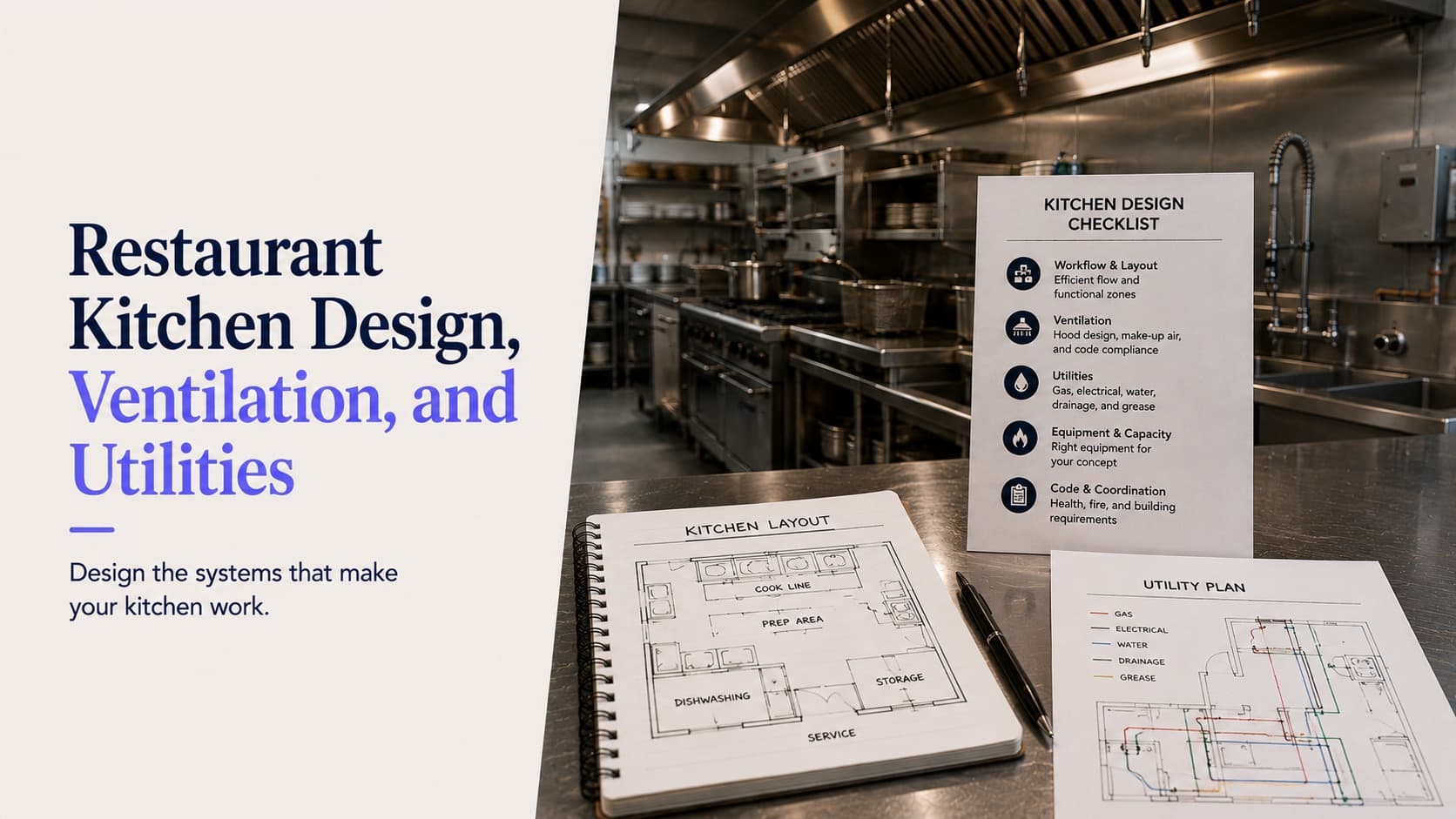
Kitchen planning advice starts with the equipment list. Pick your concept, pick your menu, pick the fryers and the griddle and the six-burner range, then lay them out in a work triangle.
That's backwards, and the reason is unglamorous: your equipment list is an output of three capacities you mostly don't control — the hood, the air you have to put back into the room, and the fuel and power the building can deliver. Choose equipment first and you will discover the constraints during plan review, which is after the point where changes are cheap.
Constraint one: which hood the equipment forces
Two families, and the equipment decides which one you're in.
Type I is for grease-laden vapors and smoke — fryers, griddles, ranges, charbroilers, woks. It requires grease-rated ductwork, a fire suppression system, and a cleaning schedule set by NFPA 96 according to your cooking type.
Type II is for heat, steam and odor without grease — dishwashers, some ovens.
The consequence: a single piece of equipment can move you from Type II to Type I, and that is not an incremental cost. It's duct, suppression, rooftop equipment, structural support, and a different plan review. "We'll add a fryer later" is the sentence that quietly triggers all of it.
This is also where a real operational decision collides with a capital one. If you want to serve guests with allergies properly you want a dedicated fryer — and only about one in ten restaurants that have a fryer have a dedicated one, which I wrote about in the allergen post. A second fryer isn't just an appliance purchase. It's hood length, exhaust volume, makeup air, and gas load.
Constraint two: the air you have to put back
Here's the number that surprises first-timers. Under the International Mechanical Code, exhaust hood systems capable of exhausting more than 400 CFM must be provided with makeup air, at a rate roughly equal to the exhaust rate. Essentially any real cooking line clears 400 CFM, so assume you're providing makeup air.
Makeup air is not a nice-to-have, and it isn't only about comfort. NFPA 96 requires replacement air sufficient to keep the building's negative pressure from exceeding 0.02 inches water column while the exhaust system runs. Go past that and you get a specific list of failures:
- Doors that won't seal or won't open easily
- Flame instability and pilot outage
- Backdrafting of combustion appliances — your water heater and boiler venting the wrong direction
- Degraded capture of grease-laden vapor, which is the thing the hood exists to do
And the self-defeating part: as the room goes more negative, the exhaust fan's actual performance falls. Volume exhausted can drop by as much as 30%. You installed the CFM. You're not getting the CFM. The kitchen fills with smoke and everyone blames the hood.
One more code requirement worth knowing because it shows up as a punch-list item: IMC 508.1 requires makeup air systems to be automatically controlled to start and stop with the exhaust system. A manual switch is not compliant, and it's also a guarantee that somebody eventually runs the hood without the makeup air.
Practically, makeup air means rooftop equipment, tempering that air in cold climates, and roof structural capacity. It is one of the largest single line items in a restaurant build-out, and it's invisible to anyone shopping equipment catalogs.
Constraint three: the meter counts everything at full
This is the one I'd most want to put in front of a first-time operator, because the intuition is exactly wrong.
Gas service is sized on the total connected load — the sum of the nameplate BTU of every appliance, plus pipe length and pressure drop. And there is no allowance for load sharing. The sizing does not care that you'd never run the fryers, the range, the char-grill, the oven and the water heater simultaneously. It sizes as if you would.
So the calculation is mechanical: add up every appliance's nameplate rating, convert to cubic feet per hour by dividing total BTU by roughly 1,024 for natural gas, then check that number against what the meter and the existing pipe can actually deliver over the run length.
Two consequences:
Undersized gas is not a performance problem, it's a stop-work problem. Improper combustion from an undersized supply is treated as immediately dangerous, and it will keep your kitchen from operating — not degrade it.
A meter upgrade is on the utility's calendar, not yours. It can involve the service line, the street, and a lead time measured in months. If you find this out during construction, it becomes your critical path.
Electrical works the same way conceptually. The NEC provides optional calculation methods for restaurant service and feeders, with different demand treatment depending on whether the kitchen is all-electric or mixed fuel — which is worth knowing because it means the all-electric concept everyone is considering right now has a materially different service requirement, and the panel that served the previous tenant may not cover it.
What this means for a second-generation space
Taking over an equipped space is usually the right financial call. But "there's already a hood" answers none of the questions above. Get these five things in writing before you sign:
- Hood type and length, and whether the length covers the equipment line you intend to run, with the required overhang.
- Exhaust CFM and the makeup air unit's capacity — and whether a makeup air unit exists at all. Older second-generation spaces frequently have a hood and no MUA.
- Gas meter capacity and the size and length of the run, against your total connected load.
- Electrical service size, and the spare capacity in the panel.
- The permit record for all of it. An unpermitted hood is a question your plan reviewer will ask, and the answer costs money.
The pattern to internalize: the previous tenant's kitchen was sized for the previous tenant's menu. If your menu adds one grease-producing appliance, you may be buying a new hood, a new MUA unit, and a meter upgrade in order to add a fryer.
What I'm not going to give you
CFM per linear foot rules of thumb. They exist, they vary by hood style, cooking duty and manufacturer, and using a generic figure to size a real hood is how you end up with the negative-pressure failures above. This is a calculation for a mechanical engineer with your actual equipment schedule.
Equipment cost ranges. Every range I found is a vendor's, and the spread between new, used and refurbished is wider than the ranges themselves.
A verdict on used equipment. The relevant question isn't age, it's whether the nameplate ratings fit inside the three capacities above and whether the piece is acceptable to your health department. A used appliance that fits your gas load is a bargain; one that forces a meter upgrade is not.
The order that actually works
- Write the menu first, in enough detail to know the cooking methods. Fried, grilled, charbroiled, steamed, baked. Cooking method determines hood type, and hood type determines a large fraction of your budget.
- Get the building's existing capacities — hood, MUA, gas meter and run, electrical service — before you commit to the space.
- Have a mechanical engineer size exhaust and makeup air from the equipment schedule, not from a rule of thumb.
- Total the connected gas load at full nameplate and check it against the meter before you buy anything.
- Then build the equipment list, and treat every addition after that point as a change that has to be re-checked against all three caps and re-approved.
The discipline is boring and it is the difference between a build-out that lands on budget and one that discovers a $60,000 makeup air unit in month three.
Disclosure: I work at Katalyst and we sell restaurant technology. None of this is a software problem, and I'd rather say that plainly than find an angle. The one honest connection is downstream: once you're open, the menu you can execute is bounded by the kitchen you built, and menu pricing that ignores which items compete for the same fryer or the same section of hood will be wrong about what your kitchen can actually produce at peak.
Topics
See how Katalyst handles your service style
A 30-minute walkthrough of the platform, tuned to how your restaurant actually runs.