Your liquor license can dictate your seating plan
Food-to-beverage ratios make menu mix a license condition, not a business choice — and Virginia's replaced its flat 45% rule with tiers as of 1 July 2026.

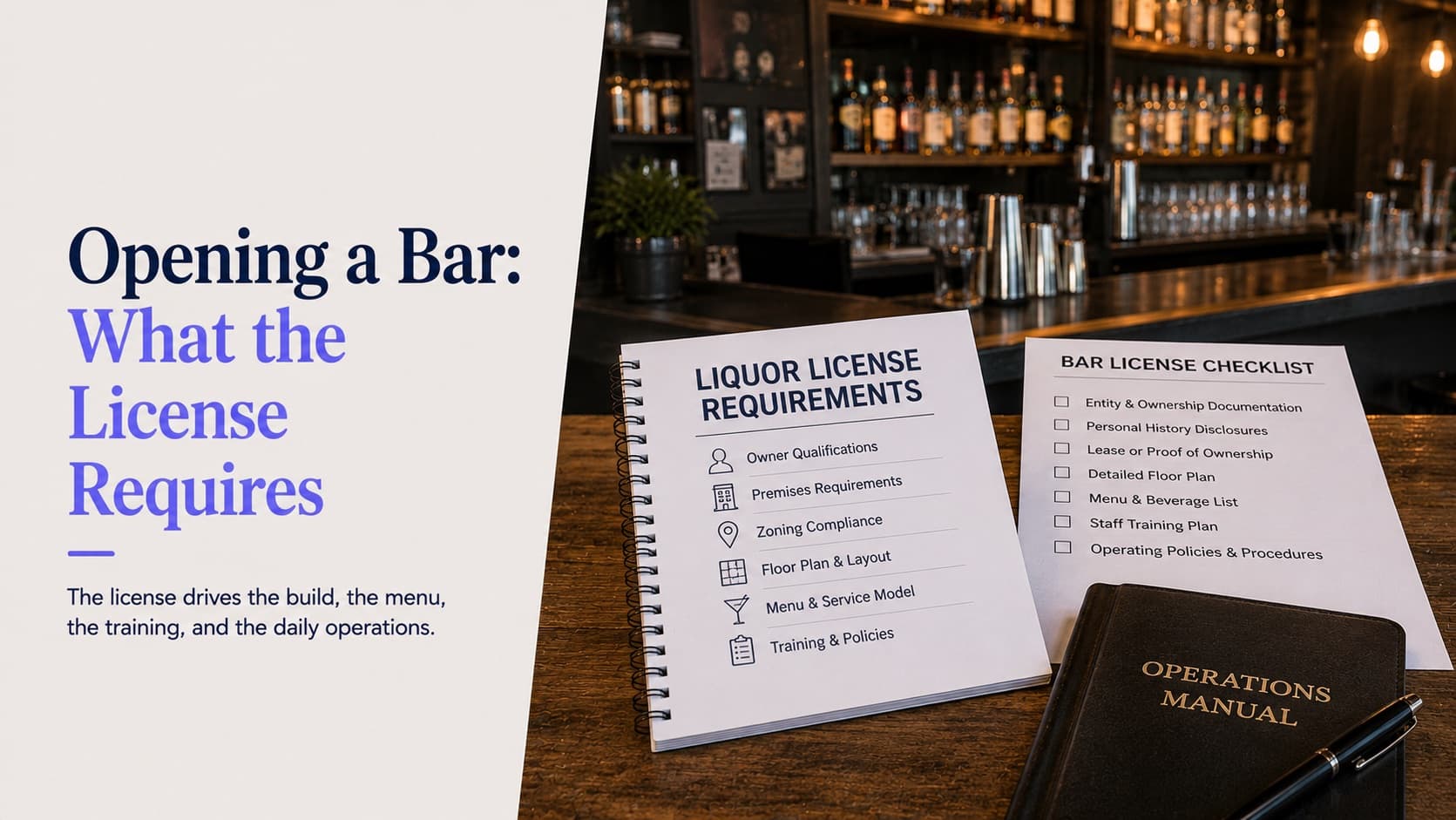
Most advice about opening a bar is advice about opening a restaurant with a paragraph added about the liquor license. The build-out, the permits, the lease — genuinely the same, and the last several posts apply unchanged.
What's different is that the license does not just permit you to sell alcohol. Depending on the class you hold, it can impose ongoing conditions on your revenue mix, your menu, and in at least one state your furniture. Miss them and the penalty isn't a fine against the business. It's action against the license, which is the business.
The ratio that turns your menu into a license condition
Many states issue on-premises licenses on the condition that a minimum share of gross receipts comes from food and non-alcoholic beverages. Operators think of menu mix as a commercial decision. In these states it's a compliance metric with a filing behind it.
California is the cleanest example. A Type 47 licence is issued to a "bona fide public eating place" — a place regularly and in good faith kept open for serving meals to guests for compensation, with suitable kitchen facilities. In practice the standard applied is that at least 51% of gross receipts come from food. The ABC can suspend or revoke the license where a licensee fails to meet the requirement.
Virginia just restructured its version, and the change is recent enough that most published guidance is stale. Under the old rule, mixed beverage licensees had to derive 45% of sales from food, with no more than 55% from mixed beverages — and, crucially, beer and wine did not count toward the ratio at all. That's a detail worth pausing on: the test was food against spirits, so a wine-led program neither helped nor hurt you.
Effective 1 July 2026, HB 975 replaced the flat requirement with three tiers keyed to monthly food sales:
| Monthly food sales | Ratio requirement |
|---|---|
| $48,000 and above | None |
| $25,000 – $47,999 | Minimum 30% |
| $4,000 – $24,999 | Minimum 45% — or 30% for venues with fewer than 30 table seats and occupancy under 60 |
The structural logic is that a venue selling enough food in absolute terms is self-evidently a restaurant and doesn't need a percentage test. The practical logic for an operator: your compliance obligation now depends on your volume, so growing across a threshold changes the rule you're measured against. Virginia ABC is collecting compliance data and reporting to the General Assembly by November 2027, so treat the tiers as current rather than permanent.
Texas structures this differently, through a Food and Beverage Certificate attached to a permit, and I'm not going to quote you a percentage. The sources I found conflict — some state a more-than-51%-from-food test, others an alcohol-may-not-exceed-60% test — and those are not the same rule. If you're licensing in Texas, get the requirement from TABC directly. I'd rather tell you the figure is contested than pick the one that reads better.
What travels regardless of state: find out before you sign whether your license class carries a receipts test, what counts in the numerator, and what counts in the denominator. Whether beer and wine count is not a detail. It can decide your entire beverage strategy.
The license also has opinions about your floor plan
From the same Virginia rules, mixed beverage licensees must maintain as many seats at tables as they have seats at counters.
Read that as a design constraint, because that's what it is. A long bar with a handful of two-tops may be the concept you want and the configuration your license forbids. This is the kind of requirement that gets discovered after millwork is installed.
The general lesson: pull the actual regulations for your license class and read them as a design brief alongside the building code, before your drawings go to plan review. Seating counts, kitchen facility requirements and service area definitions all show up there.
Which means you are building a restaurant kitchen
If your license requires 30–51% of receipts from food, you cannot satisfy it with a panini press. You need a kitchen that can produce food people actually order, at volume, alongside a bar.
That pulls the entire capacity chain back into play — hood type, makeup air, gas load — which I went through in the kitchen capacities post. Fried food is the usual instinct for bar menus and it's also the thing that forces a Type I hood and a fire suppression system.
So the honest budgeting statement for a ratio-state bar: you are building a restaurant with a large bar, and you should cost it that way. The concept that's actually cheaper to build is the one in a state or license class with no receipts test — and that's a licensing question you can answer before you sign a lease.
Your general liability policy does not cover alcohol claims
This one is nearly universal and still surprises people every year.
The standard commercial general liability form contains an explicit liquor liability exclusion — coverage is removed for claims arising from causing or contributing to a person's intoxication. If a customer sues over alcohol service, the GL carrier denies, and you fund your own defense unless you carry a separate liquor liability policy or endorsement.
Dram shop causes of action exist in the large majority of states, and the details vary enormously — which states have none at all, where recovery is capped, and how the assault-and-battery exclusion interacts across your two policies. I went through that in the insurance post, and for a bar specifically that section is the most important one on this site. The short version: check that neither policy carries an assault and battery exclusion, because a plaintiff's lawyer will simply plead into whichever one still responds.
What actually differs operationally
Three things, briefly, because the rest of running a bar looks like running a restaurant.
The loss profile is inventory, not cash. Over-pouring, unrecorded comps and the free drink for a regular are the leaks, and they're measurable through variance rather than through the drawer. The bottle math and the controls that work are in the pour cost post.
Your ratio needs to be reportable, monthly. If you're in a ratio state, food versus alcohol sales is not a year-end question — it is a number you should be able to produce for any month on demand, because that's the form the regulator asks for. That means your menu items have to be categorized correctly in the POS from day one, and non-alcoholic beverages have to be separable from alcoholic ones. A mis-categorized item is a compliance error, not a reporting annoyance.
Ownership is frozen once the license issues. Changing members, officers or even the split between existing partners is a licensing event requiring advance approval in many states — the mechanics are in the entity post. Settle the cap table before you apply.
What I'm not going to give you
A national table of ratio requirements. They vary by state, by license class within a state, and Virginia's just changed. Any table I built would be wrong somewhere on publication day.
Liquor license costs. In quota states the license is a traded asset whose price is set by a local market; in others it's a fee. A national average of those two things is meaningless.
A bar-versus-restaurant profitability comparison. You'll see claims that bars carry better margins because pour cost beats food cost. Pour cost is genuinely lower. But in a ratio state you're required to run the food program anyway, and the comparison collapses. It depends entirely on your license class, which is the theme of this whole post.
Before you sign anything
- Identify the exact license class you'll hold — not "a liquor license," the class.
- Read that class's regulations end to end. Receipts tests, seating requirements, kitchen facility definitions, hours.
- Establish what counts in the ratio, especially whether beer and wine are in or out.
- Check the distance rules for the specific address before the LOI — the location post covers why that's a hard gate rather than a negotiation.
- Get the liquor liability policy quoted early, and confirm no assault and battery exclusion on either policy.
- Budget a restaurant kitchen unless you've confirmed your class has no food requirement.
Disclosure: I work at Katalyst, and here the self-interest is direct enough that I'll name it: if you operate in a ratio state, your POS category configuration is the thing that produces your compliance number, and we sell POS. Take that with the appropriate suspicion. The part that costs nothing and matters more is step 2 — read your license class's actual regulations before your architect draws anything.
Topics
See how Katalyst handles your service style
A 30-minute walkthrough of the platform, tuned to how your restaurant actually runs.