Your health inspector will not do a courtesy walkthrough
Plan review must be approved before construction starts, the CO gates your final health inspection, and the liquor clock can't start until the lease is signed.

Every "restaurant licenses and permits" article gives you a list. The list is not the problem. Nobody fails to open because they didn't know they needed a health permit.
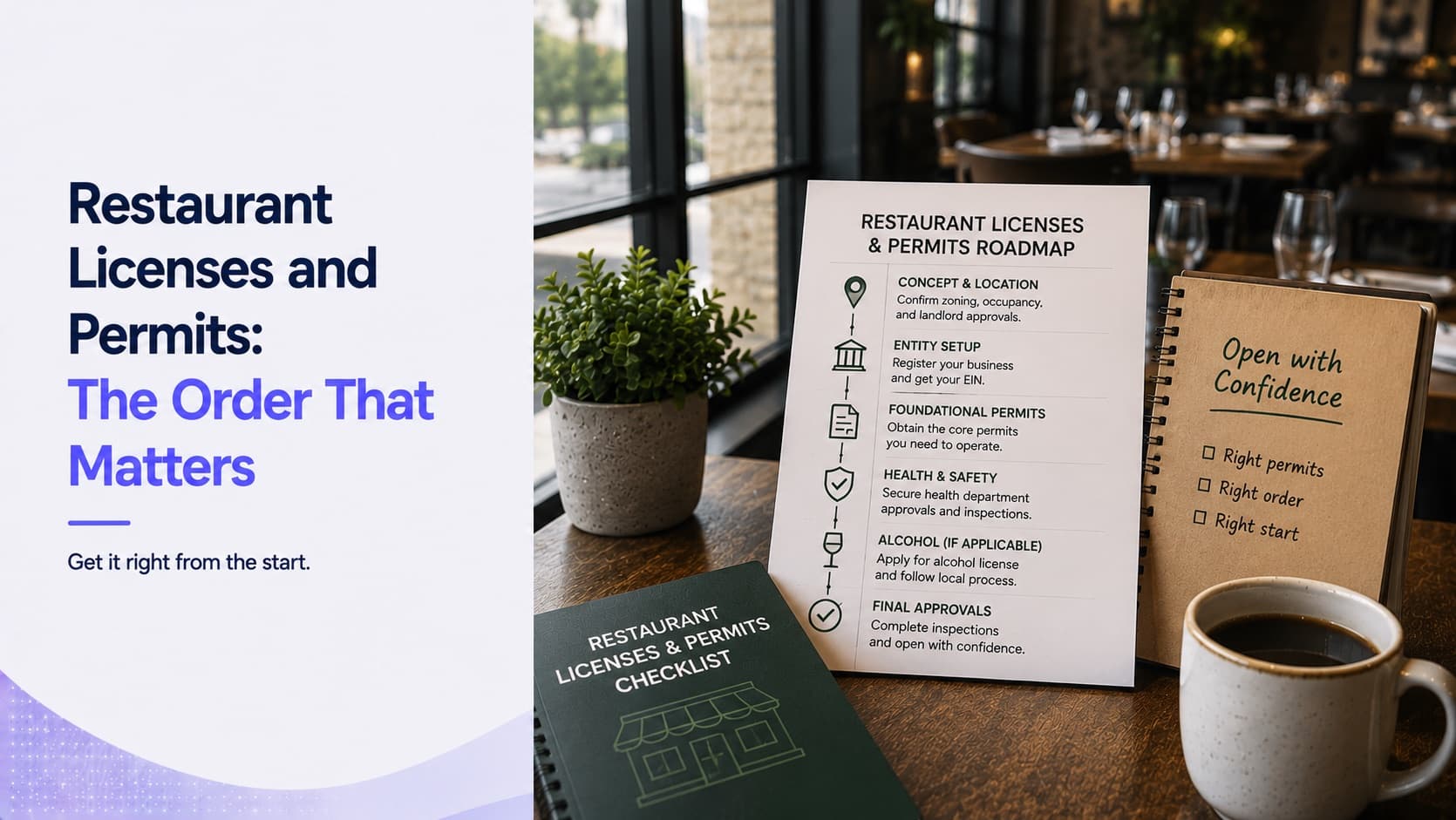
They fail because they did things in the wrong order, and half the items on that list can only be started after another item is finished. The permits form a dependency chain, and the chain has a property that costs real money: it starts at the lease signature, and so does your rent.
The chain, in the order the gates actually open
Read this as a sequence, not a checklist. Each row is blocked by the row above it.
| Step | Blocked until |
|---|---|
| Entity formed, EIN issued | — (do this first, it's free-ish and fast) |
| Lease signed | You've picked a space. Rent obligation begins here. |
| Liquor license application | You can prove control of the premises — i.e. the lease |
| Health department plan review | You have drawings to submit |
| Building permits | Plan review approved |
| Construction | Building permits issued |
| Building, electrical, plumbing, mechanical, fire inspections | Construction complete |
| Certificate of Occupancy | All of the above passed |
| Final health inspection | CO in hand |
| Health permit issued | Final inspection passed |
| Open | Health permit + liquor license (if you need one) |
Two of those gates are the ones that hurt, and they sit at opposite ends of the chain.
Plan review comes before construction, not before opening
This is the most expensive ordering mistake available to a first-time operator, and it is genuinely counterintuitive: the health department reviews your drawings, and it does so before you build.
The FDA Food Code language is unambiguous — no establishment is to be constructed, and no major alteration or addition made, until detailed plans and specifications have been submitted to and approved by the regulatory authority. Many jurisdictions want the submission at least 30 days before the project start date, and plan review itself commonly runs around ten business days when nothing is wrong.
The operator's version: if you build first and submit later, the health department can make you tear out finished work. Not fine you — make you rebuild it. I've watched a friend take out a freshly tiled prep area because the mop sink was in a location the plans never showed.
The rejections are mostly plumbing, and they repeat:
- Undersized grease interceptor. The single most common grease-trap rejection. Sizing is driven by fixture count and flow, not by how big the kitchen feels.
- Grease-bearing fixtures not routed to the interceptor. Pot sinks, three-compartment sinks, prep sinks, dishwasher pre-rinse, floor drains and floor sinks in the cook and cleanup areas generally all have to run through it.
- One floor sink serving two incompatible drains. A receptor can't serve both a drain that must pass through the interceptor and one that's prohibited from doing so. Separate receptors.
- Mop sink missing, unlabeled, or improperly drained. It has to be on the plans and labeled. And for a newly licensed establishment, mop water down a toilet or urinal is not an acceptable disposal method.
None of that is exotic. All of it is the kind of thing a designer who hasn't done a restaurant in your jurisdiction gets wrong once, which costs you a resubmission cycle — and the resubmission clock runs while you pay rent.
The Certificate of Occupancy is the keystone at the other end
Your build-out generates a series of inspections — building, electrical, plumbing, mechanical, fire — and they converge on the Certificate of Occupancy, the document declaring the space legal to occupy for your use.
The health department will not finish its work until you have it. The Richmond City Health District says this about as plainly as a government document can: "Final inspections will not be conducted until you have received a Certificate of Occupancy." The same packet directs applicants to the city's permits bureau for the CO prior to applying for the health permit at all.
And from the same source, a line worth internalizing before you plan your opening date:
Inspectors do not conduct courtesy inspections.
There is no dress rehearsal. You cannot ask someone to walk through early and tell you what would fail. You get the real inspection, and if it fails, you get another one — after you've fixed it, and after you've gotten back in the queue.
That last part is the piece operators consistently underestimate. The cost of failing an inspection isn't the re-inspection fee. It's the days between.
What you can't start until the lease is signed
Here's the structural trap. The liquor license is usually the longest lead item in the entire project, and you cannot begin it early, because the licensing authority won't accept an application from someone who can't prove they control the premises. That proof is a signed lease — in some jurisdictions a letter of intent will open the file, but the premises has to be pinned down, typically with control demonstrated for at least the license term.
So the sequence is forced: sign the lease, then start a process that in New York runs six to eight weeks in the best case and six months or more in a busy county with any deficiency in the file, and in Delaware spans roughly three to twelve months from submission through public notice, investigation, premises inspection and issuance.
Meanwhile you hold a lease.
This is the actual reason build-out timelines slip past the money. It isn't that construction is slow. It's that the two longest processes — liquor and build-out — both start at the same signature, and only one of them is under your control.
Which makes rent commencement the clause that matters most
If your lease starts the rent clock at signing or at possession, you are paying for a room you are legally barred from operating in, for however long the state takes.
Three to six months of free rent during build-out is a standard ask, and most landlords expect it. But the negotiation that matters more than the length is what triggers the clock. Tie rent commencement to the later of: substantial completion of the landlord's work, issuance of your building permits, and a date certain that reflects a realistic construction schedule for your market. A free-rent period that begins at signature can be entirely consumed by plan review before you've demolished anything.
One more thing to read for, because it converts a concession into a loan: some leases abate rent up front but include fall-back language making the abated rent repayable on default. Negotiate that out, or at minimum limit repayment to the unamortized portion.
I went through the rest of the lease — assignment, personal guarantees, percentage rent, what the 6–10% rent-to-sales rule is actually worth — in the lease negotiation post. This is the clause that interacts with permitting, which is why it's here rather than only there.
The license nobody puts on the list
Every checklist has the health permit, the business license, the seller's permit, the food handler cards. Almost none of them have this one, and it has teeth.
If you play recorded music — a playlist, a streaming service, the radio, a TV with the sound on — you are publicly performing copyrighted work, and that requires licenses from the performing rights organizations. In the United States that means ASCAP, BMI, SESAC and GMR. They represent different songwriters, and there is no single fee that covers all of them. Paying one does not cover the others, which is the specific misunderstanding that gets operators sued: they hold an ASCAP license, believe they're compliant, and play a BMI-catalog song.
The exposure is statutory, which means the plaintiff doesn't have to prove what your infringement cost them. Under the Copyright Act, statutory damages run from $750 per work up to $150,000 per work where infringement is willful. Per song. The PROs employ investigators who sit in your dining room as customers and log what plays.
I'm going to skip the widely repeated anecdote about a specific restaurant paying five figures for four songs in one evening. It appears on a lot of blogs, I could not trace it to a court record, and this post is about not getting burned by things people repeat without checking. The statute is enough on its own: $750 is the floor, and the floor is per work.
Consumer Spotify or Apple Music does not cover you. Their terms are for personal use. The practical routes are a commercial background music service that bundles the PRO licensing, or licensing directly with all four PROs.
What I'm not going to give you
A total dollar figure for permits. Every range I found sits on a vendor blog, and the underlying costs are set by hundreds of individual jurisdictions. For scale on how local this gets: Richmond, Virginia charges $40 for the food establishment permit application and $40 for plan review. Your city may charge twenty times that. A national average of a number that is set city by city isn't a planning input, it's a decoration.
A universal timeline. The chain above is the structure, and the structure holds nearly everywhere. The durations don't. The only number worth having is the one you get by calling your own health department and your own state licensing authority before you sign anything.
A count of "the X permits you need." These lists vary because jurisdictions vary — sign permits, sidewalk seating permits, grease hauler manifests, music, resale certificates, and fire suppression certifications appear and disappear depending on where you are and what you're building.
What to actually do, in order
Before you sign the lease, call the health department that will permit you and ask three questions: what does plan review require, how long is the current review cycle, and what triggers a resubmission. Then call the state liquor authority and ask what the current processing time is for your license type in your county. Those two answers set your entire schedule, and both are free.
Put the answers into the lease. Rent commencement tied to permits issued and landlord's work complete, not to signature. If the liquor authority tells you six months, a ninety-day free rent period is not a concession, it's a countdown.
Hire a designer who has been permitted in your jurisdiction specifically. Not one who has done restaurants. One who has been through plan review with your health department. The plumbing rejections above are local-practice knowledge, and buying it is cheaper than a resubmission cycle.
Assume no courtesy inspection and no early look. Build to the approved drawings, and if you deviate during construction — you will — get the change approved rather than hoping it passes at final.
Disclosure: I work at Katalyst, and we sell restaurant technology. Note that nothing in this post is a technology problem, and none of it is solved by buying a POS. Your system matters after the health permit is on the wall, and it matters quite a lot then — sales tax setup, allergen data, reporting you'll need for the liquor renewal. But it is downstream of every gate above, and anyone selling you software before you've called your health department is selling you the wrong thing first.
Topics
See how Katalyst handles your service style
A 30-minute walkthrough of the platform, tuned to how your restaurant actually runs.