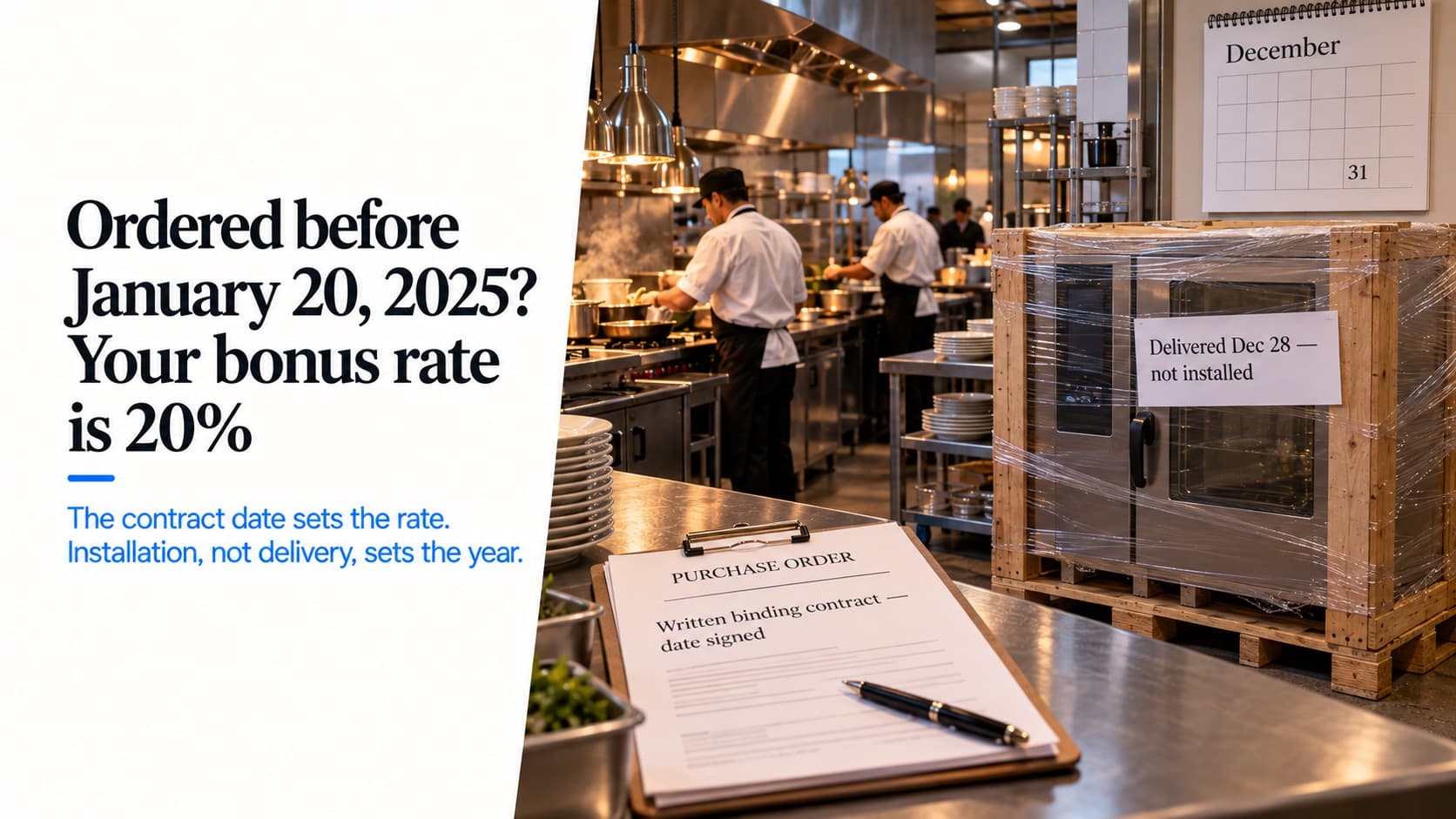
Ordered before January 20, 2025? Your bonus rate is 20%
Delivered but still crated on December 31 is next year's deduction. Roofs and HVAC take Section 179 but fail the bonus test; California caps 179 at $25,000.

Every fourth-quarter equipment pitch this year has the same headline: 100% bonus depreciation is back and permanent, so buy the cook line before December 31 and write all of it off.
The headline is true. The 2025 tax law restored a permanent 100% first-year deduction for qualified property "acquired and placed in service after January 19, 2025," and Section 179 expensing for tax years beginning in 2026 runs to $2,560,000, with the phase-out starting at $4,090,000 of property placed in service.
Three things stand between that headline and your return, and none of them appears in the pitch. I'm not a CPA and none of this is advice for your situation. It's the list of questions I'd want answered before signing a purchase order in December.
The 20% trap on long-lead equipment
Bonus depreciation is 100% for property acquired after January 19, 2025. For anything acquired before that date but placed in service during calendar 2026, the old schedule still governs. The IRS states the rate plainly: "the applicable percentage for qualified property acquired after September 27, 2017, and before January 20, 2025, and placed in service during calendar year 2026 is 20 percent."
Acquisition is tested by contract, not delivery. Property "is not treated as acquired after the date a written binding contract is entered into for such acquisition."
So the question isn't when the equipment shows up. It's when you signed. This hits exactly the assets with long lead times: hood systems, walk-in boxes, custom fabrication, anything ordered under a 2024 contract that took eighteen months to build and install. A restaurant that signed in late 2024 and opens this winter is looking at 20% bonus on that equipment while reading articles that promise 100%.
Pull the contract dates on every open equipment order before you plan around a deduction.
Delivered is not "placed in service"
The second trap is the one the December sales calendar is built on.
The standard is readiness, not receipt: "You place property in service when it is ready and available for a specific use." Actual use isn't required — but installation is, if the thing doesn't work without it. The IRS's own example is the December case exactly:
The machine was delivered last year. However, it was not installed and operational until this year. It is considered placed in service this year.
A combi oven delivered on December 28 and still crated on December 31 is next year's deduction. The same oven delivered December 20, installed, gassed and tested on December 29 is this year's, even if you don't cook on it until February.
Payment timing, by contrast, is irrelevant. Nothing in the statute conditions the deduction on cash paid, which is why financed equipment qualifies in full.
The limit that actually binds
Almost no independent restaurant is anywhere near $2.56 million. The constraint that bites is different: the Section 179 deduction cannot exceed taxable income from the active conduct of a trade or business. It cannot create a loss.
Two consequences worth knowing:
- W-2 wages count toward that income limit. An owner with outside employment income, or a spouse's salary on a joint return, can absorb more Section 179 than the restaurant's own profit would allow.
- Bonus depreciation has no income limitation. It can create a loss. For 2026 the excess-business-loss threshold for an individual is $256,000 ($512,000 joint).
Which means in a thin year the instinct to "take 179 on everything" can be exactly backwards. Section 179 gets capped by income and carries forward; bonus doesn't. The ordering rule is fixed — Section 179 first, then bonus, then regular depreciation — but which election you make, and on which assets, is a real choice with a real answer for your numbers.
The split inside a build-out
If the December spend is a renovation rather than a piece of equipment, one distinction does most of the work.
Qualified improvement property is an improvement "made by the taxpayer" to the interior of an existing nonresidential building. It excludes building enlargement, elevators and escalators, and the internal structural framework. QIP is 15-year property, so it clears the 20-year class-life test and gets both Section 179 and 100% bonus.
Roofs, HVAC, fire protection and alarm systems, and security systems are a different animal. They're expressly eligible for Section 179 as qualified real property. They are 39-year building components, so they fail the bonus test. Section 179 only.
That asymmetry is the single most useful planning point in a renovation year, and I've never seen it in a vendor's year-end email. If your Section 179 is limited by taxable income, spending it on the HVAC unit rather than the QIP finishes may be the better allocation, because the finishes can still take 100% bonus and the HVAC can't.
One more: QIP must be made by the taxpayer. Buying a building that already contains someone else's improvements doesn't give you QIP.
Financed, leased, or neither
Financed purchases qualify. Section 179 is measured by cost, not by cash paid during the year.
Leases are where it turns on documents. A true operating lease gives the lessee no deduction beyond the rent, because you can only depreciate property in which you hold the incidents of ownership. A finance agreement that is really a conditional sale does qualify — and the classic indicators are in a 1955 IRS ruling still used today: payments applied to an equity interest, title passing after a stated amount of "rent," payments materially exceeding fair rental value, and an option to buy at a nominal price.
In practice, a $1-buyout equipment finance agreement is a purchase. A fair-market-value true lease is not. Read which one you signed before assuming a deduction.
Your state probably disagrees
This is where national year-end articles do real damage.
| State | Section 179 | Bonus depreciation |
|---|---|---|
| California | Capped at $25,000, phase-out at $200,000 | None |
| New York | Follows federal | None since 2003 |
| Wisconsin | Follows federal | None |
| Florida | $1.25M / $3.13M after 2026 legislation | Add back, then deduct one-seventh a year for seven years |
An operator in Sacramento reading "expense the whole $200,000 this year" gets the federal answer and a very different state one. Maryland, New Mexico and Connecticut all moved further away from the federal rules during 2026 as well.
Two more that catch people
The mid-quarter convention. If the property you place in service in the last three months of the year exceeds 40% of the year's total, a different convention applies to everything you placed in service that year. Section 179 and bonus usually absorb the basis first, but a December-heavy buying year is worth flagging to your accountant.
The new production-property deduction doesn't apply to you. The 2025 law added 100% expensing for certain production facilities, and it excludes, by name, "any food or beverage prepared in the same building as a retail establishment in which it is sold." That is a restaurant, written into the statute. If someone pitches you a building deduction under that provision, they haven't read it.
While you're in the file: the tip credit
Unrelated to equipment, but it's the same conversation with the same CPA. The FICA tip credit is 7.65% of creditable tips, and creditable tips are reduced only by what was needed to bring the employee to a frozen wage of $5.15 an hour — the federal minimum as of January 1, 2007, not today's $7.25.
The corollary most operators miss: if you already pay a cash wage of $5.15 or more, the entire tip amount is creditable. The credit can also be claimed on an amended return within three years.
What I'm not going to give you
Numbers for New Jersey or Pennsylvania. Both have their own limits and I couldn't verify current figures to a primary source. Don't take a number for either state from an article, mine included.
An item-by-item list of what counts as QIP in a build-out. The statute gives three exclusions and no inventory. Which line items qualify is a cost-segregation question with facts attached.
Tax advice. Everything above is the published rule. Whether it applies to your entity, your year and your state is your CPA's call.
What to do before December
- Pull contract dates on every open equipment order. Anything under a binding contract signed before January 20, 2025 is a 20% bonus asset, not a 100% one.
- Change your delivery language from "delivered by" to "installed and operational by." Put it in the purchase order.
- Ask your CPA to model 179 versus bonus against your projected taxable income, not just the purchase price.
- Separate the build-out into QIP and building systems before you decide where the Section 179 goes.
- Check your state's conformity before you count a single dollar of state benefit.
- Ask whether your lease is a purchase. If the buyout is $1, it probably is. If it's fair market value, it isn't.
Disclosure: I work at Katalyst, and we sell point-of-sale hardware. Writing about equipment deductions in the fourth quarter is about as self-interested as restaurant content gets, so weigh it accordingly. The two items above that would actually change a December decision — the contract-date test and the installed-versus-delivered language — both argue for buying earlier than the last week of December, which is the opposite of what a year-end sales push wants from you.
Topics
See how Katalyst handles your service style
A 30-minute walkthrough of the platform, tuned to how your restaurant actually runs.