The Visa-Mastercard deal would let you refuse premium cards
It isn't final: preliminary approval came June 9, and there's no opt-out. The surcharge cap becomes 3% or your cost, and state bans still apply.

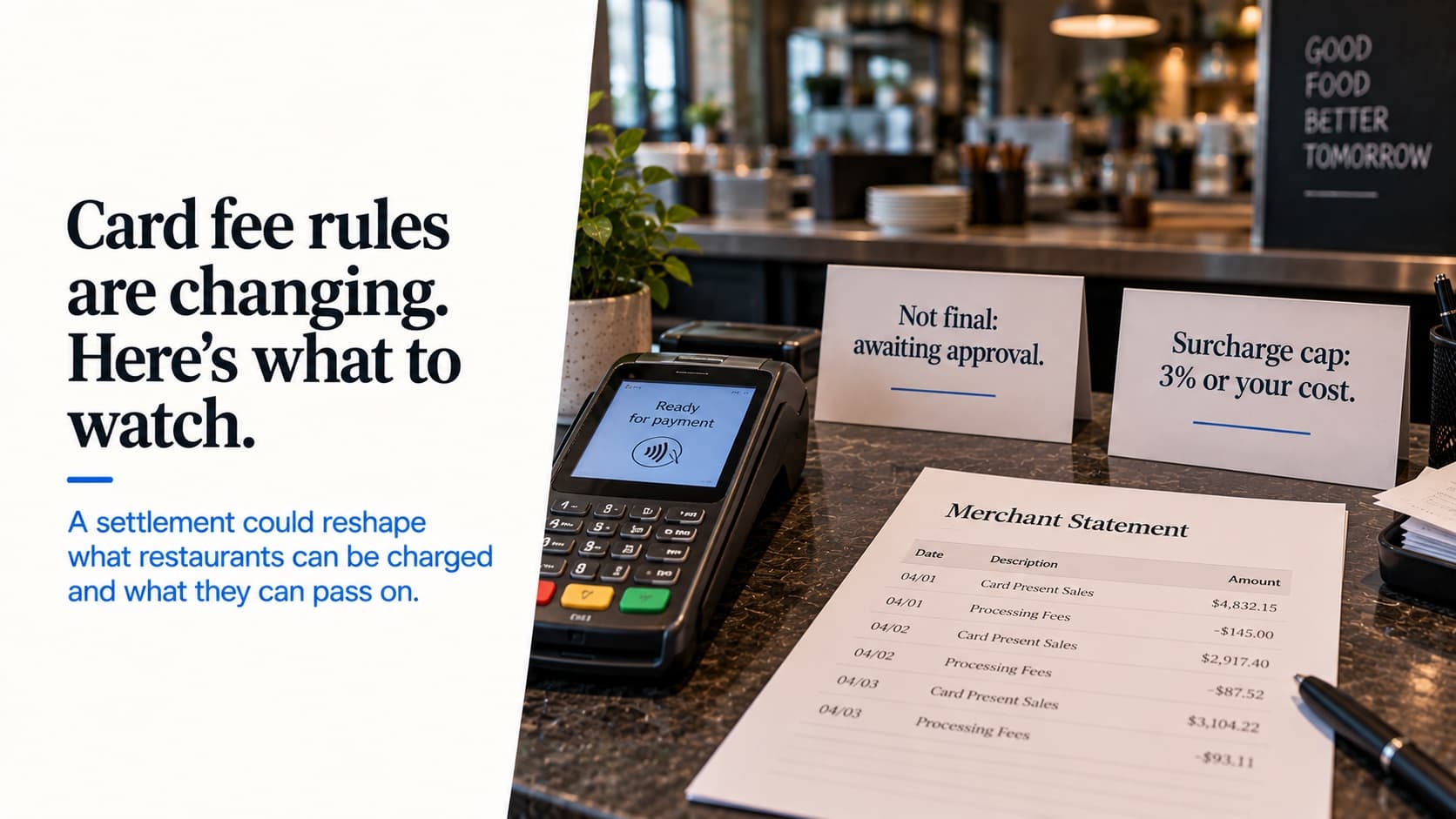
In November 2025 Visa and Mastercard settled the merchant lawsuit over card fees that has been running in federal court in Brooklyn since 2005. It covers roughly 12 million merchants, which almost certainly includes you. A federal judge, Brian Cogan, granted preliminary approval on June 9, 2026, finding the deal likely "fair, reasonable, and adequate."
Headlines have focused on the fee cut. For a restaurant, the more interesting change is a rule that has existed for decades: that if you take a network's credit cards, you take all of them. The settlement loosens it. Whether that's useful to a restaurant is a harder question, and the answer for most is no.
First, what hasn't happened yet.
Nothing changes until final approval
Final approval is still pending. Nearly a thousand merchants filed objections in September asking the judge to reject it, and the convenience-store trade group has said it will appeal if the deal is approved. The new rules start only after final approval, and some start 90 days after that.
There's also no opt-out. This is a class that seeks changes to the networks' rules rather than money, so every merchant is bound by the result and nobody needs to file a claim. You'll get the benefits automatically, and you'll also give up the claims the settlement releases. That release, which covers future conduct as well as past, is the main reason merchant groups object.
What the settlement changes
| Area | Today | Under the settlement |
|---|---|---|
| Which credit cards you must accept | All of a network's credit cards | You may choose by category: commercial, premium consumer, standard consumer |
| Surcharge cap | Network rules, 3% or 4% depending on network | The lesser of 3% or your cost of accepting the card |
| Surcharge level | Brand level | Brand level or product level, not both |
| Average credit interchange | Set by the networks | Cut by 10 basis points for five years |
| Standard consumer credit cards | No cap | Capped at 1.25% |
Surcharging stays credit-only; debit and prepaid still can't be surcharged. You'll have to give your processor 30 days' written notice before you start.
Can a restaurant really refuse premium cards?
The new flexibility sounds like a direct way to cut costs: premium rewards cards carry the highest interchange rates, so stop accepting them. Think about how that works at a table.
A guest orders, eats, drinks, and hands over a card at the end of the meal. If it's a premium card you don't accept, you're asking for a different form of payment after you've already served the food. Some guests will have one. Some won't, and the evening ends in an argument with a guest you wanted back.
The merchant coalition objecting to the deal says more than 90% of credit card spending runs on rewards cards. That's their figure and their argument, but even if it's high, premium cards are a big share of the cards your guests carry. Refusing them would mean signs at the door, staff warnings at seating and an unknown number of lost bookings.
Counter-service restaurants have it easier, since payment comes before the food. For table service, I'd expect very few to use this right. The more practical version is the product-level surcharge: charge a surcharge on premium cards only, where your state allows it, and accept everything.
The surcharge rules are where most restaurants will feel it
The new cap is the lesser of 3% or your actual cost of acceptance. If your effective rate on a card is 2.4%, that's your ceiling. The settlement also removes a quirk that effectively limited surcharges for merchants that accept American Express.
What it doesn't change is state law. The settlement rewrites the networks' rules, not state statutes:
- Connecticut, Massachusetts and Maine ban credit card surcharges.
- Colorado caps them at 2% and requires a separate line on the receipt.
- Several other states set their own disclosure and cap rules.
The state-by-state table is in the surcharging post. Nothing in the settlement makes a banned surcharge legal.
What 10 basis points is worth
A tenth of a percentage point on your credit card volume. On $1 million a year of credit sales, that's about $1,000 a year.
The National Restaurant Association, which objected to the deal, put it in context: the average card acceptance rate rose from 2.26% in 2023 to 2.35% in 2024. That's a nine-basis-point rise in a single year, against a ten-point cut. The cut roughly undoes one year's increase.
Whether you see it at all depends on how you're billed:
- Interchange-plus pricing passes interchange through at cost, so a lower rate shows up on your statement automatically.
- Flat or bundled pricing doesn't. If you pay a fixed 2.9% and interchange falls, the difference goes to your processor unless you renegotiate.
The bundled versus interchange-plus post explains the difference in full.
And the Credit Card Competition Act?
The bill that would require a second, competing network on credit cards was reintroduced in the Senate in January 2026 with the president's endorsement. It went to committee and hasn't moved since. An attempt to attach it to a housing bill in March failed. Don't plan around it.
What I'm not going to give you
The final approval date. Dates are circulating, but I couldn't confirm them from the settlement's official sources. They're worth checking directly if you're planning around this.
A prediction of the appeal. Merchant groups say they'll appeal; how long that takes is anyone's guess.
Advice to refuse premium cards. For most table-service restaurants it's the wrong move, for the reasons above.
What to do now
- Nothing operational yet. Don't change surcharges or card acceptance until the rules are final.
- Pull your card mix from your processor: what share of your credit volume is premium consumer, standard consumer and commercial cards. The merchant statement post shows where to find it.
- Know your effective rate by card type. Under the new cap, that's your surcharge ceiling.
- Check your state's surcharge law before you plan on any surcharge at all.
- If you're on flat-rate pricing, ask your processor in writing whether the interchange cut will be passed through.
Disclosure: I work at Katalyst, and our processing is interchange-plus, which means the settlement's rate cut would show up directly on our merchants' statements. Flat-rate processors aren't required to pass it on. Step 5 is the question to ask yours.
Related Katalyst products
Topics
See how Katalyst handles your service style
A 30-minute walkthrough of the platform, tuned to how your restaurant actually runs.