No commercial card program carries an interchange cap
The same $6,000 invoice: $150.10 on a corporate card, $105.10 with Level 3 data, $5.00 by Stripe ACH, $3.22 on a regulated business debit card.

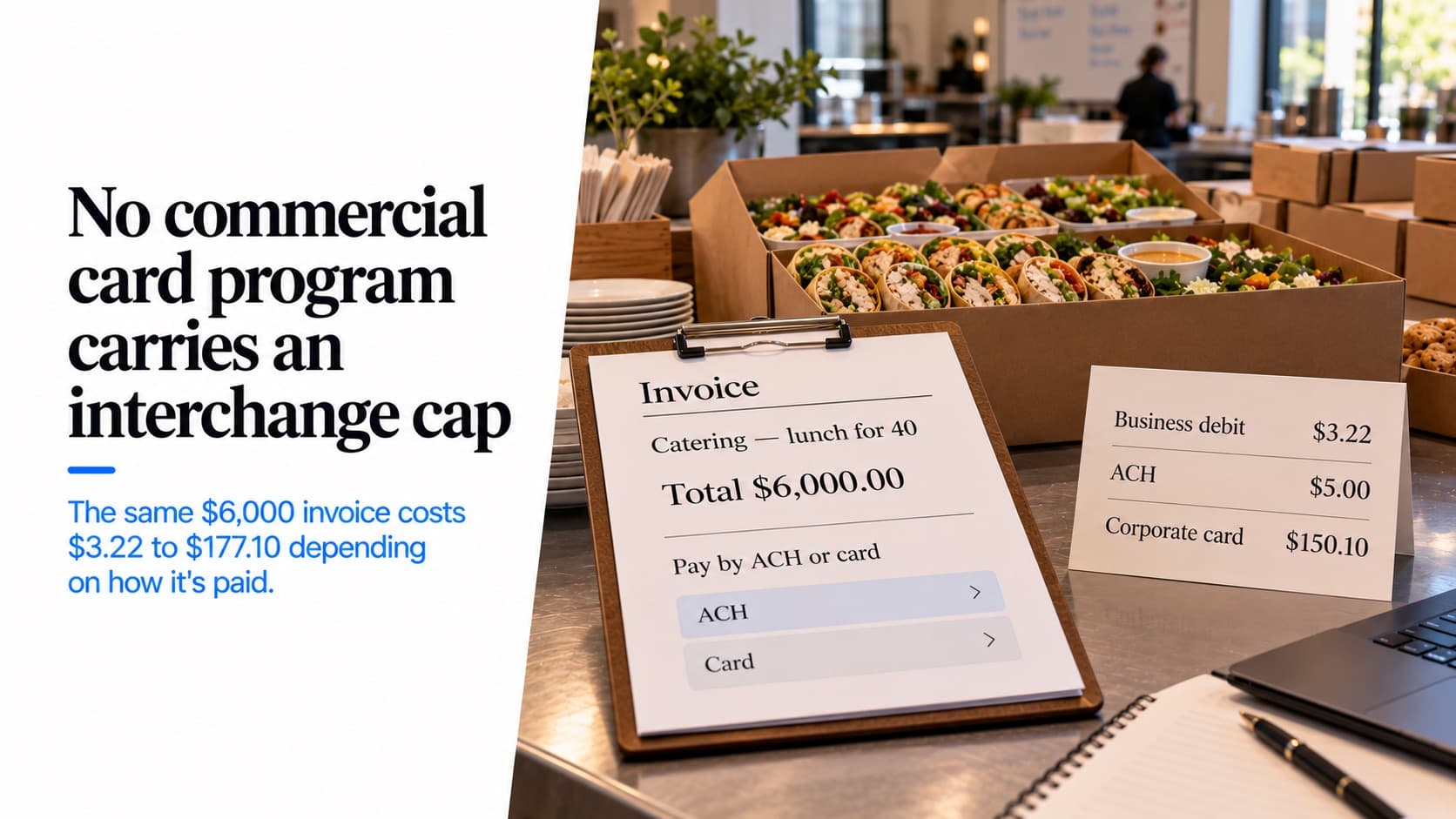
A restaurant with a catering business collects two very different kinds of money. A $60 dinner check at the table, and a $6,000 invoice from an office that booked lunch for forty.
I assumed, before I checked the rate sheets, that the big invoice was worse as a percentage. It isn't. On Visa's commercial card-present program at 2.50% + $0.10, the $60 check costs 2.667% and the $6,000 invoice costs 2.502%, because the fixed ten cents dilutes across the bigger ticket.
The real problem is simpler and worse: nothing caps it. Visa's fuel program has a $1.10 ceiling. Utility payments are a flat $0.75. Regulated debit is 0.05% + $0.21. Every category with a dollar ceiling in either network's published schedule excludes commercial credit. So the percentage runs uncapped, and the same invoice can cost anywhere from three dollars to a hundred and seventy-seven depending on how it's paid and what data rides with it.
All rates below are from Visa's schedule effective April 18, 2026 and Mastercard's effective April 17, 2026 (archived copy).
The same invoice, seven ways
| How the $6,000 arrives | Rate | Cost |
|---|---|---|
| Regulated business debit card | 0.05% + $0.21 | $3.22 |
| ACH (Stripe published pricing) | 0.8%, capped at $5 | $5.00 |
| Corporate card with full Level 3 data | 1.75% + $0.10 | $105.10 |
| Consumer card, restaurant category | 2.10% | $126.00 |
| Corporate card, card present | 2.50% + $0.10 | $150.10 |
| Corporate card, keyed or online | 2.70% + $0.10 | $162.10 |
| Corporate card, downgraded to non-qualified | 2.95% + $0.10 | $177.10 |
That is interchange only, before your processor's markup. The spread between the top and bottom rows is $174, on one invoice, for the same forty lunches.
Two things drive the upper rows. Commercial cards price above consumer restaurant rates — 2.50% against 2.10%, a 40 basis point gap. And taking the card without the card present, which is what an emailed invoice means, adds another 20 points.
Level 3 data is worth $45 on this invoice
Commercial cards have a discount available if you send enough information with the transaction. Visa replaced its old Level 3 program with the Commercial Enhanced Data Program in October 2025; qualifying transactions clear at "Product 3" rates. On the $6,000 invoice that's $150.10 falling to $105.10. On Mastercard's large-market corporate credit, Data Rate I to Data Rate III is $162.10 to $114.10.
What it takes is real work. Per line item: description, product code, commodity code, quantity, unit of measure, unit cost, line tax, and for Mastercard a discount rate. Per order: a customer reference or purchase order number, total tax, freight, duty, ship-from and ship-to postal codes. And the arithmetic has to reconcile — quantity times unit price plus tax plus shipping must equal the authorized amount, or the gateway withholds the data entirely and you clear at the higher rate anyway.
Three complications worth knowing before you build any of this:
- Visa's Level 2 tier is gone in the US as of the April 2026 schedule, except for fuel. Mastercard still pays for Level 2 — 75 basis points on small-business credit at every tier.
- On Visa small-business cards, submitting Level 3 now costs you more. Business Product 3 sits at 2.40% while Business Product 2 is 1.90%. The advice to "always send Level 3" is wrong on that product.
- Sales tax has to be a real number. The networks validate it: Mastercard between 0.1% and 30%, Visa between 0.1% and 22%. A tax-exempt corporate or nonprofit client means a blank tax field, which drops you to the higher rate.
The four-digit number that decides all of it
Here's the one I'd check first, because it costs nothing to ask and determines whether any of the above is available to you.
Restaurant merchant category codes — 5812 for eating places and 5814 for fast food — are excluded from Level 2 and Level 3 on both networks. 5811, the code for caterers, is not on either exclusion list.
If your catering revenue runs through a merchant account boarded as 5812, no amount of line-item data will earn you the Level 3 rate. If it runs through 5811, it can.
I want to flag the evidence honestly: that exclusion list comes from a major processor's documentation restating network rules, not from a network document I could open. Confirm it with your acquirer before you restructure anything. But do ask, because the same question has a second answer attached — Visa's restaurant interchange now runs above its general retail credit rates, so the restaurant code isn't the bargain operators assume it is.
Below $7,756, chase Level 3. Above it, don't.
Both networks run a large-ticket program with a low percentage and a high fixed fee: Visa at 1.30% + $35.00, Mastercard at 1.45% + $35.00. Against Level 3 at 1.75% + $0.10, the crossover is $7,756. Visa's own straight-through-processing ladder corroborates it, with the $35-fee tier starting at $7,000.
So a caterer with $4,000 weekday office orders and $40,000 wedding invoices should not treat them as one payment problem. Below the crossover, the data work pays. Above it, the flat-fee program wins on its own.
ACH is the cheapest rail, with a different risk
Published US pricing, for the same invoice:
| Provider | ACH price | On $6,000 |
|---|---|---|
| Stripe | 0.8%, capped $5 | $5.00 |
| GoCardless Standard | 0.5% + $0.05, capped $5 | $5.00 |
| Melio | $0.50 flat | $0.50 |
| BILL | $0.59 flat | $0.59 |
| Authorize.net eCheck | 0.75% | $45.00 |
Same Day ACH currently carries a $1,000,000 per-entry limit, and Nacha has approved raising it to $10,000,000 effective September 17, 2027. Two details that matter for catering: the limit is per entry, not per batch, so a client paying several event invoices can send each as its own same-day entry. And an over-limit entry isn't rejected — it settles the next day.
The risk profile is genuinely different from cards, and in your favor:
- Business accounts have roughly two business days to dispute a debit. Consumers get 60 calendar days. Most catering clients are businesses.
- ACH disputes are final. There's no appeal process the way there is with a card chargeback.
- But a dispute invalidates the mandate, so you need fresh authorization before you debit that client again.
Watch your return rates: Nacha's thresholds are 0.5% unauthorized, 3% administrative, 15% overall, and exceeding them triggers a remediation plan through your bank.
Surcharge, cash discount, or neither
You may surcharge commercial cards. Visa's own definition of a credit card covers "revolving or non-revolving consumer, business, or commercial credit or charge accounts," and Mastercard's merchant FAQ says merchants may surcharge consumer and corporate credit. You may never surcharge debit or prepaid, including when the customer presses "credit" at a terminal.
The conditions are strict: the US cap is 3%, and below that your own average cost of acceptance is the ceiling. You must notify your acquirer in writing 30 days ahead, and Mastercard wants notice too. Visa specifies disclosure down to the typography — 32-point Arial at the main entrance, 16-point at each checkout, 10-point on the first e-commerce page that names card brands and again at checkout, plus a chance to cancel after disclosure in any card-absent channel.
A cash discount is the better instrument for most caterers, and the reasons rarely get listed: no registration, no 30-day notice, no 3% cap, and it isn't limited to credit cards, so it can favor ACH or check over every card including debit. The compliance line is that the posted price must be the card price and the discount comes off it. Inflating a base price and "discounting" it back is a surcharge wearing a disguise.
A convenience fee almost certainly doesn't work here. Under Visa's rules it must be a flat amount, may only be charged on card-absent transactions, cannot be charged by a merchant operating exclusively in a card-absent environment, must apply to every payment method in that channel including ACH, and can't be combined with a surcharge. An emailed invoice payment page fails several of those at once. That's my reading of the rule text, not a ruling from Visa.
Two costs people forget
Refunds don't give the interchange back. Visa's credit-voucher rate for corporate and business cards is 2.35%; Mastercard's commercial refund groups run 2.16% to 2.37%. Refunding a cancelled event's deposit on a corporate card is a second interchange event, not a reversal of the first.
Checks are the most-defrauded rail you accept. In the 2026 AFP survey of 465 treasury practitioners, 76% of US organizations experienced attempted or actual payments fraud in 2025, and checks were targeted at 58% — ahead of ACH debits at 30% and wires at 25%. Your corporate client knows this and is still mailing paper.
What I'm not going to give you
A catering days-sales-outstanding figure. I couldn't verify one for food service. What I can verify: an insurer's North America survey puts overdue invoices at about 23% of B2B receivables, collected on average 20 days past due.
Virtual card mechanics. Corporate accounts payable departments increasingly pay by single-use card number, and those land in the commercial category — a $12,000 invoice keyed at 2.70% + $0.10 is $324.10 of interchange. The benefit claims around them come from network-funded studies, so I'm not repeating them.
Your processor's markup. Everything above is interchange, which your processor pays. What you pay is that plus their margin, which is the part you can negotiate.
What to do
- Ask your acquirer what MCC your catering account is boarded under. One phone call, and it determines whether Level 3 is even available.
- If corporate cards are a real share of your volume, price out Level 3 support with your gateway — and check whether the cards you take are corporate or small-business, because the answer flips on Visa.
- Route by invoice size. Below roughly $7,700 the data work pays; above it the large-ticket programs do.
- Put ACH first on the invoice, with the card as the second option. The $5-versus-$150 gap on a single invoice funds a lot of administrative effort.
- If you want to steer, use a cash discount rather than a surcharge, and make sure your posted price is the card price.
- Write the late-fee clause. In California a contract that's silent still earns 10% a year from the date of breach, but that's a state default, not a national rule.
Disclosure: I work at Katalyst, and our processing is interchange-plus, which means every number in the first table shows up on our merchants' statements as its own line rather than blended into a flat rate. That's a real advantage for this analysis and an obvious reason for me to write it. The step that saves the most money doesn't involve us at all: get the client onto ACH.
Related Katalyst products
See how Katalyst handles your service style
A 30-minute walkthrough of the platform, tuned to how your restaurant actually runs.