The church can consent and the state still must say no
Change of use can make you fix the sidewalk, ADA path-of-travel runs to 20% of build cost, and every prior tenant's inspection record at that address is public.

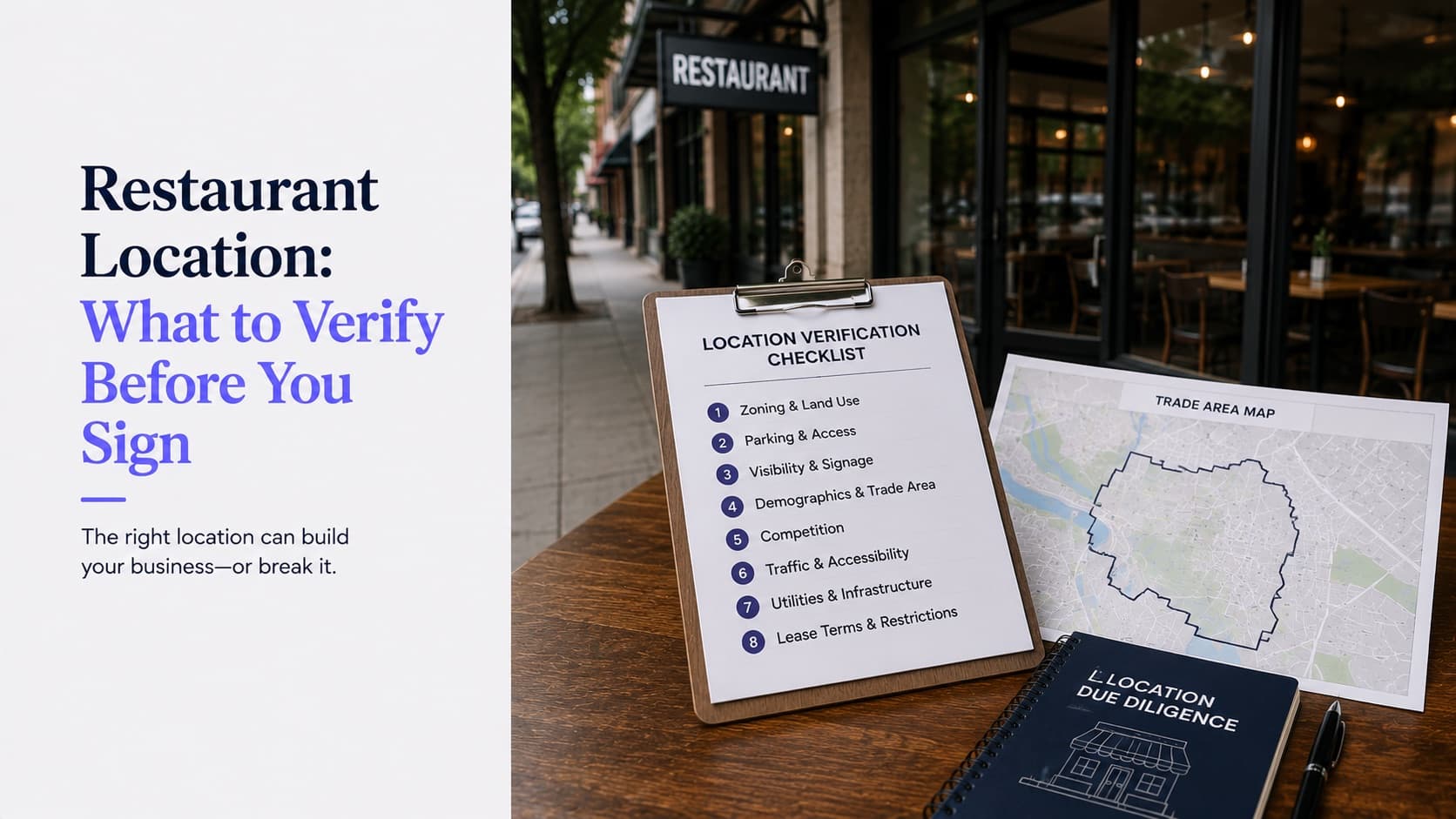
Location advice for restaurants is almost entirely about the neighborhood: demographics, foot traffic, daytime population, visibility, parking, who else is on the block. All of it is real, all of it is worth knowing, and none of it is where deals actually die.
Deals die at the address. Not the area — the specific parcel, its zoning designation, its occupancy classification, its permit history, and what the last tenant left behind. Every one of those is a matter of public record, checkable before you spend a dollar, and almost nobody checks them until they're already in a lease.
Start with the checks that can disqualify a site outright, because there's no point evaluating foot traffic at an address where you can't legally do what you're planning.
The distance rules that end the conversation
If alcohol is part of your concept, measure before you fall in love.
New York's is the sharpest example and the one worth understanding even if you're elsewhere, because it shows how absolute these rules can be. Under the Alcoholic Beverage Control Law, a license may not be issued for premises on the same street and within 200 feet of a building used exclusively as a school, church, synagogue or other place of worship. It applies to on-premises consumption and to package sales.
Here's the part that surprises people: the Liquor Authority has no discretion. If the 200-foot rule applies, the agency cannot grant the application — and it cannot grant it even if the school or the house of worship affirmatively consents. There is nobody to negotiate with. The site is simply not available for that use.
The 500-foot rule works differently and is often confused with it. No on-premises license may be granted for premises within 500 feet of three or more existing operating on-premises licenses — but here the Authority does have discretion. That turns a hard no into a hearing, a public-interest showing, and months of calendar. Survivable, but it belongs in your schedule and your risk assessment, not as a surprise in month four.
Other states draw these lines differently, and some draw them around different things. The lesson transfers regardless: before anything else, find out what your state's proximity restrictions measure, what they measure to, and whether the agency has discretion when they apply. The measuring method matters too — the distance is defined by statute, not by what looks close on a map.
Zoning, and the word "conditional"
The second free check: is your use permitted at this address as of right, or does it require a discretionary approval?
Restaurants are frequently permitted by right where a bar is not. A "drinking establishment" — tavern, pub, cocktail lounge — is commonly restricted to specific districts and often requires a conditional use permit, which means a public process, a hearing, neighbors with standing to object, and a body that can say no.
That distinction is worth pinning down precisely, because it determines whether your concept can drift. A restaurant that plans to become bar-forward at night may be proposing a different use than the one its zoning allows, and finding that out after the build-out is an expensive way to learn it.
What the previous tenant's occupancy classification costs you
This is the node that turns a "turnkey" space into a budget problem, and it's the one I'd most want a first-timer to understand.
When you change a building's use — retail to restaurant, office to assembly — you don't inherit the old building's code compliance. You trigger a review against current requirements. Depending on jurisdiction and the scope of your work, that review can pull in:
- Additional parking, if your zoning district calculates it by use and floor area, and restaurants usually consume more of it than whatever was there before.
- Egress capacity. Assembly occupancy carries higher occupant loads than retail or office, and occupant load drives exit width and count.
- Restroom fixture counts, calculated from occupant load.
- Fire-resistance ratings, which step up for assembly uses.
- Mechanical and ventilation loads.
- Energy code compliance.
- Off-site improvements — sidewalk, curb, gutter, curb ramps, the driveway or alley approach. Yes, the city can require you to fix the sidewalk.
The one with a number attached is accessibility. Under the ADA, when you alter an area containing a primary function, you must also make the path of travel to that area accessible — the route from site arrival points, the entrance, and the restrooms, telephones and drinking fountains serving it. The cost obligation is capped: alterations to the path of travel are deemed disproportionate when they exceed 20% of the cost of the alteration to the primary function area.
Read that cap carefully, because it cuts both ways. It limits your exposure — you are not obliged to spend without bound. But it also means compliance is required up to the 20% point even when that doesn't produce a fully accessible path. So a $300,000 dining room renovation carries roughly $60,000 of path-of-travel obligation before disproportionality relief applies. If your budget didn't have it, your budget was wrong, and the number scales with how much you spend on the part you actually care about.
The address has a record, and it's public
Every restaurant that operated at your candidate address left a trail you can read.
Health inspection history is public everywhere. Most jurisdictions now publish it online. New York City's ABCEats covers roughly 29,000 restaurants; New York State posts most food service inspections through its open data portal; Florida publishes sanitation and safety inspection records including type, disposition and violations cited. If you don't know where your jurisdiction posts them, the Association of Food and Drug Officials maintains an index of state portals.
What you're reading for is not whether the last operator was clean. It's whether the same structural violations recur across different tenants. A repeated citation for inadequate refrigeration capacity, a plumbing issue that shows up under two different owners, ventilation findings that persist through a change of ownership — those are building problems wearing an operator's name. They will become yours, and they are priceable before you sign.
Permit history tells you the other half: what was legally built, and when. A hood installed under a permit in 2009 is a different asset than a hood with no permit record at all, and the second one is a question your plan reviewer will eventually ask.
"Turnkey" is a claim, not a condition
If a space comes with restaurant equipment in place, four things decide whether that's an asset or a liability, and all four are checkable:
The hood and make-up air. Type, size, and whether it matches the equipment line you actually plan to run. A hood sized for the last tenant's concept is not sized for yours.
The grease interceptor. Undersizing is the most common grease-trap rejection in plan review, and existing undersized equipment doesn't get grandfathered when you submit new plans. Get the size and compare it against what your fixture count will require.
Utility capacity. Gas line sizing and electrical service are the two that quietly cap your equipment list. Upgrading either can mean the utility, the street, and a schedule you don't control.
What's actually owned. Ice machines, espresso equipment and POS terminals are frequently on separate leases that don't convey with the space, which is the same trap that shows up when buying an existing restaurant.
The ordering point matters here: all of this feeds plan review, and plan review has to be approved before you build. Discovering an undersized interceptor during review costs you a resubmission cycle. Discovering it before you sign costs you a phone call.
What I'm not going to give you
Foot traffic thresholds. You will find articles asserting a minimum daily pedestrian count for a viable restaurant. I could not find a primary source for any of them, and the number would be meaningless across concepts anyway — a destination dinner house and a lunch counter do not need the same sidewalk.
A rent-to-sales percentage to shop by. I went looking for the provenance of the 6–10% rule and couldn't find one; filed 10-Ks put actual restaurant rent anywhere from 1.6% to 7.7% of sales. The reasoning is in the lease post. Don't use a ratio to pick an address.
A verdict on whether to take a second-generation space. It depends entirely on the four checks above, and the answer flips based on what you find.
The afternoon that saves you six months
Before you sign an LOI, do this in roughly this order. None of it costs money.
- Measure the distance from the property line to any school or place of worship on the same street, and find out how many on-premises licenses operate within 500 feet. If your state has proximity rules, this is a pass/fail gate.
- Call zoning with the address and your exact concept, including what it becomes at 10pm. Ask whether it's permitted by right or requires a conditional use permit.
- Pull the inspection history for the address, not just the last tenant. Look for violations that repeat across operators.
- Pull the permit history and confirm the hood, the interceptor and any gas or electrical upgrades were permitted.
- Ask the building department what a change of use to assembly triggers at this address — parking, egress, restrooms, off-site work.
- Get the interceptor size and the gas line size in writing from the landlord, and have your designer check them against your equipment list.
Then go look at the foot traffic. It's a real input. It's just not the one that kills deals.
Disclosure: I work at Katalyst and we sell restaurant technology, which has nothing to do with any of the above — deliberately. This post is the part of opening a restaurant where a vendor has nothing to sell you and therefore no reason to write about it, which is exactly why the information is thin out there. The checks are free. The mistakes are not.
Topics
See how Katalyst handles your service style
A 30-minute walkthrough of the platform, tuned to how your restaurant actually runs.