Your contractor's unpaid sub can put you in lease default
Paying the GC in full is no defense: the sub liens the landlord's building, and your lease gives you 10 to 20 days to clear it at your own cost.

Restaurant build-outs are famous for running 30% over. The stories always blame the same things: surprises behind the walls, permit delays, an equipment change halfway through.
Those are real. They're also the expensive-but-survivable category. The two mechanisms that turn a build-out into a genuine crisis are contractual, they're invisible in every "how to plan your build-out" article, and one of them can cost you the lease.
You can pay in full and still owe the money
Here's the mechanism, and it's not exotic — it's the ordinary operation of construction lien law in every state.
You hire a general contractor. The GC hires a plumber, an electrician, a hood installer, and buys materials from suppliers. You pay the GC on schedule, in full, on time. The GC does not pay the plumber.
The plumber files a mechanic's lien against the property. The fact that you already paid the GC for that plumbing work is not, by itself, a defense. To clear the lien, you may end up paying the plumber directly — paying twice for the same work — and then chasing a GC who by then may have nothing left to chase.
This is the single largest uninsured financial risk in a build-out, and the protection is procedural and boring:
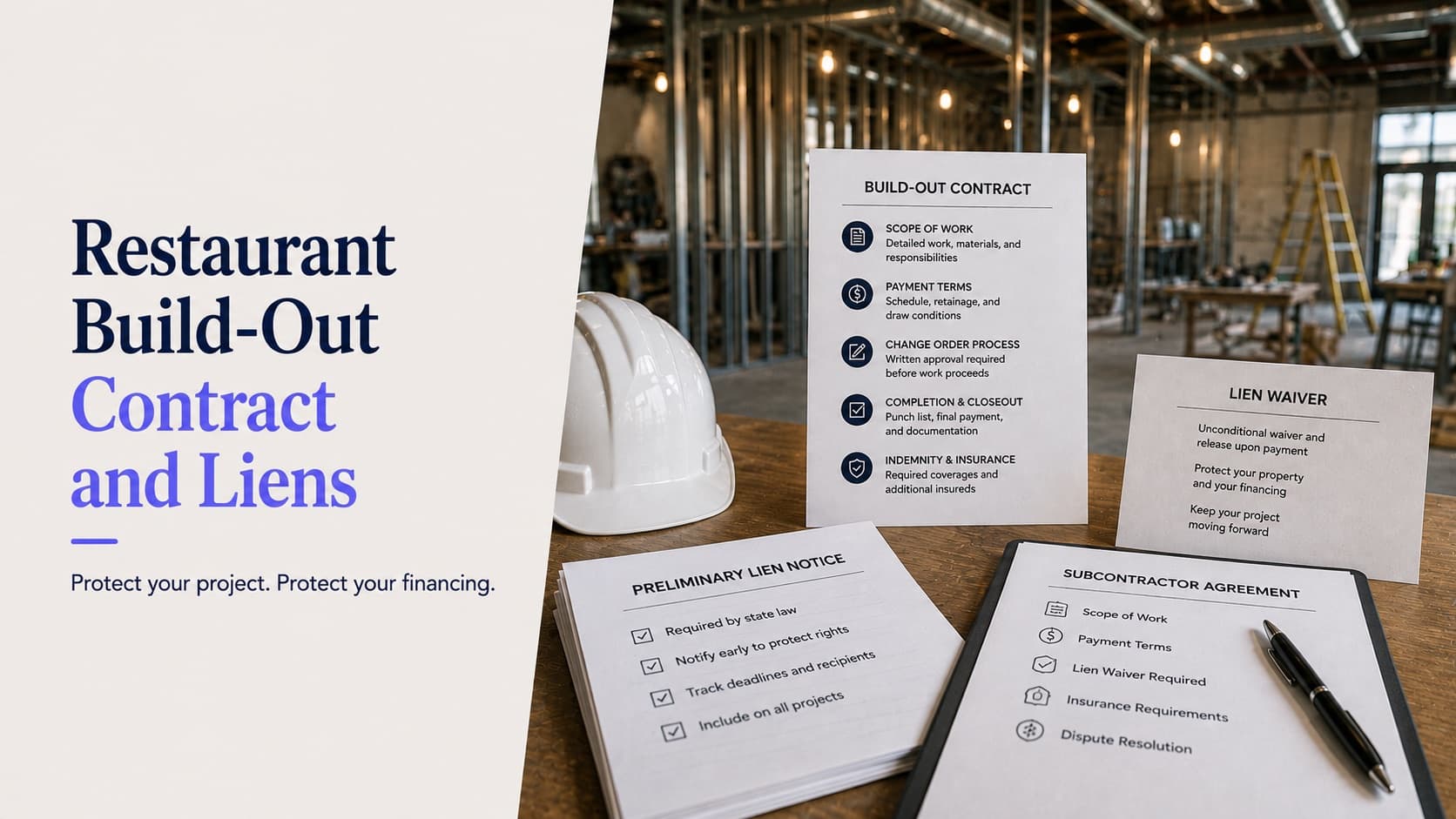
Require lien waivers at every draw. Not just from the GC — from each subcontractor and each material supplier. Pay only against them.
Understand conditional versus unconditional. A conditional waiver takes effect when the payment actually clears; an unconditional one takes effect on signature regardless. Give conditional waivers when you're paying by check that hasn't cleared. Collect unconditional waivers for work already paid.
Ask for a payment bond. If the GC carries one, an unpaid sub has somewhere to go other than the property.
Get a sworn statement listing every sub and supplier before the first draw, so you know who can lien you. You cannot collect waivers from parties you don't know exist.
None of that is unusual to ask for. Any competent commercial GC has done it a hundred times. A GC who resists is telling you something.
And as a tenant, the lien is a lease default
This is the part that makes construction liens specifically dangerous for restaurants, and I have not seen it discussed in restaurant content at all.
You don't own the building. The lien attaches to the landlord's property. And essentially every commercial lease prohibits exactly that: the tenant shall not permit any mechanic's or materialman's lien to be filed against the landlord's real property, and must discharge any that appears — commonly within 10 to 20 days of filing or notice, at the tenant's sole cost.
Fail to clear it in time and the lease typically gives the landlord the right, but not the obligation, to pay the claim or post a bond itself, with the cost immediately due from you as additional rent. So the sequence runs:
- Your GC and a subcontractor have a payment dispute you're not party to
- The sub files
- A clock starts that you didn't know about
- You're in default of your lease over somebody else's argument
The realistic remedy inside a 10-day window is a lien release bond — you post a bond, the claim detaches from the property and attaches to the bond instead, and you litigate the merits afterward without the lease exposure. It costs money you didn't budget, and it requires knowing the mechanism exists before you need it, because arranging a surety bond from a standing start in ten days is not pleasant.
Two things to do about this in advance:
Read your lease's lien clause before signing and negotiate the cure period up. Ten days is short; thirty is reasonable and landlords will often give it. This belongs on the same list as the other clauses in the lease negotiation post.
Tell your GC in writing that the premises is leased, and that liens against the landlord's property trigger your default. It changes how seriously the payment chain gets managed.
The contract type decides who eats the surprise
Three structures, and the choice determines who carries risk. Most first-time operators sign whatever their GC hands them without knowing which one it is.
| Who carries overrun risk | Where it goes wrong | |
|---|---|---|
| Fixed price / lump sum | The contractor | Every change order is priced at full value, because the GC's margin is fixed and change orders are where it's recovered |
| Cost-plus | You | Fee as a percentage of cost rewards a bigger cost; there's no ceiling |
| GMP | The contractor, above the cap | The cap moves with approved change orders, so scope creep pierces it |
Fixed price is the usual right answer for a first-time operator, because you need certainty more than you need upside. But understand what you're buying: certainty on the defined scope. The word doing all the work is "defined."
Allowances are the scope you didn't define
An allowance is a placeholder in the bid — a dollar figure for a category that hasn't been specified yet. Lighting allowance. Flooring allowance. Millwork allowance.
Every allowance is a fixed-price contract with a hole in it. When you eventually choose the actual fixture and it costs more than the placeholder, that's a change order at full price, and the certainty you paid for evaporates on that line.
So the practical rule: the number of allowances in the bid is a measure of how fixed the fixed price actually is. Before you sign, go through them and either specify the item or accept that the line is an estimate. Two identical-looking bids where one has a $40,000 allowance and the other has specified fixtures are not comparable documents.
Define the contingency boundary in writing
Related and equally common: the contract has a contingency, and nobody wrote down what it's for.
Owners assume the contingency covers everything unexpected. Contractors treat it as covering their estimating variance, and submit change orders on top for scope changes. Both readings are defensible when the contract doesn't say, and the argument arrives at the worst possible moment.
Write it down explicitly: what draws on contingency, what requires a change order, who authorizes each, and what the approval turnaround is. An unapproved change order that stops work is a schedule problem, and schedule is money — you're paying rent throughout, and if your rent commencement was tied to the wrong trigger, you're paying full rent.
Where the real overruns actually came from
In my experience and from the sequencing in the last few posts, the overruns cluster in three places, and two of them are avoidable by ordering the work correctly:
Mechanical capacity discovered late. The makeup air unit, the gas meter upgrade, the electrical service. These are large, they're on somebody else's schedule, and they're knowable before you sign a lease — the capacities post covers what to ask for.
Plan review resubmission. Rejected drawings mean a cycle you pay rent through, and the rejections repeat across projects. The permitting sequence covers what gets caught.
Change-of-use triggers. Parking, egress, restrooms, accessibility, sometimes the sidewalk. These attach to the address and are checkable before the LOI — see the location post.
The genuinely unforeseeable category — what's actually behind the walls — is the smallest of the three, and it's the only one a contingency is really for.
What I'm not going to give you
A cost per square foot. The ranges circulating are averages across concepts, markets and build conditions wide enough to be useless for budgeting a specific project. Get three real bids on your actual drawings.
A contingency percentage. You'll see 10%, 15%, 20%. None of them traces to a study I can find; they're rules of thumb repeated between articles. The defensible approach is to size contingency against your identified unknowns — how much demolition is exploratory, whether the building's age suggests surprises — rather than against a number someone published.
The 30% overrun figure I opened with. I've heard it my whole career and used it in the cost-to-open post as a lived observation, not a statistic. I've never found a dataset behind it. Treat it as the shape of the risk, not its measurement.
The short version
Before you sign the construction contract: get the sworn statement, set lien waivers as a condition of every draw, ask about a payment bond, read your lease's lien cure period and negotiate it longer, count the allowances, and put the contingency boundary in writing.
That's an afternoon with a construction lawyer, and it is the cheapest insurance in the entire project — because unlike the mechanical surprises, these failures don't just cost money. They put the lease at risk, and the lease is the business.
Disclosure: I work at Katalyst and we sell restaurant technology, which has no bearing on any of this. The only reason a POS company ends up writing this post is that we watch a lot of restaurants open, and this is the category of pain we see that nobody warned them about — mostly because the people who write about build-outs are selling build-outs.
Topics
See how Katalyst handles your service style
A 30-minute walkthrough of the platform, tuned to how your restaurant actually runs.