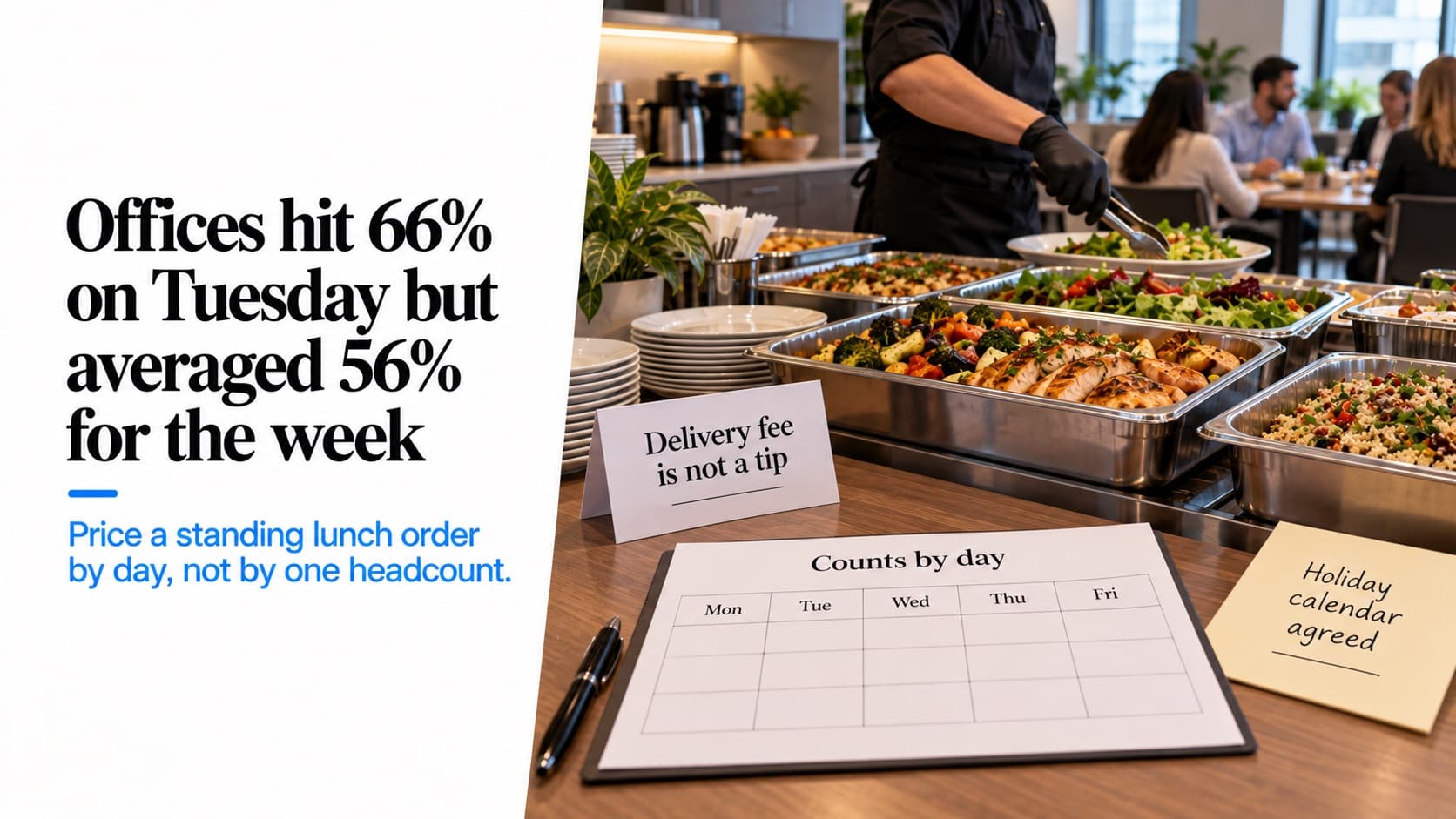
Offices hit 66% on Tuesday but averaged 56% for the week
ZeroCater charges headcount cuts on the same schedule as cancellations. On ezCater, 15% commission plus 2.99% processing is about 18% of an order.

A standing office lunch is the account every catering salesperson wants. Same client, same address, every week, no proposal to rewrite. It's also the account most caterers price wrong, because they quote it like a single event repeated five times: one headcount, one price, Monday through Friday.
Offices don't work that way anymore, and the published data on office attendance shows exactly how far off a flat headcount is.
Price by day of the week
Kastle Systems measures office attendance from access-card swipes in ten US cities. For the week ending October 21, 2026, its barometer averaged 56.1% of pre-pandemic levels. The peak day, Tuesday, was 66.1%.
The city spread is wider than the national one. Austin averaged 77.3% for the week and peaked at 92.9% on Wednesday. New York averaged 69.9% and peaked at 85.6%. Philadelphia averaged 42.3%.
So a standing order sized to Tuesday's headcount feeds an office that isn't there on Monday and Friday. Either the client pays for empty chairs and notices by the third week, or you cut the count every Friday morning and eat the food cost. Price the program by day, and put the day-by-day counts in the contract.
What corporate clients are buying
The largest source on workplace ordering is ezCater, which sells the platform, so treat these as a vendor's numbers. Its May 2026 data:
- The average workplace order was $430 for 26 people, about $16.54 a head.
- 30% of orders came with less than 24 hours' notice.
- 38% of employees get employer-provided meals daily or weekly.
- 96% of workplaces ordered from a restaurant new to them in 2025.
Two of those matter for a standing program. A 48-hour ordering rule turns away nearly a third of the market for one-off orders, which is a reason to lock in the recurring ones. And clients rotate restaurants constantly. A standing order is a contract against that rotation, so write it like one.
What published terms look like
| Caterer | Minimum | Delivery fee | Cancellation |
|---|---|---|---|
| Martin's Bar-B-Que (Nashville) | $300 delivery | Service charge, not driver tip | 50% inside 48 hours, 100% inside 24 |
| Panera (institutional pages) | $50 | $15 to $150; 10% to $250; $25 above | — |
| Daily Provisions (NYC) | $150, before delivery, tax and gratuity | — | — |
| Tufts University dining | $200 | $15 | — |
| NYIT dining | 10 people | — | $2.50 per person under the minimum |
National chains vary by store. On marketplace listings, Chipotle shows $75 minimums and sweetgreen $50, with cancellation fees inside 24 hours running 25% at some stores and 100% at others.
The clause ZeroCater gets right
The most useful published policy I found isn't a caterer's. It's ZeroCater's, a managed office-food company, for its own clients:
- Cancel or reduce before 2 p.m. two business days ahead: no charge.
- Before 2 p.m. one business day ahead: 50%.
- After that: 100%.
- Orders of 300 or more shift one business day earlier.
Two details make it work. Headcount reductions are charged on the same schedule as cancellations, which closes the "cut thirty people the night before" loophole. And when a deadline falls on a holiday, it moves a business day earlier — Thanksgiving and the day after are on the list. Copy both into your standing-order terms.
The delivery fee isn't the driver's tip
Martin's states it in one line: "The delivery fee is a service charge, and is not gratuity for the delivery driver(s)." Clients often assume otherwise, don't tip, and your driver finds out on the fourth delivery. Say what the fee covers and whether a tip is expected. The wording matters for tax too, as the catering sales tax post shows.
What a marketplace costs on the same order
If the standing order runs through a marketplace, the math changes. ezCater's published fees are a 15% commission on the food and delivery fees, plus 2.99% card processing. On a $430 order that's about $77.50 — roughly 18% of the order, before you pay a driver. The marketplace commission post goes through it in detail. Other platforms don't publish their restaurant-side rates.
That's the real argument for moving a recurring client to a direct contract: the same lunch, 18 points better, with terms you wrote.
The terms nobody publishes
I couldn't find a single US caterer publishing a minimum weekly volume, a price-lock period or a holiday calendar for standing orders. They're negotiated, which means you get to write them. Here's what I'd put in:
- Day-by-day base counts, with a range each day can move without a fee.
- A price lock for a set term, usually a quarter, with the date your next price applies.
- The holiday calendar, agreed in advance, so a closed office doesn't become a cancellation fight.
- The change deadline in hours and days, with the same rule for cancellations and reductions.
- The delivery fee and what it covers, and the tip policy.
- Invoicing and payment terms. The vendor onboarding post covers what large clients will ask for.
What I'm not going to give you
Commission rates for platforms that don't publish them. Figures circulate; none come from the platforms.
A share of employers who feed staff. The last broad HR survey figure I found is from 2018.
Standard price-lock terms. There aren't any to cite.
What to do
- Pull a month of order counts by weekday before you quote a standing program.
- Write the counts by day, not as one headcount.
- Charge reductions like cancellations, on a stated schedule.
- Agree the holiday calendar at signing.
- Name the delivery fee correctly and say whether drivers are tipped.
- Move recurring marketplace clients to a direct contract when the relationship allows it.
Disclosure: I work at Katalyst, which sells catering software that handles recurring orders and day-by-day counts. The decision that protects the account is the cancellation clause, and that's a sentence you write once.
Related Katalyst products
See how Katalyst handles your service style
A 30-minute walkthrough of the platform, tuned to how your restaurant actually runs.