USDA says not to reheat a whole cooked Thanksgiving turkey
A cold-pickup holiday dinner should be eaten within 2 days, not the usual 3–4. The 2026 Food Code adds a 2-inch maximum depth for cooling pans.

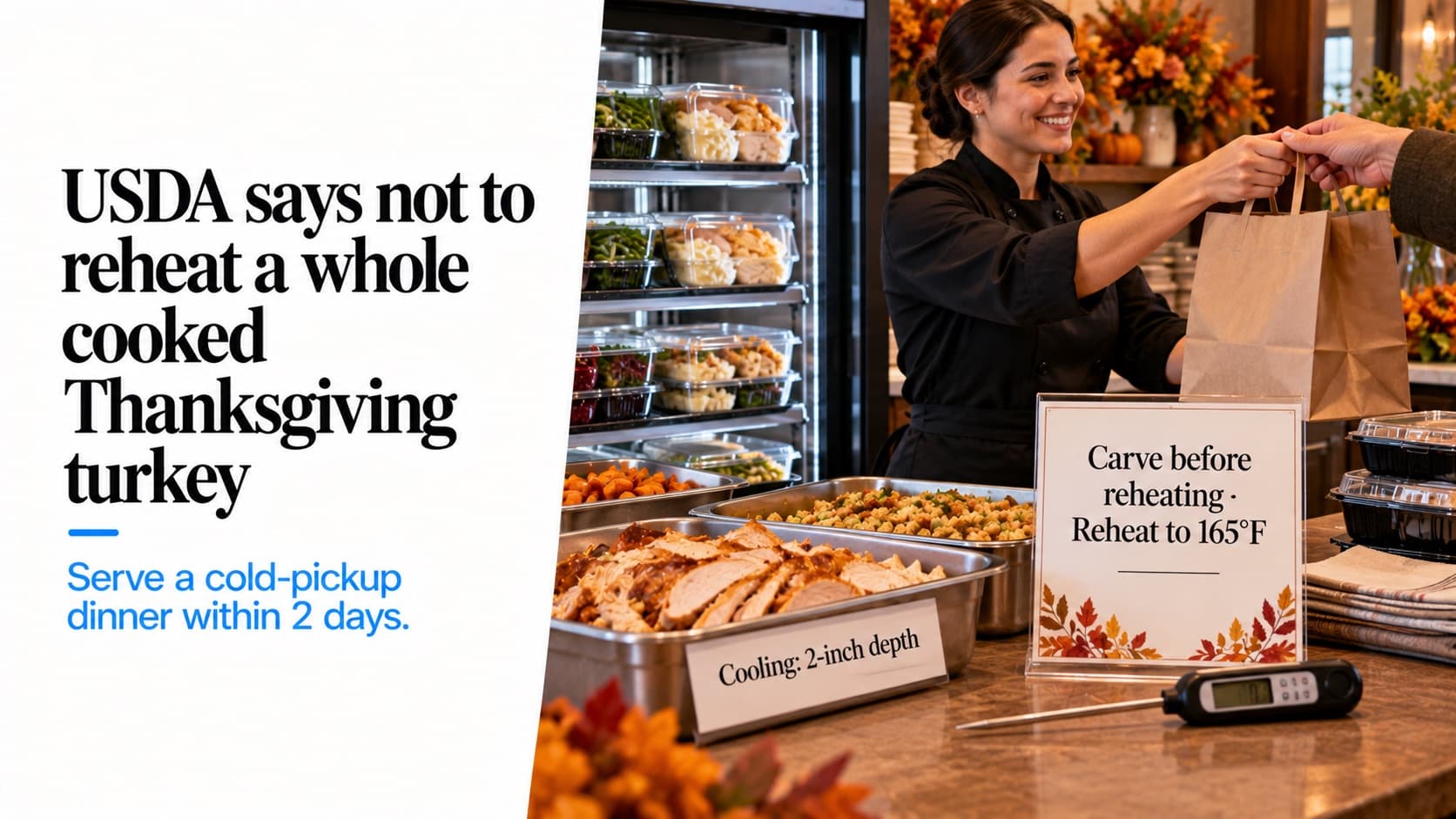
Nora covered how to price a Thanksgiving pre-order program. This is the other half: Wednesday, November 25, when 150 dinners leave through your front door between 9 a.m. and 3 p.m. Almost every way that day goes wrong happens before the first customer arrives — in how the turkeys were cooled — or after the last one leaves, in what your reheating sheet told them to do.
Why this is the risky day
The CDC estimates Clostridium perfringens causes nearly 900,000 illnesses a year in the US, and "most outbreaks happen in November and December," many linked to turkey and roast beef. It's a spore-former: it survives cooking and grows when cooked food cools too slowly or sits warm.
The CDC's own case study reads like a pickup-day plan gone wrong. At a North Carolina catered lunch in 2015, turkeys were "cooked about 10 hours before lunch," then held in warming pans or at room temperature for up to eight hours across several car trips, with no temperature monitoring. Forty-four of the 58 people surveyed got sick.
Cooling is the step that fails
The Food Code's cooling rule hasn't changed in the 2026 edition: cooked food must go from 135°F to 70°F within two hours, and to 41°F within six hours total. The first two hours matter most; food that makes 41°F in six hours but took three to reach 70°F hasn't been controlled. (New York City starts the clock at 140°F.)
The code's own commentary names the problem: "Large food items, such as roasts, turkeys, and large containers of rice or refried beans, take longer to cool," and "commercial refrigeration equipment is designed to hold cold food temperatures, not cool large masses of food." A whole roasted turkey in a walk-in doesn't cool in time.
What works:
- Carve before cooling. Breast off the bone, legs separated, sliced or portioned.
- Shallow pans. The 2026 Food Code adds a new method, placing food "at a depth of no more than 2 inches." Not three. Two.
- Ice baths and stirring for gravy, stock and sides.
- Space. The code requires enough cooling and holding equipment to hit the temperatures. Running out of walk-in space the night before pickup is a violation, not bad luck.
The 2026 code also adds an approved alternative method — uncovered two-inch pans in a unit with electronic time and temperature monitoring — but it needs your health department's approval, and I found no state that had adopted the 2026 edition yet.
Cold pickup, hot pickup, or raw
Published programs show three structures:
- Cold on Wednesday, in a wide window. Founding Farmers offers pickup Wednesday 9 a.m. to 3 p.m., with reheating instructions.
- Hot on Thursday, in a narrow morning window. A Florida resort offers only hot pickup, Thursday 9 to 11:30 a.m., with orders closing Tuesday afternoon. The window is short because the food has to be eaten soon after.
- Raw. Founding Farmers also sells a brined, ready-to-roast spatchcocked half turkey. The customer roasts it, and the cook-cool- reheat chain never starts. It's the safest product on the list.
If you hold food hot for pickup, keep it at 135°F or above. Anything cooked and cooled that you reheat for hot holding has to reach 165°F within two hours.
What the USDA tells your customers
The USDA has guidance specifically for "ready-prepared turkey dinners," and it's stricter than the general leftover rules:
- Hot pickup: keep the food at 140°F or above and eat it within two hours — one hour if it's above 90°F outside.
- Cold pickup: refrigerate on arrival, within two hours, and "serve the meal within 2 days." Not the three to four days people expect for leftovers.
- "Reheating a whole cooked turkey is NOT recommended." Carve it, then reheat the pieces.
That second point matters for your schedule. Dinners picked up Monday are at the edge of the guidance by Thursday. A Wednesday pickup fits.
What to print on the reheating sheet
- Refrigerate as soon as you get home.
- Eat within two days of pickup.
- Carve the turkey before reheating. Don't reheat it whole.
- Reheat everything to 165°F, checked with a thermometer — turkey, stuffing, sides. Bring gravy to a boil.
- Stuffing heats in its own dish, never inside the bird.
- Questions on Thanksgiving Day: the USDA Meat and Poultry Hotline, 1-888-674-6854, is open 8 a.m. to 2 p.m. Eastern.
What not to print: one grocery's 2025 sheet told customers to let the turkey "sit at room temperature for 1-2 hours before reheating." That uses up the entire safe window before it goes in the oven.
Labels and the pickup line
A family feast packed into boxes the day before is packaged food, and in most places it needs a label with ingredients and allergens. The boxed lunch post covers when that applies.
For the line itself: give every order a pickup slot, stage the cold orders in coolers or a reach-in near the door, and if you stage anything out of refrigeration, do it under written time-control procedures, which allow four hours with the discard time marked. Check order numbers, not names; half your customers are picking up for someone else.
What I'm not going to give you
A current count of hotline calls. The figures I found are old and secondhand.
Reheating times by bird size. They depend on your product. Test yours and print what you measured.
Which states allow the new cooling method. I couldn't find any.
What to do
- Plan cooling capacity before you set the order cap — Nora's post on pricing the program covers the cap.
- Carve and pan in two-inch layers.
- Log temperatures at two and six hours.
- Choose cold Wednesday pickup unless you can staff a tight hot window.
- Print the USDA's rules, not the ones people remember.
- Consider a raw-turkey option.
Disclosure: I work at Katalyst, which sells restaurant and catering software, and I still pick up a handful of events a year. The tool that matters most on pickup day is a probe thermometer and a log sheet. The software just tells you who's coming at 11:15.
Related Katalyst products
Topics
See how Katalyst handles your service style
A 30-minute walkthrough of the platform, tuned to how your restaurant actually runs.