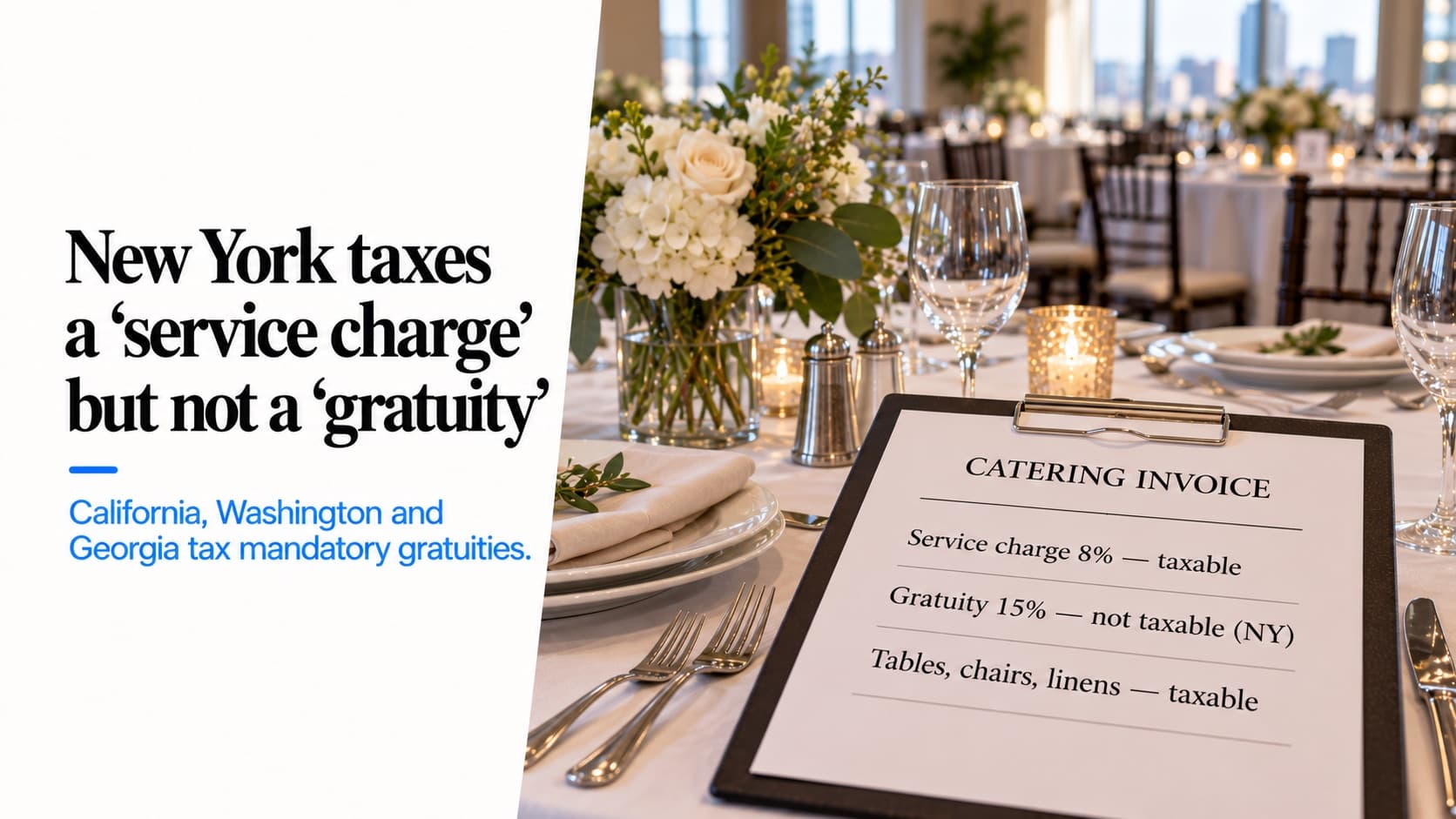
New York taxes a 'service charge' but not a 'gratuity'
California, Washington and Georgia tax a mandatory gratuity even when staff get all of it. Texas taxes the whole charge once it passes 20%.

A catering invoice has more taxable decisions on it than a dinner check. Food, a service charge, delivery, rented tables, setup labor, sometimes a room, sometimes a client who says they're tax-exempt. Each line is a separate question, and the answer often depends less on what the charge is than on what you called it.
I read the catering rules of a dozen states for this. The pattern that matters most: the same 18% charge can be taxable or not depending on one word, on where the money goes afterwards, and in some states on how your payroll codes it. None of this is tax advice; it's the published rule, and your state's version is the one that counts.
The word on the invoice decides
- New York taxes "service charges or other charges not specifically listed as gratuities." Its own caterer example: an 8% "service charge" is taxable and a 15% "gratuity" is not, even though both went to the servers.
- Texas goes the other way on the label. A qualifying mandatory gratuity can be identified "by any reasonable means, including such terms as service fee or service charge."
- Florida excludes a separately stated gratuity the business keeps none of, but "service charges, minimum charges, corkage fees, setup fees, or similar charges" are taxable.
So the line that's fine in Houston is taxable in Manhattan. A caterer working both states needs two invoice templates.
Three states tax the gratuity even if staff get every cent
- California: "A mandatory payment designated as a tip, gratuity, or service charge is included in taxable gross receipts, even if the amount is subsequently paid by the retailer to employees." Anything "negotiated between the retailer and the customer in advance of a meal" counts as mandatory, which describes every banquet contract.
- Washington: the Department of Revenue's own example is an 18% automatic gratuity on $100: "Retail sales tax and retailing B&O tax applies on $118."
- Georgia: any amount "whether designated as a tip, gratuity, or service charge" is mandatory and taxable when negotiated in advance or added by the seller.
California adds a twist that ties sales tax to payroll. Since 2015, amounts are presumed optional if you keep "records consistent with reporting these amounts as tip wages" for the IRS, and deemed mandatory if you report them as regular wages. How your payroll codes the money decides whether the invoice line was taxable.
Washington adds one for your payment terminal: a tip is voluntary only if the screen starts at a blank line or $0. A tip pre-filled by an app or device is mandatory and taxable.
Keep any of it and all of it is taxable
New York's rule is all-or-nothing on distribution. Its example: a 23% gratuity where 18% goes to staff and 5% stays with the house makes the entire 23% taxable. Illinois taxes any part of a service charge used for wages or "employer costs of doing business." Colorado's Department of Revenue has said that if any part of a tip pool is kept by the employer, the whole pool is taxable.
That's the sales tax version of the payroll question in the tip-pooling post. If the house keeps a slice, label the line accordingly and tax it.
Texas taxes the whole charge above 20%
Texas lets a mandatory gratuity go untaxed only if it's 20% or less, separately stated, and paid to qualified employees — "wait staff, busboys, bartenders, wine stewards, but not janitorial personnel, chefs, cashiers, dishwashers, or owners." Above 20%, "the entire mandatory gratuity charge is subject to sales tax." Virginia also caps its exclusion at 20%. A 22% service charge on a Texas wedding isn't 2 points taxable. It's 22.
You pay tax on your rentals, then charge it again
This is the one caterers argue with their accountants about. In Texas, New York, Illinois and California, the tables, chairs, linens and dishes you rent for an event are taxable when you rent them, and the charge you pass to the client is part of the taxable catering price. There's no resale exemption to make the first tax go away.
New York's bulletin is blunt: the caterer pays tax on rented tables, chairs, tents and linens, "A caterer's entire charge to its customer is taxable," and it "cannot claim a credit... for the tax paid on these purchases." Texas goes further with venues: a caterer using a hotel room pays hotel occupancy tax, then collects sales tax on the room charge passed to the client, "including the occupancy tax."
Bands, valet and AV: depends where you are
- New York: a caterer can hire a band, DJ, photographer or temp staff tax-free, but must charge sales tax on them once they're on its bill, "even if the charges are separately listed."
- Illinois: charges "not related to the provision of food or beverages" stay out — security, valet, coat check, entertainment, audiovisual services, and cancellation fees.
- Georgia: separately itemized services not needed for the sale, like coat check, are exempt. "The bartender and ID checking service charges are taxable."
The room, and who's selling the food
New York taxes room rent when the venue sells the catering or hires the caterer, and not when the client rents the room and separately hires an independent caterer. Illinois applies a "true object" test that surprises venues: if the venue requires the client to use a specific caterer or one from its list, the venue "shall be deemed to be the provider," and its room charge becomes taxable even though it sells no food. In California, a room charge that guarantees a minimum food purchase is taxable as part of the meal.
Federal clients: the card decides
Sales to the federal government are exempt when the government pays. Sales to federal employees aren't, even if they'll be reimbursed. In practice that comes down to the card:
- GSA SmartPay purchase cards are centrally billed and "should be exempt from state sales tax."
- Travel cards are mostly individually billed, and GSA says only "some" of those may be exempt in "select states."
- The sixth digit of the card number tells you which, per GSA's guide: 1–4 individually billed, 6–9 and 0 centrally billed. New Jersey treats 5 as individually billed; GSA says 5 can be either.
California adds the paperwork rule: the exemption applies only when the United States pays the vendor directly, and you must keep a purchase order or proof of direct payment.
Nonprofits: the payer and the paper
A nonprofit buyer isn't automatically exempt. New Jersey requires payment "directly from organization funds" and a signed exemption certificate; if a volunteer pays and gets reimbursed, it's taxable. Massachusetts requires the organization's state certification. And in Georgia, nonprofits "must pay both state and local sales and use tax" on food unless some other exemption applies. Many caterers there accept exemption paperwork they shouldn't.
Delivery, cancellation and local meals taxes
- Delivery is taxable in New Jersey, Georgia, Texas and Illinois when you charge for it. Colorado exempts it only if the customer could have picked up and the charge is separately stated.
- Cancellation fees are outside Illinois's taxable base by rule. In California, a forfeited food-and-beverage minimum may be taxable as a guarantee. Elsewhere I couldn't find a clear rule.
- Local meals taxes sit on top: Massachusetts towns can add 0.75%, and Virginia counties up to 6%, though Virginia exempts mandatory gratuities up to 20% and a nonprofit's first three fundraising events a year.
What I'm not going to give you
Pennsylvania's rules. I couldn't confirm its treatment of mandatory gratuities or caterer rentals to a primary source.
Chicago's and Minneapolis's local food and beverage rates. Check the city's own page.
Record-retention periods outside California, where exemption certificates must be kept at least four years.
What to do
- Name each invoice line on purpose, using your state's taxable and non-taxable vocabulary.
- Make your payroll and your invoice agree. In California, the tip coding decides the tax.
- Set terminal tip prompts to start at zero if you work in Washington.
- Tax the rental line, and stop expecting a resale credit.
- Check the sixth digit on government cards, and keep proof that the government paid.
- Collect exemption certificates before the event, and confirm the organization itself is paying.
- Put these rules into your POS tax settings once, by line type — the sales tax settings post shows where restaurants usually go wrong.
For pricing the event itself, see how to price catering orders.
Disclosure: I work at Katalyst, which sells POS and catering software with per-line tax settings. The software applies whatever rule you set; deciding which rule applies is still on you and your accountant.
Related Katalyst products
See how Katalyst handles your service style
A 30-minute walkthrough of the platform, tuned to how your restaurant actually runs.