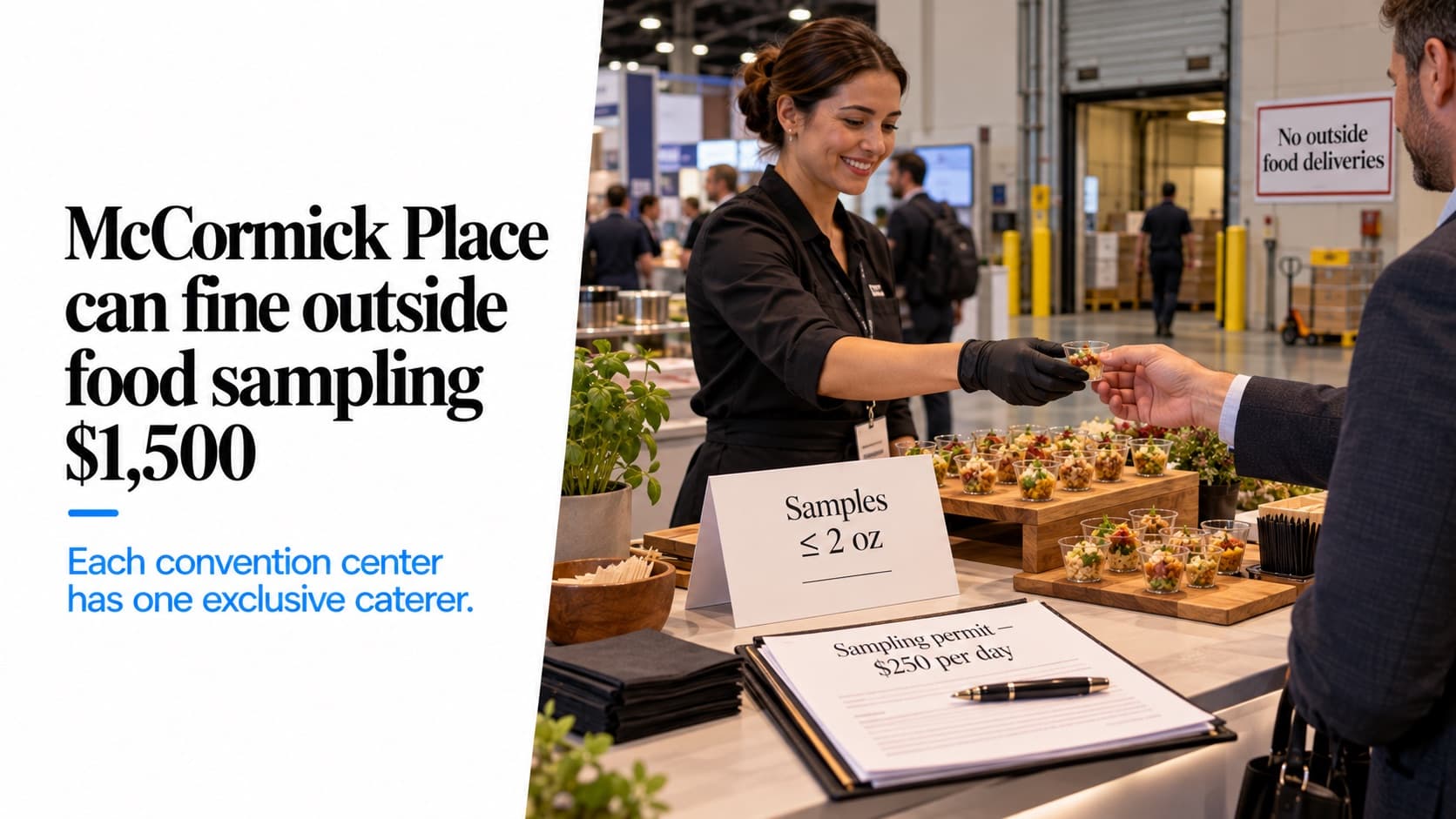
McCormick Place can fine outside food sampling $1,500
Food samples are capped at 2 oz at McCormick and Javits but 1 oz at Moscone, which bans alcohol sampling. Older city contracts paid 18–49% of receipts.

Every season a client asks me some version of this: we have a booth at the convention center, our favorite caterer does our office lunches, can they bring something in for the booth reception? The answer is almost always no, and the reason isn't food safety. It's the contract the building signed.
Here's how the exclusivity works, what exhibitors are allowed to do, and where an outside caterer fits — mostly outside the building.
One caterer per building
Every major convention center I checked has a single exclusive food and beverage provider:
- McCormick Place, Chicago: OVG Hospitality, under a contract running to 2028. "The Sampling & Selling of Food and/or Beverage products by any other entity is strictly prohibited."
- Javits Center, New York: Cultivated, the venue's own hospitality brand, run with Levy. "All food & beverage served or distributed is required to be purchased through CULTIVATED."
- Las Vegas Convention Center: Las Vegas Food & Beverage, operated by Sodexo Live!, which "retains the exclusive right to provide, control and retain all food and beverage services."
- Moscone Center, San Francisco: Legends Global holds "the exclusive food and beverage distribution rights."
- Orange County Convention Center, Orlando, and San Diego: Sodexo Live!. San Diego's exclusivity covers even private-label bottled water.
- Austin: ACC Catering by Levy.
Atlanta's Georgia World Congress Center adds a second layer: Coca-Cola holds exclusive pouring rights, so a permitted sample can still be blocked if it competes with the sponsor.
Why: the building gets a cut
The exclusivity exists because the public owner earns a share of every food and beverage dollar. Older public contracts show the range: 18% of gross receipts at one Virginia convention center, 30% on average at Las Vegas in a 2001 deal, and 45 to 49% of concession receipts at a New York civic center, though only 10% on its catering. Palm Springs signed a new deal in June 2026 projecting $17.3 million to the city over five years, with a $750,000 minimum annual payment above a revenue threshold.
An outside caterer's sale is money the building doesn't see. That's the whole reason the door is closed, and why negotiating it open rarely works.
What exhibitors can sample
Sampling is the main exception, and the limits differ by building. There is no national "2 ounce" rule:
| Venue | Food | Soft drinks | Beer | Wine | Spirits | Fee |
|---|---|---|---|---|---|---|
| McCormick Place | 2 oz | 4 oz, no cans or bottles | 2 oz | 1 oz | 0.5 oz | $250 a day per location |
| Javits | 2 oz | 4 oz | 2 oz | 2 oz | 0.25 oz | — |
| Las Vegas | 2 oz | 3 oz | With approval, house bartender | "Fees may apply" | ||
| Orlando | 2 oz | 2 oz | 0.5 oz, house bartender | 50% of retail for full-size items | ||
| Moscone | 1 oz | 2 oz | Prohibited by state law | Handling fees |
The fine print matters more than the table:
- Only your own product. McCormick limits samples to products manufactured, processed or distributed by the exhibitor. Anything else, including the coffee and popcorn used to draw traffic, has to be bought from the house caterer.
- A full-size bottle isn't a sample. McCormick bans cans and bottles; Orlando charges 50% of the caterer's retail price for them.
- Penalties are real. McCormick's form says outside products "may be subject to immediate stopping of all product sampling or sales and/or a $1,500.00 fine." Alcohol sampling there requires an OVG bartender at $375 for four hours. One Orlando show fines exhibitors $600 when sample lines spill into the aisle.
The paperwork
McCormick requires $1 million in liability insurance naming both the caterer and the building's public authority as additional insured. Moscone wants the sampling form at least four weeks before the show, a copy of the on-site person's food safety certification, and a city health permit. Las Vegas requires hand-washing and sanitizing stations for any open sampling and caps unhooded cooking surfaces at 288 square inches.
The dock is where outside caterers fail
Even before the food rules, an outside caterer has no way in. McCormick's personal consumption policy lets an exhibitor bring individual servings of food and drink for its own staff. But "deliveries by outside food and beverage companies are not allowed inside the facility, on the exhibit floor, or at back of house areas," and no exhibitor, contractor or organizer may "authorize any outside caterer or restaurateur to set up."
Labor rules close the rest. At McCormick, an exhibitor's own full-time employees can set up their booth with hand tools, but can't use pallet jacks or forklifts; union crews handle material in and out of the hall. Javits lets exhibitors set up booths of 250 square feet or less themselves. A caterer with a van of hotel pans doesn't fit either category.
Hotels work the same way
Hotels publish the same rule, often with a public health reason attached. One California inn says no food or beverage "may be brought on to premise by the group or any of the guests," charges $3.50 a person to cut an outside cake and $20 a bottle in corkage. A Georgia resort's guide lists fines up to $500 a day for unauthorized food in meeting space. The health code doesn't actually forbid guest-supplied food; the real drivers are liability and the hotel's food and beverage minimum.
Where an outside caterer fits
- Off-site, before or after the show. The client's reception at your restaurant or a venue you work with, a few blocks away. That's where most of my convention-week work comes from.
- The hotel suite, if the hotel allows it, which most don't.
- The client's office, for the pre-show team dinner.
Inside the building, the honest answer is to send the client to the house caterer, and quote them the reception outside. The meeting packages post covers how a restaurant competes with a venue's per-person price.
What I'm not going to give you
Current revenue splits for the largest buildings. McCormick's, Las Vegas's and Javits's terms weren't published in documents I could reach.
Food truck rules. No major convention center publishes one; the general outside-food ban covers them.
A universal sampling limit. Every building sets its own.
What to do
- Tell clients early that the building's caterer handles everything inside.
- Read the show's sampling form before promising a product demo.
- Get the insurance certificate with both names on it.
- Sell the off-site reception instead.
Disclosure: I work at Katalyst, which sells catering software, and I still pick up a handful of events a year. The convention-week business is real for an independent caterer. It just happens across the street.
Related Katalyst products
See how Katalyst handles your service style
A 30-minute walkthrough of the platform, tuned to how your restaurant actually runs.