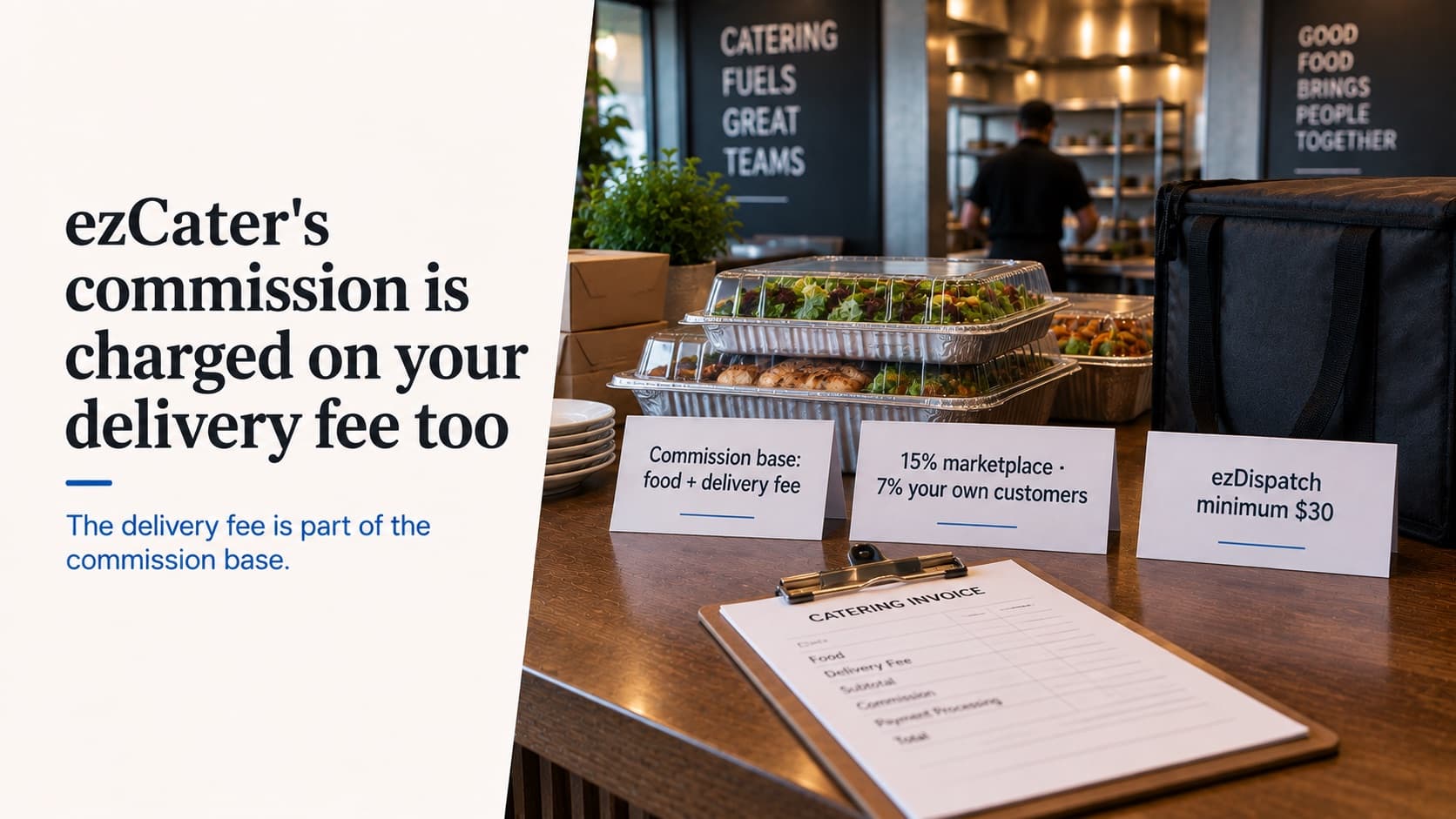
ezCater's commission is charged on your delivery fee too
Marketplace orders pay 15% plus 2.99%; customers you bring in pay 7%. On ezCater's $420 average order, that is roughly $83 versus $46 in fees.

Catering marketplaces are to office lunch what DoorDash is to Friday-night delivery. ezCater is the largest of them. It brings in customers you'd never reach on your own: the office manager in a building three miles away who needs forty boxed lunches on Thursday and has never heard of you.
The difference from delivery apps is the ticket size. ezCater's 2025 workplace report put the average order at $420, up 12% on the year before, feeding about 25 people. A percentage of $420 is real money, so the fee structure is worth reading more carefully than most operators do.
The two published rates
ezCater's partner help pages list two prices, and neither has a signup or monthly fee:
| Channel | Commission | Payment fee |
|---|---|---|
| Marketplace (customer found you on ezcater.com) | 15% | 2.99% |
| ezOrdering (ezCater checkout embedded on your own site) | 7% | 2.99% |
The commission doesn't apply to voluntary tips or tax. The payment fee doesn't apply to tips.
That sounds like the whole story, and on most guides it is. There are three details that change the arithmetic.
Detail one: the delivery fee is in the commission base
You set your own delivery fee on ezCater: flat, by distance, or a percentage. The customer pays it on top of the food. What's easy to miss is that the commission is calculated on what the customer pays, excluding tips, tax and fees ezCater itself adds. Your delivery fee stays in.
ezCater's partner agreement defines the commission base this way, and its own ezDispatch pricing sheet says it outright: "Delivery fees are subject to commission based on the order source (ie. Marketplace base 15%)." The agreement I could read in full is from 2020, and the dispatch sheet from 2021; the current partner pages weren't reachable. But nothing I found suggests the base has changed, and several current guides that say "15% of the food subtotal" appear to be wrong on this point.
Here's the average order worked through, with an assumed 7% sales tax and a $35 delivery fee:
| Marketplace | ezOrdering | |
|---|---|---|
| Food | $420.00 | $420.00 |
| Delivery fee | $35.00 | $35.00 |
| Commission base (food + delivery) | $455.00 | $455.00 |
| Commission | $68.25 | $31.85 |
| Payment fee (2.99%, tax included) | $14.48 | $14.48 |
| Total fees | $82.73 | $46.33 |
| As a share of the food | 19.7% | 11.0% |
If you run your own delivery van, you're paying ezCater 15% of what you charge to drive it.
Detail two: ezDispatch has a $30 minimum
If you don't deliver yourself, ezCater's courier service, ezDispatch, costs 10% of the food subtotal with a $30 minimum. The customer's delivery fee goes toward it, after commission, and you pay the difference.
ezCater's own example: a $200 order with a $25 delivery fee. The dispatch cost is $30, because 10% of $200 is below the minimum. The $25 fee nets $21.25 after the 15% commission. You pay the remaining $8.75. Raise the customer's delivery fee to $30 and your share falls to $4.50.
Two things follow. On orders under $300, ezDispatch costs a flat $30 whatever the distance, so a small order to the building next door is expensive to deliver. And the delivery fee you charge isn't a pass-through. Set it at or above the ezDispatch cost, or you're subsidizing the courier out of margin.
Detail three: the 7% rate has a structural handicap
The 7% ezOrdering rate is for customers you bring in yourself, through ezCater's checkout on your own website. It's less than half the marketplace rate, and it's the obvious place to move repeat corporate customers.
The problem is ezCater's customer rewards. Ordering on ezcater.com earns the person placing the order at least 1 and up to 5 points per dollar on food, redeemable as Amazon gift cards or order discounts. Orders through ezOrdering on a restaurant's site don't earn points.
Think about who's ordering. The office manager placing a $420 order earns at least 420 points personally, every week, on the marketplace. Ask them to use your link instead and you're asking them to give that up to save you 8 points of commission. Most won't, and you shouldn't build a plan that assumes they will. The multiplier above 1x comes from restaurants offering bonus points, which by most accounts they fund themselves.
What else is in the agreement
The 2020 partner agreement is the most recent full text I could read. Treat the following as what the contract said then, and ask for current wording before you sign:
- Price parity. Restaurants agreed to "match the lowest prices and fees you offer customers for that location, whether that be in-store, over the phone or through any other website." Unlike delivery apps, where marking up app prices is common, ezCater expected the same price everywhere. Its current help pages say prices must match your own website.
- Customer contact. You received contact details for customers you brought in yourself and could market to them. For customers the marketplace found, no such right was stated.
- Cancellations. ezCater's help center says a 25% fee generally applies to orders cancelled within 24 hours of delivery or pickup, and restaurants may set their own terms.
The other marketplaces
Fooda publishes provider terms. The commission itself is set in a private addendum, but the processing fees are public: 3.5% + $0.15 on mobile and online orders, 1.95% + $0.25 on delivery and catering. There is also a clause worth reading twice: after termination, a restaurant may not do business with a Fooda customer for 18 months. If a corporate account you met through Fooda wants to order from you directly, the contract says no.
CaterCow says "a percentage is deducted from each payout" and doesn't publish the number. Rates reported by third parties vary and I couldn't confirm any of them.
What I'm not going to give you
Current ezCater contract terms. The partner help center that holds the current wording wasn't reachable. The 2020 agreement and 2021 dispatch sheet are the latest primary documents I could read. Rates may have changed; the structure probably hasn't.
Payout timing. The 2020 contract says twice monthly. Current third-party guides say weekly. I can't resolve that from outside.
Whether ezCater is worth it. For a restaurant with no corporate catering business, a marketplace that sends $420 orders is often the best customer acquisition cost available. For one with an established book of office clients, running those clients through the marketplace means paying 15% to talk to your own customers.
What to do
- Price the delivery fee knowing it's commissioned. If delivery costs you $30, a $30 fee on the marketplace nets $25.50.
- Set the fee at or above the ezDispatch cost if ezCater delivers. Under $300, that's $30.
- Use the marketplace for first orders, then move the account to a direct relationship. Corporate catering accounts run on net-30 invoicing, and that's the relationship to build.
- Don't count on ezOrdering to win back marketplace customers. The rewards points work against it. Direct invoicing with your own terms is a stronger offer than a cheaper checkout.
- Read the non-solicit clause on any catering marketplace before you sign. Fooda's runs 18 months after you leave.
- Build the fees into the price. Catering margins are thinner than they look once packaging, labor and delivery are in; the catering pricing post has the full cost stack.
Disclosure: I work at Katalyst, which sells catering management with direct ordering, invoicing and deposits, so I benefit if restaurants move catering clients off marketplaces. The first order is often best won on ezCater. What I'd push back on is paying 15% on the tenth order from a customer who already knows your name.
Related Katalyst products
Topics
See how Katalyst handles your service style
A 30-minute walkthrough of the platform, tuned to how your restaurant actually runs.