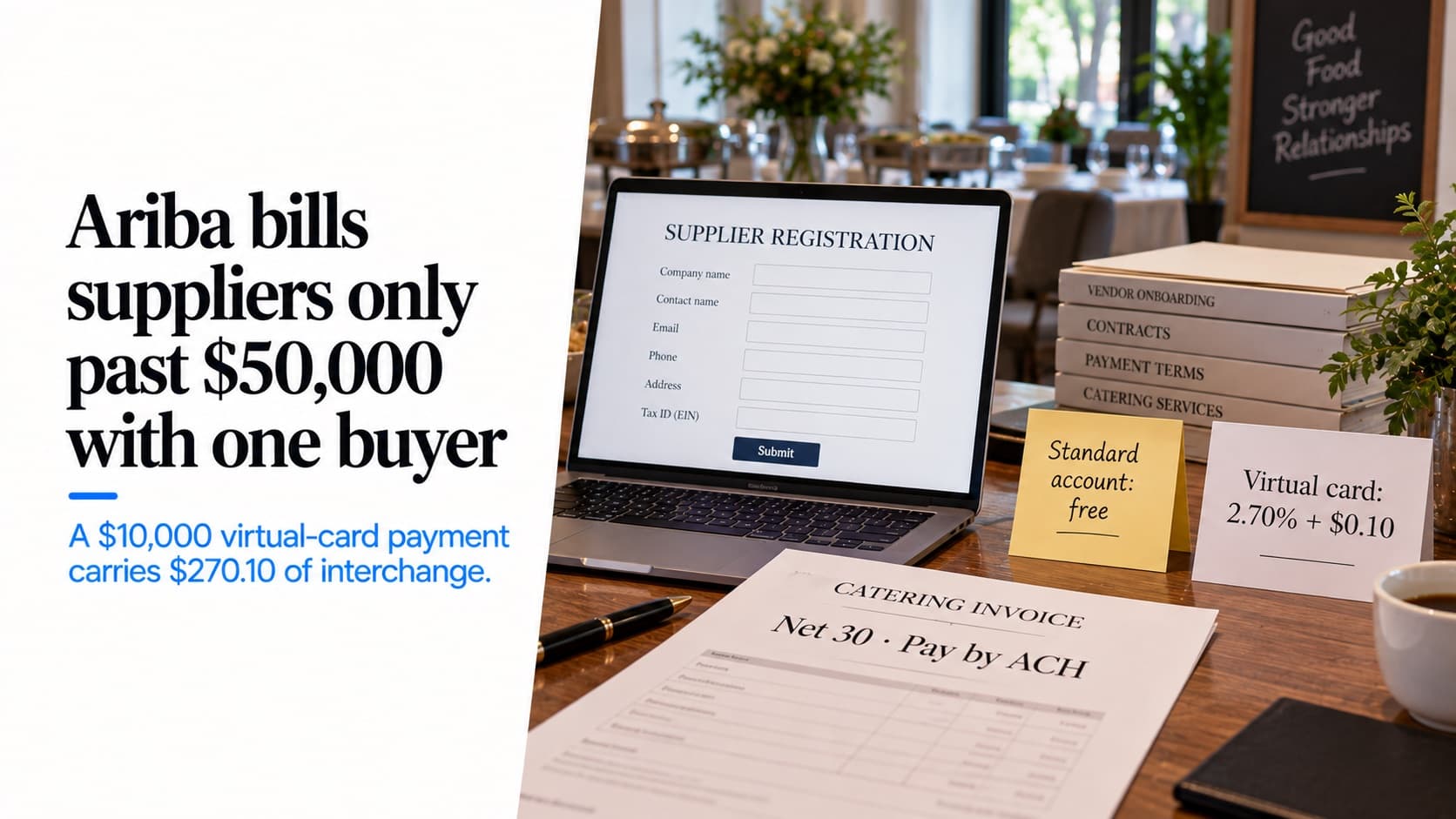
Ariba bills suppliers only past $50,000 with one buyer
A $10,000 catering invoice paid by virtual card carries $270 of interchange. Restaurants hold a median 16 days of cash; large companies pay in about 59.

The best corporate account I ever landed took four months to close and two more to get paid. The sales part was a tasting and a proposal. The rest was a supplier onboarding form, a portal registration, an insurance certificate, and then sixty days of waiting for the first invoice to clear.
Getting onto a company's approved vendor list is worth it. Recurring lunches, the holiday party, the board dinner. But it changes how you get paid, and three of the costs it brings never show up in the sales conversation.
The paperwork is mostly routine
Every buyer will want a W-9; the current form is the March 2024 revision. One change helps: the threshold for issuing Form 1099 rose from $600 to $2,000 for payments after 2025, and payments to corporations are generally exempt. The W-9 still matters even if you're incorporated, because buyers use it to match your tax ID and avoid backup withholding.
Expect a certificate of insurance too. The amounts vary by buyer and I couldn't find a published university or corporate standard to quote, though venue requirements of $1 million per occurrence and $2 million aggregate are common, as the venue lists post showed. Add the buyer as additional insured when asked; it's a certificate request, not a new policy.
Supplier portals: who pays
Most large buyers will ask you to register on a procurement network. The two you'll meet most are SAP's Business Network (still widely called Ariba) and Coupa.
Coupa's supplier portal is free. SAP's has two kinds of account:
- A standard account is free.
- An enterprise account becomes chargeable only if, with any one buyer over 12 months, you exceed $50,000 and five documents. Then SAP's fee schedule charges 0.155% of the volume, capped at $20,000 a year per buyer, plus a subscription from $50 to $5,500 a year by document count.
The catch for caterers is the higher rate. If the buyer uses "service entry sheets" — common for services — the fee is 0.35%, more than double. Catering is a service.
Three ways out:
- Ask whether a standard account is enough. Many buyers accept it.
- Ask whether the buyer pays. Some do; Intel says it pays the enterprise fees for its own suppliers.
- US suppliers may be exempt when selling to public-sector buyers or nonprofits, or when certified as small disadvantaged, woman-owned, minority-owned or veteran-owned. If you qualify, the certification has a dollar value here.
Net 60 against a 16-day cushion
Large US companies took about 59 days to pay their suppliers in 2025, by one consultancy's count of the top 1,000 public companies. Another survey of a broader set put it at 42. Either way it's longer than the net 30 on your invoice.
Now the other side. A JPMorgan Chase Institute study of 597,000 small businesses found the median one held 27 days of cash. Restaurants held the fewest: 16 days. It's older data, from 2015, but the gap it shows hasn't closed. On net 60, a restaurant caterer is financing almost four times its typical cash cushion for a client with a treasury department. The cash flow post is about exactly this gap.
What I'd ask for on a new corporate account:
- A deposit on events, even with a purchase order. Event deposits are normal; most procurement teams will process one if you ask before the PO is cut.
- Net 30 for recurring orders, and the AP contact's name, not just the portal.
- ACH as the payment method, stated on the vendor form.
Early payment programs are expensive money
Some buyers offer to pay faster in exchange for a discount. A classic "2/10 net 30" — 2% off if paid in 10 days — works out to about 37% a year for the money you're getting 20 days early. "1/10 net 30" is about 18%. Dynamic discounting platforms let you name your own rate. Sometimes that's still worth it. Do the arithmetic first.
The virtual card is a fee you didn't price
More and more accounts payable departments pay by single-use virtual card. It's fast, which is good. It's also a commercial credit card taken without the card present, which on Visa's schedule costs 2.70% + $0.10 in interchange alone. On a $10,000 holiday party, that's $270.10 before your processor's markup.
Lucas's post on catering invoice payment costs goes through the alternatives, including the Level 3 data that brings the rate down. The short version for a vendor form: list ACH first.
Selling to the federal government
Federal agencies are bound by the Prompt Payment Act: pay within 30 days of a proper invoice, with a goal of 15 days for small businesses. An improper invoice must be sent back within seven days with every defect listed. Late interest is paid automatically, at 4.75% a year for the second half of 2026.
The interest is too small to change anyone's behavior: on a $20,000 invoice paid 30 days late, it's $79.17. What speeds payment is a clean invoice the first time.
One more federal detail: agency purchase cards can buy up to $15,000 without a contract, but only $2,500 for services covered by the Service Contract Act, which lists food service. That's likely why federal clients split catering orders or route them through a formal contract. The per diem post covers what they're allowed to spend per person.
Some states have their own prompt payment rules. Virginia's agencies pay within 30 days, with interest starting seven days after the due date; New York's within 30 calendar days.
What I'm not going to give you
A standard insurance requirement for universities. I couldn't retrieve a published caterer policy to quote.
A late-payment rate for small suppliers. The figures in circulation trace back to accounting software vendors.
Where supplier diversity programs stand now. Federal and corporate policy has shifted since 2025; check the specific buyer.
What to do
- Register on the portal as a standard account unless the buyer requires otherwise.
- Ask about service entry sheets before you accept a PO structure.
- Put ACH first on the vendor form, and price virtual cards in if you accept them.
- Ask for an event deposit before the purchase order is issued.
- Model the cash gap: your first invoice may arrive two months after your food cost.
- Send clean invoices, with the PO number on every one.
Disclosure: I work at Katalyst, which sells catering software that issues invoices and tracks payments. A good invoice helps. The bigger decision is which accounts are worth carrying for sixty days, and no software makes that one.
Related Katalyst products
See how Katalyst handles your service style
A 30-minute walkthrough of the platform, tuned to how your restaurant actually runs.