Visa says a deposit receipt must use the word 'Deposit'
A client can dispute a cancelled event deposit for 120 days after the event date, capped at 540 days. ACH has no dispute right for cancelled services.

The client cancels six weeks out. Your contract says the deposit is non-refundable at that point, so you keep it. Three weeks later your processor tells you the client has disputed the charge with their bank, and the money is gone until you prove you're entitled to it.
Whether you win was mostly decided the day you took the deposit. Visa's rules are specific about what a merchant has to do before and when it charges a deposit, and most catering paperwork doesn't do it. All of what follows is from the Visa rulebook, October 2026 edition, unless I say otherwise.
What Visa requires before you charge
A merchant that limits cancellations "must clearly disclose" its cancellation and refund policies, and how depends on how you take the card:
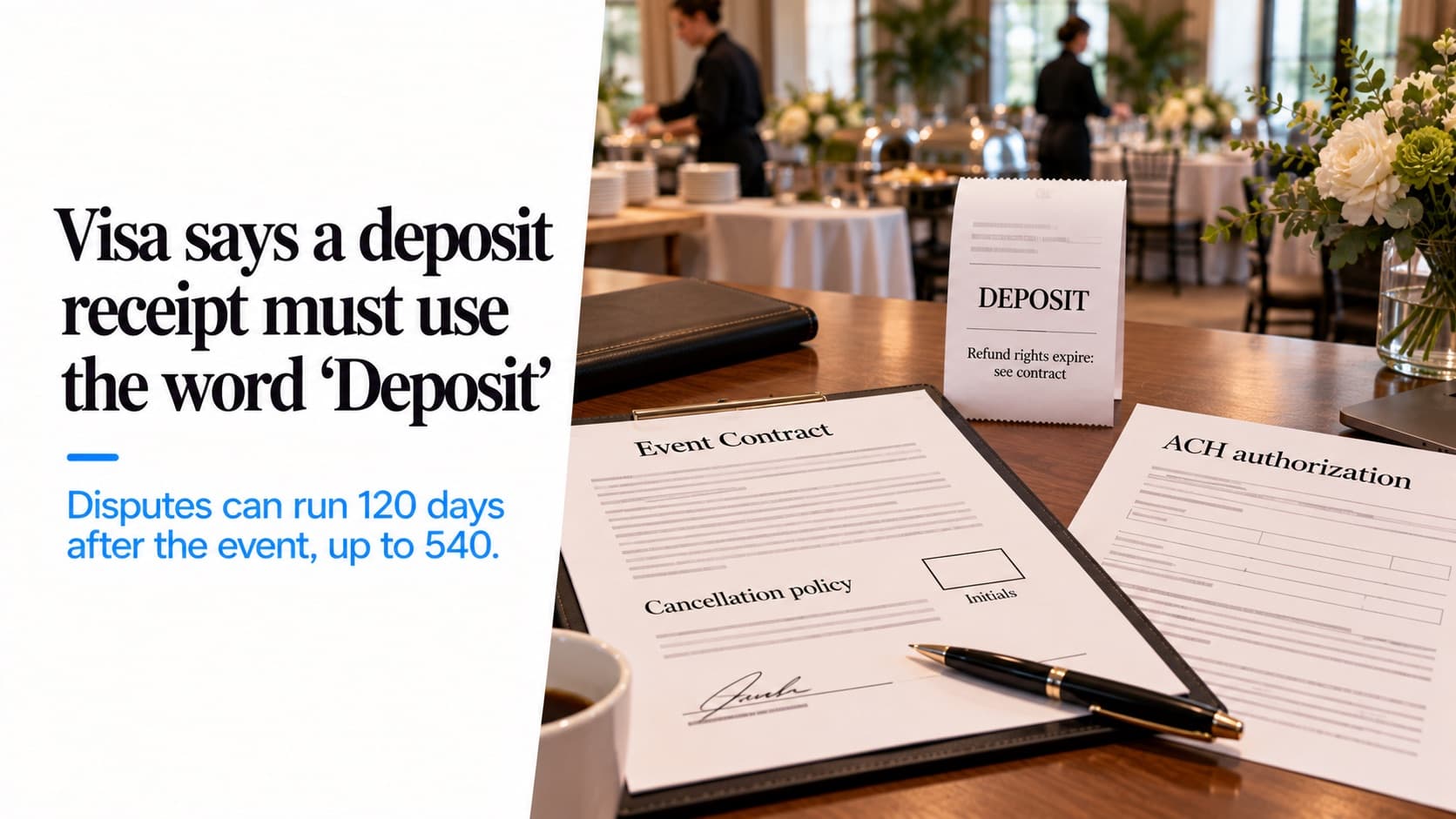
- In person: before the transaction or on the front of the receipt. If the policy is "in a separate contract, it must be accompanied by a space for the Cardholder to indicate acceptance" — an initial line next to the cancellation clause itself.
- Online: before checkout, with "a 'click to accept' button, checkbox, or other acknowledgement." A link in the footer doesn't count.
- By phone or invoice: by email, mail or text.
And one rule many contracts break: "A Merchant must not require a Cardholder to waive the right to dispute a Transaction." A clause saying the client agrees not to charge back is itself non-compliant.
The receipt has to say "Deposit"
To Visa, an event deposit is an "advance payment." Before taking one, you need the client's agreement to terms that include "the date that any cancellation privileges expire." And the receipt for a partial payment must include the full cancellation policy, the date refund rights expire, and the word "Deposit," "Advance Payment" or "Partial Payment." The final payment's receipt says "Balance."
A generic card receipt reading "Catering — $5,000" doesn't meet that. That's often the whole reason a caterer loses.
How long the client has
The dispute for cancelled services gives the issuer 120 days from the date the service was expected, capped at 540 days from the charge. The issuer has to wait 15 days after the cancellation first, and the client is supposed to try to resolve it with you before disputing.
In practice: a deposit charged nine months before an event can be disputed until about four months after the event date. Keep the contract, the receipt and the cancellation emails at least that long. The record retention post covers the rest of what to keep.
If you're the one who cancels or can't perform, a different dispute applies — services not received — on the same 120- and 540-day clock.
How you win
For a cancelled-service dispute, the client has a right to it only if you "did not properly disclose or did disclose, but did not apply" a limited cancellation policy. So your evidence is exactly two things:
- Proof you disclosed the policy properly at the time of the charge.
- Proof the client didn't cancel according to it.
Even then, the dispute is capped at "the value of the unused portion of the cancelled service." Starting in October 2027, issuers also have to certify when and how the cardholder tried to resolve it with you first.
Card on file for late cancellations doesn't work
Hotels and rental companies can hold a card and charge a no-show fee. That framework, Visa's "guaranteed reservation," is limited to lodging and rental businesses. A caterer that keeps a card on file and charges it after a late cancellation is making a charge Visa doesn't recognize, and it will look like a disputed or unauthorized one. Charge each milestone as its own disclosed deposit instead.
ACH works differently
ACH has no dispute right over goods or services. Nacha's rules are explicit that its return codes for unauthorized debits don't cover "disputes about goods and services." A client who properly authorized an ACH deposit and then cancels has a contract claim against you, not a reversal.
What they can still claim is that the debit was unauthorized: within two banking days for a business account, and 60 days for a personal one. Keep the signed authorization. For large deposits from corporate clients, ACH is the more stable rail as well as the cheaper one, as the invoice payments post shows.
"Non-refundable" isn't always enforceable
Card rules aside, state law decides whether you can keep a deposit at all. California's statute treats clients differently. Against a business, a deposit clause is valid unless the business proves it was unreasonable. Against a person booking for "personal, family, or household purposes" — a wedding, a birthday — it's void unless actual damages would have been impracticable to fix.
The same 50% non-refundable deposit can hold against a company's holiday party and fail against a family's wedding. For private clients, tie the forfeiture schedule to costs you can document: staff you committed, food you ordered, the date you turned away.
Fighting is worse than preventing
A chargeback-services company's 2026 survey of merchants found a 44.6% win rate on disputes they contested, but only 10.7% net recovery across all cases once second rounds were counted. It's a vendor's self-reported survey, but the direction is right: the paperwork you do before charging is worth more than the response you write after.
What I'm not going to give you
Mastercard's exact rule text. I couldn't open its guide; secondary sources describe the same 120- and 540-day windows.
A friendly-fraud percentage. Estimates run from about 20% to over 80% depending on who counts.
A single industry win rate. Sources range from 8% to 45%.
What to do
- Put an initial line next to your cancellation clause.
- Date the forfeiture tiers — exactly when each part of the deposit stops being refundable.
- Make every deposit receipt say "Deposit" and restate the policy.
- Use a click-to-accept box for online payment links.
- Take large deposits by ACH, with a signed authorization.
- Don't charge a card on file for a late cancellation.
- Document your costs for private clients.
- Keep the file until 120 days after the event.
For weather cancellations specifically, see the force majeure post. For disputes in general, see restaurant chargebacks.
Disclosure: I work at Katalyst, which sells catering software that takes deposits and prints receipts. Check that yours says "Deposit," whichever system printed it.
Related Katalyst products
See how Katalyst handles your service style
A 30-minute walkthrough of the platform, tuned to how your restaurant actually runs.