Toast's $0 plan costs more past $11,500 a month in card sales
Toast's Starter Kit hardware is owned, not leased; the 36-month-lease claim is stale. What Square, Clover and Katalyst charge the same new restaurant instead.

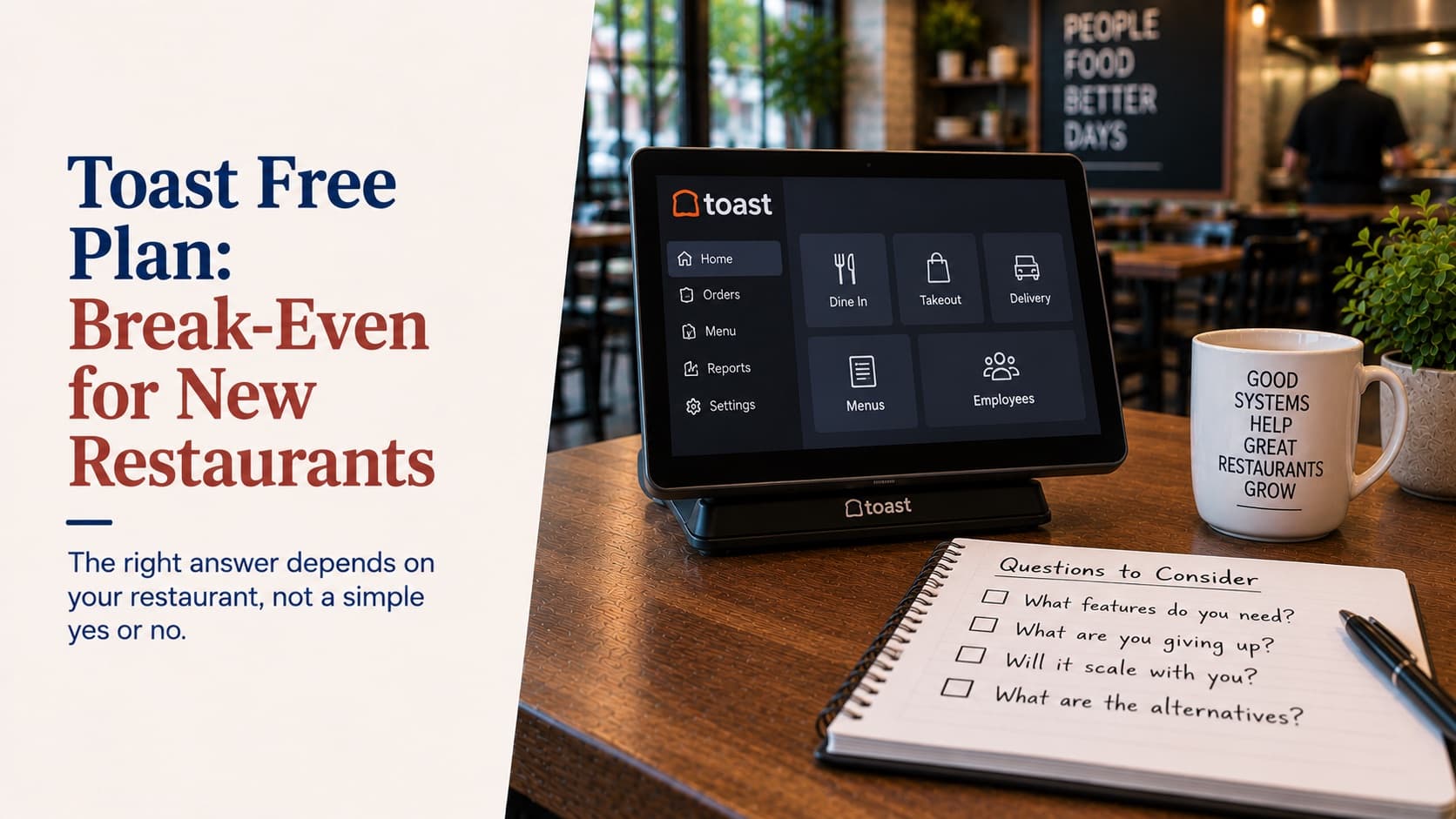
The search that brings people here is some version of "cheapest Toast alternative for a new restaurant." I want to answer it properly, and the honest first answer is awkward: for a lot of new restaurants, the cheapest alternative to the Toast plan they're looking at is the other Toast plan. Nobody in the top ten results does that arithmetic, so let's do it, then get to the actual competitors.
The two prices Toast publishes
Toast's pricing page lists three plans and a payroll bundle, but the processing rate — the number that decides your bill — isn't on it. It's on the Starter Kit shop page, and it reads like this as of September 2026:
- Pay-as-you-Go. "A 3.09% card processing fee covers all costs, except for shipping and taxes." No monthly fee for the basic POS software, no upfront charge for the basic hardware.
- Traditional. "This option includes a 2.49% card processing fee." You buy the hardware up front and pay the monthly software fee, which the pricing page puts at $69 for the Point of Sale plan.
Three conditions sit in the footnotes: the $0 pricing applies to new customers and single locations only, the kit is one location with up to two terminals, and the price includes the first terminal — "additional charges apply for subsequent devices."
Where "free" stops being free
The difference between the two rates is 0.60 points. The difference in fixed cost is $69 a month. Divide one by the other and you get the volume at which the two plans cost the same:
$69 ÷ 0.006 = $11,500 a month in card sales.
Below that, Pay-as-you-Go is cheaper. Above it, you're paying more each month for the privilege of not having paid for a terminal. Here's what that looks like at real volumes, software and processing only:
| Card sales / month | Pay-as-you-Go (3.09%) | Traditional (2.49% + $69) | Difference |
|---|---|---|---|
| $8,000 | $247 | $268 | Pay-as-you-Go saves $21 |
| $11,500 | $355 | $355 | Break-even |
| $20,000 | $618 | $567 | Pay-as-you-Go costs $51 more |
| $40,000 | $1,236 | $1,065 | $171 more, about $2,050 a year |
| $80,000 | $2,472 | $2,061 | $411 more, about $4,900 a year |
Two things are missing from that table on purpose. The per-transaction cents that third-party guides attach to both plans cancel out, so they don't move the comparison. And the hardware you'd buy up front on Traditional isn't there because Toast doesn't publish the price — you get it in the quote. Once you have it, the payback is one division: terminal cost divided by the monthly gap in the right-hand column. At $40,000 a month, a $2,000 terminal pays for itself in about a year, and every month after that the "free" plan is the expensive one.
For a new restaurant the practical question is which side of $11,500 you'll land on by month three. If you're pricing a menu with no sales history, you already have a covers-times-check estimate. Multiply by the share of guests who pay by card — for most concepts now, most of them — and you have your number.
The lease claim, corrected
I wrote in June, in the vendor-by-vendor pricing post, that Toast leases hardware on 36-month financing. That's the claim you'll find repeated across most Toast pricing guides, and it's the reason "contract length" shows up in so many alternative searches.
Toast's own shop page now says the opposite about the Starter Kit:
The hardware you purchase is yours to keep regardless of your payment plan. The Toast Starter Kit is not leased or rented and is owned by the purchaser.
And for Pay-as-you-Go specifically: "it's not a lease; you own the hardware from day one."
The lease that does exist is a different product. Toast Easy Pay is a 180-day lease in which Toast withholds 0.75% of your daily card sales (1.75% before you go live) against the hardware and implementation balance, collects any remainder by ACH at the end, and gives you the option to buy the equipment. Six months, not thirty-six.
What I can't tell you from Toast's published pages is the service term attached to Pay-as-you-Go. Third-party guides describe a two-year agreement; Toast's page doesn't state one either way. Larger Build-Your-Own deals are explicitly custom. So the question to put in writing before you sign isn't "is there a lease" — for the Starter Kit there isn't — it's "what is the term, and what do I owe if I leave early." The rest of what to read for is in the contract red-flags post.
What the cheaper competitors charge the same restaurant
Now the comparison the search actually wants, held to the same entry tier and the same volumes.
Square for Restaurants, Free plan. $0 a month, 2.6% + 15¢ in person per Square's published fee schedule. At $11,500 that's $299 in processing against Toast Pay-as-you-Go's $355; at $40,000 it's $1,040 against $1,236 — and $25 under Toast's Traditional plan too. On rate alone, Square's free tier beats both Toast plans at every volume in the table. The reason to pay Toast anyway is depth: table management, kitchen display, and the restaurant-specific workflows that Square reaches for with add-ons. Whether that's worth $200 a month at $40,000 in card sales is a real question, not a rhetorical one. The Plus and Premium plans cut the rate to 2.5% and 2.4% for a monthly fee.
Clover. No published rate, because Clover doesn't set it — the processor or bank that sold you the terminal does. That makes Clover cheaper or dearer than Toast depending entirely on the reseller, and it carries a cost nobody quotes up front: Clover terminals can't be repointed at another processor, so shopping for a better rate later means buying hardware again. Get the rate and the ownership terms in the same document.
Katalyst. Processing is interchange-plus rather than a flat bundled rate, which is a structural rather than a headline difference — the bundled-versus-interchange-plus post explains why the flat number on a rate sheet isn't the number you pay. I'm not going to put a Katalyst figure in a table I built from competitors' public pages, because ours comes from a rate analysis on your actual card mix, and a number I picked to look good next to 3.09% would be exactly the move this post is criticising. Contracts are annual or month-to-month. If you want the comparison done on your statements, that's what the rate analysis is for.
For everything above the entry tier — where Toast's add-on modules and the competitors' equivalents start to matter more than the rate — the Toast alternatives comparison puts five systems side by side on contract, feature billing, processing and catering.
Where the entry price stops mattering
The $11,500 calculation is a first-month calculation. By month six, a full-service restaurant on Toast has usually added online ordering, loyalty, and something from the marketing suite, and each is a separate module with its own fee. I priced that stack line by line in June and won't repeat it here; the short version is that the add-ons routinely exceed the base subscription, and they're the same on either Toast plan. The processing-rate choice above saves or costs you a few hundred dollars a month. The module choices decide whether your software bill is $69 or $400.
What I'm not going to give you
A total cost of ownership figure. Every one I could build would rest on a hardware price Toast doesn't publish and a service term it doesn't state. A number built on two unknowns is a guess wearing a decimal point.
Toast's per-transaction cents. Third-party guides say 15¢ on both plans. Toast's shop page says only the percentages. I've used what Toast says.
A Katalyst rate. See above. Ask for the analysis; that's the honest version of the number.
What to do
- Estimate your month-three card volume from your covers-and-check projection, and put it against $11,500. That decides which Toast plan is the cheaper Toast plan.
- Get the Traditional hardware price in writing and divide it by the monthly gap at your volume. That's the payback period, and it's usually shorter than a new operator expects.
- Ask for the service term and the early-exit terms on whichever plan you take. The Starter Kit hardware is yours; the agreement may not be.
- Run Square's free tier against both Toast plans at the same volume before deciding restaurant depth is worth the difference. It often is. Decide it with the number in front of you.
Disclosure: I work at Katalyst, and we sell a competing POS with interchange-plus processing, so I benefit if you conclude Toast is expensive. Note that the central finding here is that Toast's paid plan is cheaper than Toast's free plan for most restaurants past a modest volume — an argument for a competitor to make only if they'd rather you knew the arithmetic than didn't.
Related Katalyst products
Topics
See how Katalyst handles your service style
A 30-minute walkthrough of the platform, tuned to how your restaurant actually runs.