Toast's partner API fees aren't published anywhere
Clover's marketplace keeps 30% of app revenue, so the tool you want is priced to net 70%. Ask which integrations exist today, not whether there's an API.

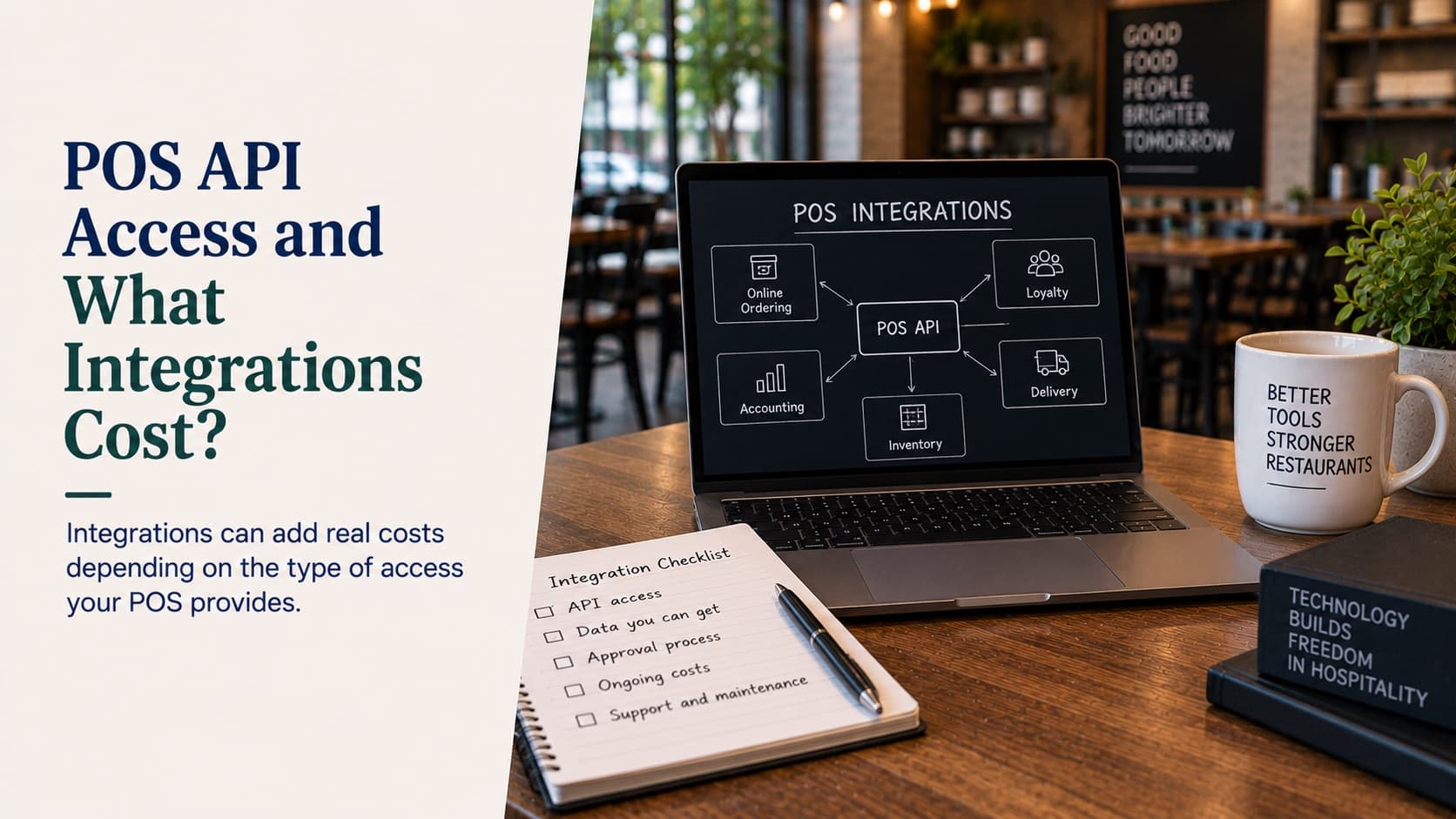
"Does it have an open API?" is the integration question every POS buying guide tells you to ask, and every vendor answers yes.
It's the wrong question, and answering it tells you almost nothing. What determines whether you can connect the scheduling tool, the accounting package or the inventory system you actually want is not whether an API exists. It's what the platform charges to be on it, and who it lets on.
The toll is the story
Two of the largest platforms run marketplaces, and both take a substantial cut of what third-party software charges you.
Clover publishes its terms in developer documentation: a developer receives 70% of what Clover collects from the merchant for an installed app, and Clover keeps a 30% transaction fee on the net revenue of each install. API access itself is free; distribution requires signing the App Market agreement.
Toast does not publish equivalent terms. Access to the Toast Partner API runs through an eight-stage partner process ending in certification, with fees that aren't public — reporting from 2019 indicated a 30% revenue share, which I'd treat as directionally useful and badly out of date rather than current. The documented technical constraint is a rate limit of 20 requests per second.
Note what the Toast entry actually says. Not "the fee is high." The fee is not published. You cannot find out, as a prospective customer, what it costs a vendor to integrate with the system you're about to buy — which means you cannot assess how likely your preferred tools are to be there in two years.
For balance: Toast states that Partner Connect integrations can be added without an additional Toast fee, and major delivery integrations — DoorDash, Grubhub, Uber Eats — are free to connect. So the toll isn't uniform, and the highest-volume integrations are the ones least likely to carry it.
What a 30% marketplace take does to your bill
This part is inference rather than a documented fact, so treat it as reasoning — but the arithmetic is hard to escape.
If a software vendor has to hand 30% of subscription revenue to the platform, they have three options: price 43% higher on that platform to net the same amount, accept a materially worse margin, or not be on the platform at all.
In practice you see all three. The consequences for an operator are the ones you actually experience:
- The tool you want isn't available on your POS.
- It's available but costs more than the same tool bought directly.
- It's available but thinner — a reduced integration rather than the full product, because the economics didn't support building the whole thing.
None of that shows up in a feature checklist. All of it shows up in year two.
The four questions that actually predict this
Replace "do you have an API?" with these:
1. Which specific tools do you integrate with today — by name? Not "we integrate with accounting systems." Which one, and at what depth. Ask for a customer using that exact combination.
2. What does it cost a partner to integrate with you? If the answer is "that's between us and them," you've learned something. If the answer is a number, write it down.
3. Is the integration built by you, by them, or by a middleware vendor? Three-party integrations break differently and support disputes take longer, because each party can point at another.
4. What are the API rate limits, and what data is not exposed? Rate limits are published sometimes — Toast's 20 requests per second is documented — but the more consequential answer is usually what the API doesn't expose. Modifier-level detail, void and comp reason codes, labour data by job code, and historical data beyond a retention window are all common gaps, and each one silently caps what a downstream tool can do.
That last one connects to something concrete I've written about: the nightly journal entry from POS to accounting breaks in specific, balanced, invisible ways. Several of those failures are integration-depth problems rather than accounting problems — an unmapped tender type has to be exposed by the API before anything downstream can map it.
Why platforms behave this way
Worth understanding, because it makes the behaviour predictable rather than arbitrary.
A marketplace take rate isn't greed; it's the business model of a platform. And it's consistent with what the ownership structures predict: when a POS is owned by a payments company or a growth fund, revenue per merchant is the metric, and marketplace revenue is a lever on it that doesn't require raising your subscription price.
It also explains an asymmetry worth naming. Platforms have every reason to integrate deeply with things that increase transaction volume — delivery, online ordering, loyalty — and much less reason to invest in integrations that help you leave or compare, like data export or independent analytics. Look at where the integrations are rich and where they're thin, and you can read the incentive off the product.
What I'm not going to claim
That Toast's fees are high. I don't know. That's the point — they aren't published, and the one figure I found is seven years old.
That an open API is automatically better. A platform with strict certification produces integrations that break less often. Gatekeeping is a real quality mechanism, not only a toll. The trade-off is genuine.
A complete comparison. I could source marketplace economics for Clover and partial information for Toast. For Lightspeed, SpotOn, TouchBistro, Revel, Micros, Brink, HungerRush and Lavu I could not find published integration economics I'd repeat with their names attached. That's a gap in what's public, and it's worth noticing that the gap is the norm.
And ask us question 2. Katalyst sells a bundled feature set rather than a per-app marketplace, which is a different model with its own trade-off — fewer third-party options, no marketplace toll. Whether that suits you depends on whether the tools you want are in the bundle, which is exactly question 1, and you should make us answer it by name like anyone else.
The practical version
Before you sign, list the five tools you actually intend to run alongside the POS. Get written confirmation that each one integrates today, at what depth, built by whom, and at what added cost. A vendor that can name a customer running your exact stack has answered the question. One that says "we have an open API" has not.
Related Katalyst products
Topics
See how Katalyst handles your service style
A 30-minute walkthrough of the platform, tuned to how your restaurant actually runs.