Clover terminals can't be repointed at another processor
Switching means buying hardware again while the old lease runs. The termination fee is the small part — reported ranges disagree by a factor of five anyway.

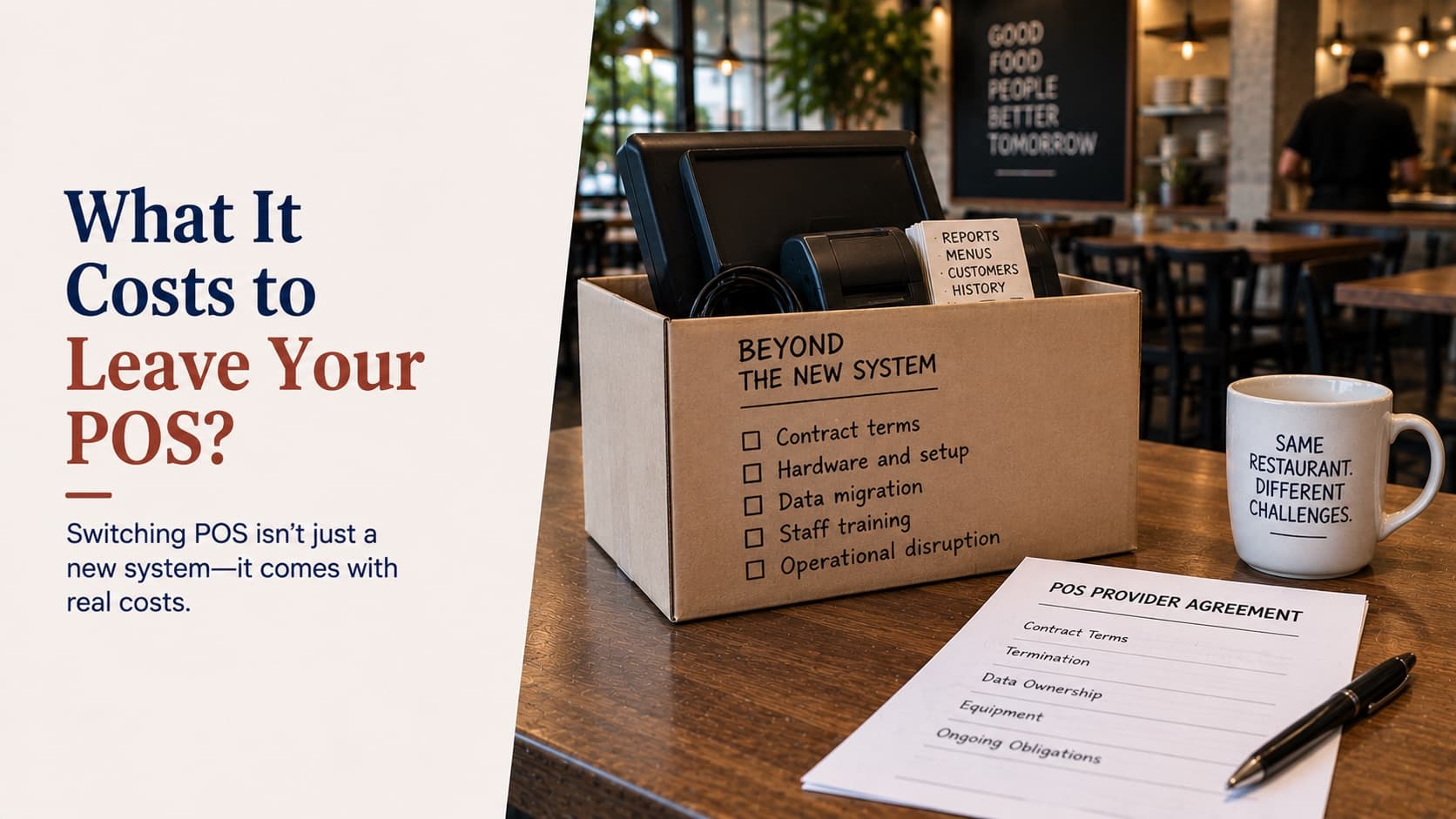
I've written about the contract terms to check before signing and how to move systems without losing data. This post is about a narrower question that neither one answers directly: when you actually leave, what do you write a cheque for?
The answer surprises people, because the line everyone worries about — the early termination fee — is usually not the biggest one.
The termination fee is the part you can find out
Every vendor has one, and the published ranges are all over the place. For Toast, reported figures include $500 to $1,500 per terminal in one source and "remaining software fees plus processing commitments" in another. For Clover through resellers, reported early termination fees run around $295 to $595, with three-year terms and automatic renewal common — and at least one source describes a standard first-term Clover contract as 48 months and not cancelable.
Those are not small discrepancies. They're different by a factor of five, and by structure — a flat fee per terminal and "all remaining fees" are not the same instrument at all.
I'm not going to resolve them, because they aren't resolvable from outside. Termination terms are set in your merchant agreement, they vary by reseller, by term, by whether hardware was leased or bought, and by what you negotiated. The number in your contract is the only number. Everything published is a range describing somebody else's deal.
What's worth taking from the spread: if independent sources reporting on the same vendor disagree this much, the terms are being varied deal by deal — which means they are negotiable, which means you should negotiate them going in rather than discovering them going out.
The hardware is the expensive part, and here's why
This is the mechanism nobody explains, and it explains the whole exit cost.
A payment terminal isn't a generic computer that talks to whichever processor you configure. Card data is encrypted the instant it's read, inside the device, using a key derived from a master key that was injected into the device at a certified key injection facility. The matching decryption keys live at the processor.
That architecture is good security — it's the basis of point-to-point encryption, and it's why a compromised network between your terminal and your processor doesn't expose card data.
It also means a terminal is not neutral hardware. It is bound to a processor by cryptographic material, and re-pointing it at a different one is a controlled re-injection process rather than a settings change.
Now the commercially important part: that process is possible in principle, and vendors who own the hardware platform simply don't offer it. Clover hardware is locked to Fiserv's processing network, and a Clover device cannot be reprogrammed to work with another processor.
So the lock isn't a law of physics. It's a business decision, implemented through key management. That distinction matters, because it tells you the answer to "can this be worked around" is no — not because it's technically impossible, but because the party who could authorise it is the party you're leaving.
Which produces the double payment
Put the pieces together for a merchant leaving Clover mid-term:
- You cannot take the terminals to the new processor.
- You buy new hardware.
- If the old hardware was leased, you keep paying the lease on equipment you no longer use, for the remainder of its term.
- The old hardware has minimal resale value, because the pool of buyers is limited to merchants on the same processing network.
That's the real exit cost: new hardware plus a dead lease, and neither line appears in a "what's the termination fee" conversation.
The lease-versus-purchase choice at signing is what determines how bad step 3 gets, which is why it sits on the contract red flags list. Buying hardware outright costs more on day one and caps your exposure on the last day. For a first restaurant with no capital, leasing is often the only option — just price the exit into the decision rather than treating it as a monthly-payment question.
What actually survives the move
Data does, if you extract it before you give notice. Menu structure, customer records, sales history, gift card and loyalty balances — the sequence and the traps are in the switching post, and the single most important item there is that you should pull everything before you cancel, not after.
Gift card and loyalty balances deserve a specific mention here because they're a liability, not a file. Outstanding balances are money you owe guests, and if the program lives in your outgoing vendor's system, migrating those balances is a negotiation with a company that no longer has a reason to help you.
The four questions, before you sign
These are exit questions, and the time to ask them is at the start, when you still have leverage:
- Is the hardware leased or purchased, and if leased, what happens to the lease if I terminate the software? These are frequently separate agreements with separate terms, and terminating one does not terminate the other.
- Can this hardware be used with any other processor — yes or no? Not "is it standard hardware." The specific question.
- What is the termination fee, exactly, as a formula? A flat per-terminal amount and "all remaining fees for the term" produce wildly different numbers.
- What is the notice window, and when does auto-renewal lock in? Missing a 30-day window before a three-year renewal is the most expensive calendar mistake in this industry.
Get all four in writing. A salesperson's answer is not a term.
What I couldn't verify, and where we sit
The figures above are secondary. They come from payments blogs and review sites reporting on merchant agreements, not from the agreements themselves. I've quoted the spread rather than picking a number precisely because the spread is the finding.
I've named Clover on the hardware lock because the sourcing is consistent across independent write-ups. I did not find comparably clear sourcing on hardware re-pointing for TouchBistro, Lightspeed, Revel, Micros, Brink, HungerRush or Lavu, so they're absent here rather than characterised.
Katalyst is a vendor too. We take the position that hardware and processing shouldn't be a trap, and the previous post covers who actually processes payments behind each system. But this is our blog, so apply question 2 to us with exactly the suspicion you'd apply to anyone else, and get our answer in the contract rather than from a post we wrote.
The general rule holds regardless of who you choose: the cost of leaving is set on the day you sign. Every term above is negotiable before there's a signature and none of them are afterwards.
Related Katalyst products
Topics
See how Katalyst handles your service style
A 30-minute walkthrough of the platform, tuned to how your restaurant actually runs.