Clover arrived at Fiserv inside a $22 billion payments deal
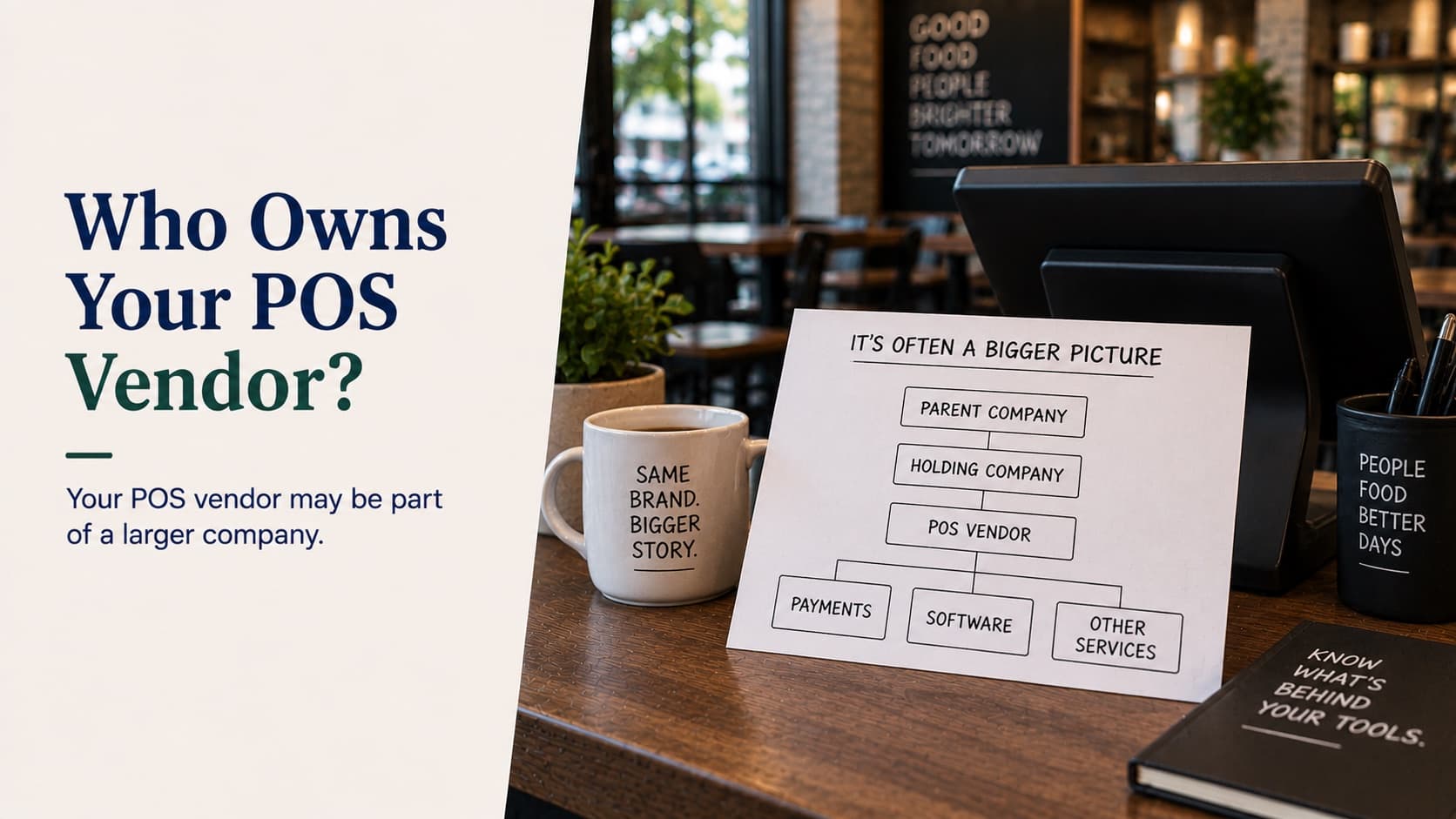
Most restaurant POS companies are owned by a processor, a database vendor, or a fund with a hold period. That owner sets the roadmap you'll live with.

Operators describe the same experience to me over and over. The system was great when they bought it. Then support got slower, the roadmap stalled, prices moved at renewal, and a feature they relied on got folded into a higher tier.
They usually explain it as the company getting greedy or getting big. Sometimes that's it. More often something specific happened that's a matter of public record: the company changed hands, or answers to someone whose business isn't restaurants.
Ownership is the least-discussed variable in POS selection and one of the more predictive ones, because it determines what the product is for.
Who owns what
| System | Owner | What that owner's business actually is |
|---|---|---|
| Clover | Fiserv — acquired with First Data in 2019, a $22 billion deal | Payment processing |
| Square | Block | Payments and financial services |
| Micros | Oracle | Enterprise database and applications |
| Aloha | NCR Voyix | Retail and restaurant technology, post-spinoff |
| Brink | PAR Technology (public) | Restaurant technology |
| TouchBistro | Backed by Francisco Partners — $150M CAD growth round | Private equity |
| HungerRush | Majority stake held by Corsair, acquired from CapStreet | Private equity |
Read the right-hand column as the answer to "what is this product for."
Three ownership models, three predictable behaviours
Owned by a payments company. The POS is a merchant acquisition channel. Clover came to Fiserv inside a payments megadeal, and Square is Block's. When the software's job is to originate and hold processing volume, the software's commercial design follows: bundled processing, hardware bound to the network, and terms that make leaving expensive.
That isn't a criticism so much as an explanation. The hardware lock I wrote about in the last post looks arbitrary until you know who owns the platform and what they're optimising. Then it looks like exactly what it is — the product working as intended.
Owned by private equity. TouchBistro raised $150 million CAD from Francisco Partners explicitly to move upmarket and pursue acquisitions, and went on to buy PeachWorks. Corsair took a majority stake in HungerRush from another PE firm — a fund-to-fund transfer, which is worth noticing on its own.
PE ownership produces a recognisable pattern: capital for acquisitions, then integration work that consumes roadmap for a year or two, then pressure toward an exit. None of that is bad for customers in principle — the money often does fund real product. But two things follow reliably. Funds have hold periods, so your vendor will be sold again, probably within the term of the contract you're signing. And the metrics that govern the business between now and then are revenue retention and net expansion, which is a polite way of saying price increases and tier migrations.
Owned by an enterprise software company. Oracle owns Micros. The restaurant product is a line inside a portfolio measured in tens of billions, and its priority is set relative to everything else in that portfolio. Enterprise vendors are excellent at scale, contracts and compliance. They are structurally slower at responding to a 40-seat restaurant's problem, because that restaurant isn't the customer the organisation is built around.
Why the incumbents look different from the newcomers
There's a useful framing in the trade coverage: Toast and Clover are characterised as newer entrants competing for restaurant customers who were historically served by Oracle's Micros and NCR Voyix. In the smaller-restaurant segment, Square was reported as the third-largest player at around a 13% share, with Global Payments at about 11%.
The strategic point for a buyer: the segment is contested right now, which is good for you on price and bad for you on stability. Contested markets consolidate. Some of the names in that table will be inside other companies before a three-year contract runs out — which is precisely why the terms in the contract red flags post matter more than the demo did.
What to actually do with this
You cannot pick a vendor by its cap table, and you shouldn't try. But three concrete moves follow:
Ask who owns them, and check the answer yourself. For public companies it's in the filings. For PE-backed ones it's usually in a press release. If a salesperson is vague about ownership, that is itself informative.
Assume roadmap promises don't survive a change of control. A feature "coming next quarter" is a statement by people who may not be making that decision next quarter. Contract for what exists today; treat the roadmap as upside.
Price the renewal, not the first term. If the owner's model runs on net revenue expansion, the deal you're being offered is an entry price. Negotiate the renewal cap now — it's the single most valuable clause you can add and the cheapest to get before signature.
And the general lesson from the ownership table: when the software is owned by a payments company, expect the payments relationship to be the hard part, which is exactly what the processing comparison found from the opposite direction.
What I'm not going to claim
That any of these are bad products. Micros runs enormous operations successfully. Clover is a genuinely good product for many merchants. Ownership predicts commercial behaviour, not software quality.
That independence is automatically better. A smaller independent vendor carries its own risk — less capital, fewer engineers, and the possibility of being acquired or failing outright. That's a real trade-off and I'm not going to pretend otherwise.
Complete ownership coverage. Revel is missing from the table, though its owner is on record: the payments company Shift4 completed its acquisition in June 2024. I could not find sourcing I'd stand behind on the current ownership of Lavu, so it's not in the table either. Ownership also changes; verify before you sign rather than trusting a table with a date on it.
And you should ask us the same question. This is Katalyst's blog, we compete with most of the names above, and "who owns you and what is their hold period" is a fair question to put to our salespeople too. If we're vague, apply the same rule I just gave you.
The point isn't that one ownership model wins. It's that a POS contract is a multi-year relationship with a company whose incentives are set somewhere above the product team — and that's knowable in advance, for free, before you sign anything.
Related Katalyst products
Topics
See how Katalyst handles your service style
A 30-minute walkthrough of the platform, tuned to how your restaurant actually runs.