G2 agreed to acquire Capterra, Software Advice and GetApp
Vendors pay $3,000 to $95,000 a year for placement, Capterra's default sort is Sponsored, and review incentives run to $25 on one site and $100 on the other.

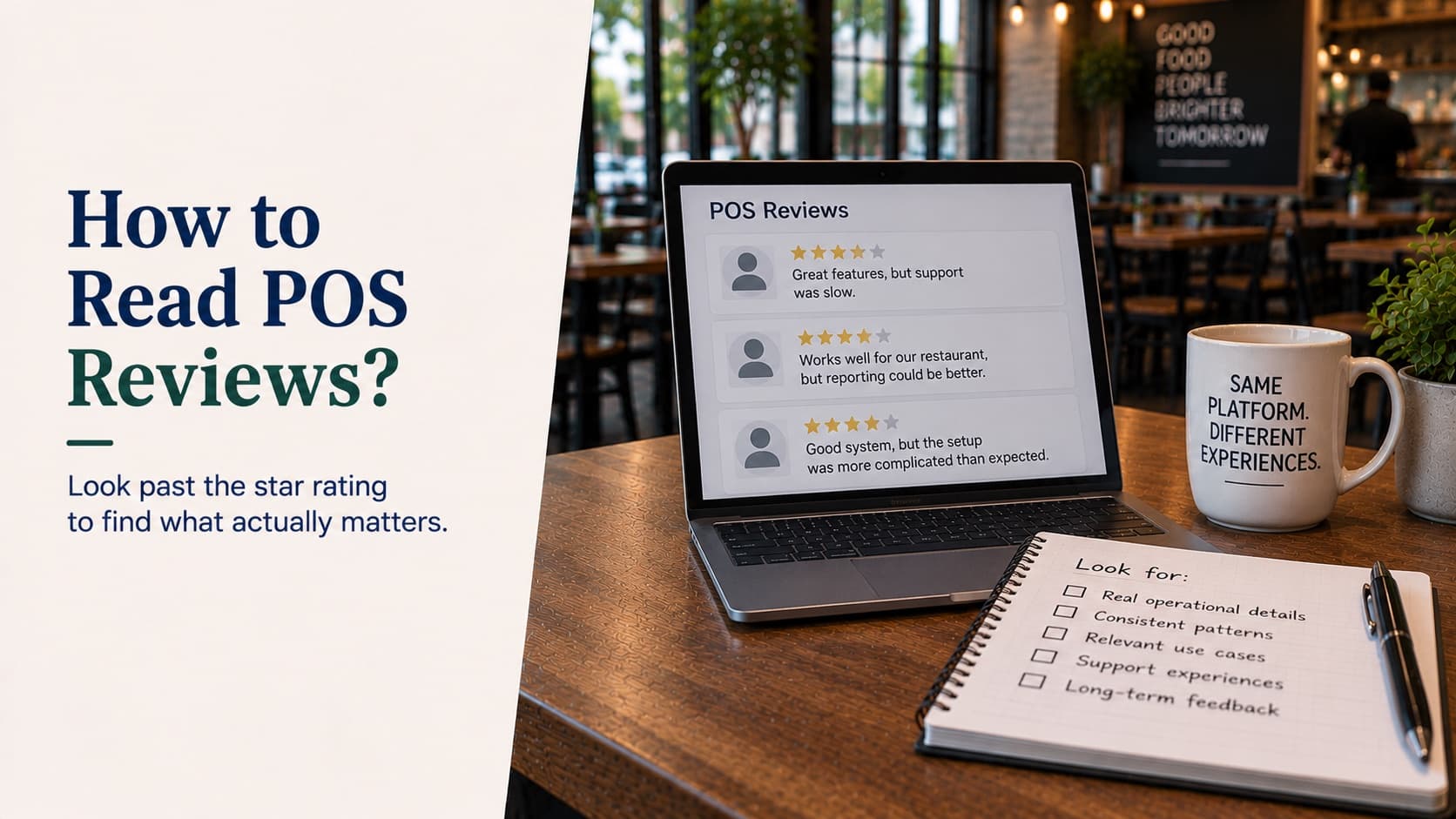
Standard advice for choosing a POS: read the reviews. Check G2. Cross- reference against Capterra. Look at the ratings, weigh the volume, notice the patterns.
On 29 January 2026, G2 announced an agreement to acquire Capterra, Software Advice and GetApp from Gartner, with the deal expected to close in the first quarter. Those three had sat inside Gartner Digital Markets since the mid-2010s.
So the cross-check that advice depends on is now four of the largest B2B software review platforms under one owner. Comparing your G2 findings against Capterra is no longer comparing independent sources.
That's a good moment to look at how these sites actually make money, because the answer explains what you're reading.
The buyer isn't the customer
Roughly 200 million buyers a year use these platforms for free. The revenue comes from the vendors being reviewed, and it is not small: reported ranges run $3,000 to $95,000 per year for visibility, badges and review-collection campaigns. On Capterra, pay-per-click bids start around $2 and run past $20 in competitive categories.
The structural consequence shows up in what you see first. Capterra's default sort is "Sponsored." G2's is its own G2 score. Neither default is "best rated." A well-reviewed product whose vendor doesn't buy placement can sit below a worse-reviewed product whose vendor does.
That isn't hidden — it's disclosed, and it's an ordinary advertising business. It just isn't what a buyer assumes they're looking at when they open a "top 10 restaurant POS systems" page.
Incentivised reviews, and what they do to the sample
Both platforms permit paid incentives for leaving a review. Capterra runs campaigns offering gift cards up to $25; G2 permits incentivised reviews capped at $100.
The important detail is that the incentive is for the act of reviewing, not for positive sentiment. Nobody is paying for stars.
That sounds like it neutralises the problem. It doesn't, because it changes who reviews, and that's the bigger effect.
Think about who responds to a $25 gift card offer that arrives by email from a vendor's customer success team. It's a current customer, usually one recently onboarded, in the window where a vendor deliberately runs review campaigns — when the relationship is newest and best. The people who don't get that email are the ones who left, the ones in a billing dispute, and the one who spent eighteen months fighting an integration before giving up.
So the sample skews toward early-tenure customers of vendors who run campaigns. That is a real and predictable bias, and it needs no bad faith from anyone to produce it.
Users also report a pattern they call asymmetric moderation — legitimate negative reviews stuck in moderation while incentivised positive ones pass through. I'll label that as an allegation rather than a finding, because I can't verify moderation practice from outside. The sampling bias above needs no such allegation to hold.
What this means for reading a POS review page
Three practical adjustments:
Read the one-year-plus reviews first. Most review interfaces let you filter or sort. A POS's problems — renewal pricing, support decay, integration breakage, the cost of leaving — surface in year two, and the review campaign that produced the bulk of the five-star volume ran in month three.
Read the three-star reviews. Five-star reviews from happy new customers tell you the onboarding was good. One-star reviews are often about a single billing dispute. The middle is where you find people describing trade-offs, which is what you actually need.
Count what's absent. If a category of complaint appears on every competitor's page and none on one vendor's, that's more likely to be a moderation or campaign artefact than a product achievement.
Where less-incentivised signal lives
None of these are clean, and I'd rather name their biases than present them as the answer:
Operator communities. Restaurant subreddits and owner groups have no incentive structure paying for posts, which makes them more candid and much noisier. They skew toward complaints — people post when something breaks, not when it works — and toward smaller independents. Useful for finding failure modes, useless for measuring how common they are.
Your local peers. The single highest-value research available, and the least used. Walk into four restaurants of your size and service style in your market and ask what they run and what they'd change. Nobody is paying them, they have no reason to perform, and they operate in your labour market with your guests.
Ask a vendor for a customer running your exact stack. Not a reference — those are curated. A customer with your service style, your volume, and the specific integrations you need. If they can't produce one, that's an answer about fit.
Public filings and press releases, for the structural facts: ownership, acquisitions, processing partnerships. These are the least sexy sources and the most reliable, and they're where the ownership picture and the processing relationships in this series came from.
The questions that beat any review
Reviews describe someone else's experience of a product. What you actually need is the terms you'll be signing, and those aren't in any review:
- Who processes your payments and may you change it
- Whether the hardware works with anyone else
- What the termination fee is, as a formula
- Which of your five required tools integrate today, by name
- What the renewal price is capped at
That list is in the demo questions post in longer form, and every item is answerable in writing before you sign. A four-and-a-half star rating is not a substitute for any of them.
Our own position, since it applies here
Katalyst publishes POS comparison pages covering a dozen competitors. We wrote them. We sell a competing product. Everything in this post applies to that material as much as to G2's.
What I'd say for them is that they're built on published pricing, documented features and public filings rather than on sentiment — and that where we couldn't source something in this series, I've said so by name rather than filling the gap. That's a claim about method, and you're entitled to test it: pick any factual assertion on those pages and check it against the vendor's own documentation.
The general rule I'd apply to all of it, ours included: weight a source by whether it's telling you something checkable. A rating is not checkable. A processing arrangement, a termination formula, an ownership structure and an integration list are.
Related Katalyst products
Topics
See how Katalyst handles your service style
A 30-minute walkthrough of the platform, tuned to how your restaurant actually runs.