A comped soft opening tells you nothing about your prices
Contribution margin and menu engineering need a sales mix you don't have yet. Measure ticket time as a distribution, and tag the tables that aren't friends.

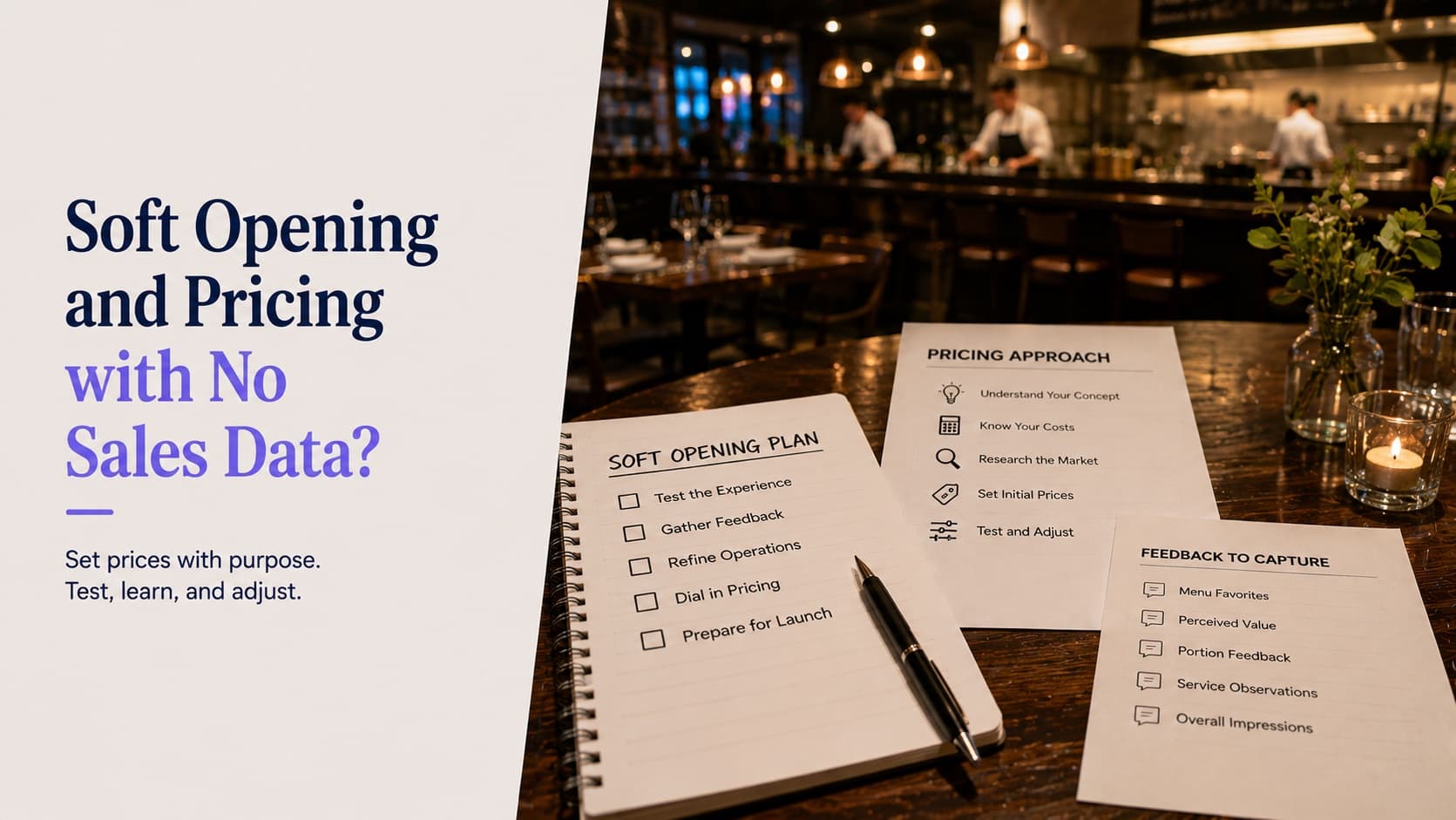
I've written a fairly complete guide to pricing a restaurant menu — food-cost markup, contribution margin, competitive pricing, dynamic pricing, and where menu engineering fits.
Re-reading it from the position of someone who hasn't opened yet, I noticed something I should have said there: three of those four methods require data you do not have. Contribution margin needs to know what sells. Competitive pricing needs to know which of your items guests actually comparison-shop in your market. Menu engineering needs a sales mix by definition — you cannot plot popularity against profitability with no popularity axis.
So month zero is a different problem, and the soft opening is the only instrument you get for solving it.
What you can actually price on before you open
One method survives with no data: ideal food cost markup. You know your recipes, you have supplier quotes, so you can compute plate cost and mark it up to a target. That gives you a defensible floor for every item.
Two adjustments on top, both of which you can make from knowledge rather than data:
Identify your comparison-shopped items yourself. In most concepts a handful of items are the ones guests price-check — the burger, the margarita, the house wine by the glass. You can walk into four competitors and read their menus in an afternoon. Those items get priced against the market. Everything else gets priced on margin.
Price for dollars on the items you control. Contribution margin reasoning works without mix data as long as you apply it item by item rather than portfolio-wide: an item that returns $9 of margin at a higher price and $7 at a lower one is a better item at the higher price unless the lower price sells meaningfully more of it — and "meaningfully more" is precisely the thing you're about to measure.
That's it. Anything more sophisticated is pretending to have information.
The soft opening is a measurement exercise
Here's where most first-timers lose the only pre-opening data they'll ever get. The soft opening gets designed as a celebration: invite everyone, comp the food, collect compliments.
Comps are the specific mistake. A comped soft opening produces zero price signal. Nobody's order tells you anything about willingness to pay, mix shifts toward whatever's most expensive or most interesting, and the check average is meaningless. You have run a party and learned about your kitchen.
Learning about your kitchen is genuinely valuable — it's the other half of the job. But you can have both by charging.
What the soft opening is actually for, in order of value:
Ticket time under a full rail. Prep times that worked in testing run long in service; dishes that plated perfectly come out inconsistent when the kitchen is handling a full board. This is the finding that matters most, and it only appears under load.
Measure the distribution, not the average. An average ticket time of 14 minutes hides the fact that 20% of tickets took 25. Guests experience the tail, not the mean. Your POS or KDS will give you this if you look for it — it's one of the few numbers a brand-new restaurant can produce honestly, which is why it's on my list of metrics that actually matter.
Which station is the bottleneck. Usually one. It determines your real capacity, and it's frequently not the one you designed around — which loops back to the fact that your kitchen's throughput is bounded by the equipment your hood and utility capacities allowed you to install.
The first sales mix, at real prices, from paying guests.
Your friends-and-family mix is biased, and you can correct for it
This part is reasoning rather than data, and I'll label it as such because I haven't found a study on it.
The people at your soft opening are not your guests. They know you. They order generously, they order what you suggest, they order the thing you're excited about, and several of them order the most expensive item on purpose because they're trying to support you. Your mix will overweight your signature dishes and your check average will be optimistic.
Two corrections that cost nothing:
Stop suggesting. Let people order off the menu with no steering, including from you. Every recommendation you make contaminates the one measurement you're running.
Segment the data. Tag the tables that are genuinely strangers separately from the ones that aren't. If you invited the public for part of the run — and you should — that subset is your only clean sample, and it's worth more than the rest combined.
The practical implication: run the soft period long enough, and open enough of it to strangers, that you have real tickets rather than friendly ones. A soft period commonly runs one to three weeks, which is enough time to get both if you plan for it.
Menu size is the one variable you fully control
Before you open, you can't know what sells. You can decide how many things you're asking the kitchen to execute, and that choice compounds into food cost, waste, prep labor, inventory complexity and ticket time.
Almost every article on this cites the same piece of research: the supermarket study where shoppers offered 24 jams bought at a 3% rate while shoppers offered six bought at 30%. It's a real and famous finding.
It is also a study about jam in a grocery store, not about menus in restaurants. I've seen it presented as though it measured restaurant behavior. It didn't. Hospitality-specific work suggests something in the range of six choices per category for quick service and seven to ten for full service, but those figures come from a smaller literature and I'd hold them loosely rather than treat them as targets.
What I'd actually rely on is the operational argument, which needs no study: every additional item is another SKU to hold, another prep to execute, another thing to waste when it doesn't sell, and another decision at the table when the kitchen is already behind. A new restaurant with an ambitious menu is choosing to learn many things poorly instead of a few things well.
Open narrow. Adding items once you know what sells is easy. Removing the guest favorite you can't execute is not.
The correction window is shorter than you think
Prices set from ideal food cost will be wrong somewhere, and you'll see where within a few weeks of real trading. This is the moment to fix them, because two things are true early and stop being true later:
Nobody has anchored yet. You have no regulars with an expectation of what your burger costs. Six months in, a price change is a visible event; in week three it's just the menu.
Your costs are still moving. Opening supplier pricing frequently isn't your steady-state pricing, and your yields improve as the kitchen stops wasting product. Both push your actual food cost away from the plate cost you calculated.
So plan a deliberate re-pricing at roughly the six-to-eight-week mark, once you have a real mix. That's when the methods in the pricing post become usable, and when menu engineering starts to mean something rather than being an empty grid.
Tell your team this is the plan in advance. A scheduled correction reads as competence; an unscheduled one reads as panic.
What I'm not going to give you
A number of soft opening covers. It depends on your seat count and your kitchen. The operationally useful target isn't a cover count, it's a condition: run the kitchen at full ticket load at least twice, because the first time you learn what breaks and the second time you learn whether the fix held.
A markup multiplier. The multiplier that gets you to a target food cost is arithmetic, and the target depends on your concept and your labor model. It's in the pricing post.
A menu item count. See above — the honest answer is "fewer than you want," and the research everyone cites for a specific number was about jam.
The short version
Price from ideal food cost, benchmark only the handful of items guests actually compare, charge real money at the soft opening, measure ticket time as a distribution rather than an average, keep the menu narrower than feels comfortable, segment your stranger tables from your friendly ones, and schedule the real re-pricing for six to eight weeks in.
Disclosure: I work at Katalyst. The measurement half of this post is obviously easier with a system that reports ticket time distributions and item mix cleanly, and we sell one — so weigh that. But the two decisions that matter most here cost nothing and involve no software: charge for the food, and stop recommending dishes to the people whose orders you're trying to learn from.
Related Katalyst products
Topics
See how Katalyst handles your service style
A 30-minute walkthrough of the platform, tuned to how your restaurant actually runs.