A blackout excused a wedding hall, not its $10,578 deposit
Markel's event policy excludes the ordinary thunderstorm. One Outer Banks venue refunds only on a county evacuation order in place that day, and only 80%.

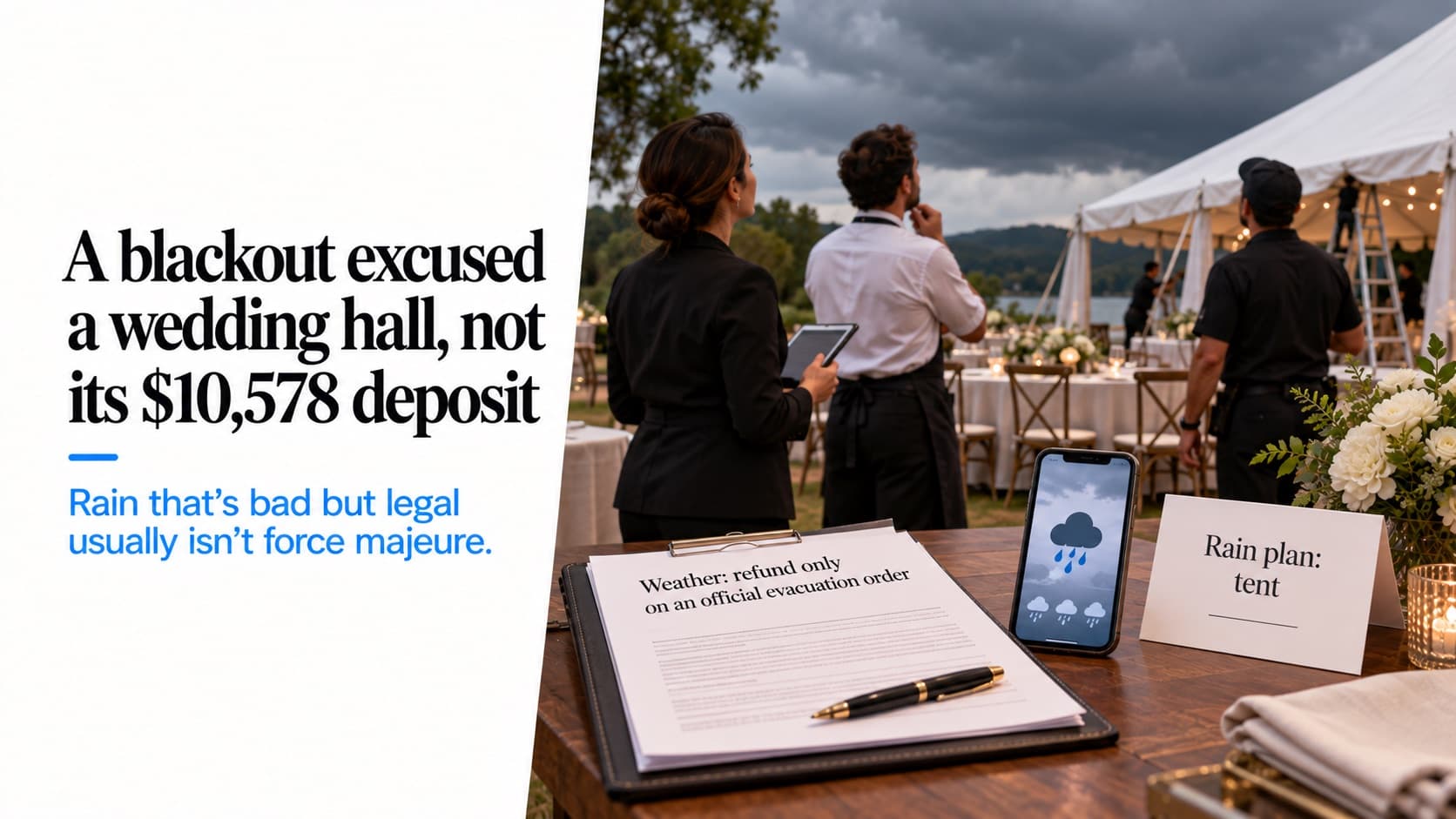
It's Wednesday, the forecast for Saturday's outdoor event has gone from "chance of showers" to a red blob, and the client is on the phone asking the question every contract should answer and most don't: if we cancel, what do we get back?
The honest answer depends on three things: what your contract says about weather, whether anyone with authority actually orders the event stopped, and what you've already spent. Here's what published contracts and the courts say about each.
Force majeure is a shield, not a vault
The most useful case I found is a New Jersey wedding from 2002. Less than 45 minutes into an August reception, an area-wide power failure shut the hall down. The couple had prepaid $10,578. The hall's contract excused it from performance for "an act of God (e.g., flood, power failure, etc.)."
The appeals court in Facto v. Pantagis agreed the hall was excused — it couldn't be sued for damages. But it held the trial court "erred in allowing the banquet hall to retain the full payment." The couple got their money back, less the value of the service actually delivered.
That's the general rule. A force majeure clause protects the party who can't perform from paying damages. It doesn't let them keep the money for something they didn't deliver, unless the contract says so in plain words.
Rain usually isn't force majeure
Weather that makes an event less pleasant is different from weather that makes it impossible. Courts read force majeure clauses narrowly, and commentators agree ordinary rain doesn't qualify unless the contract names it. I couldn't find a US case squarely holding that, so treat it as the consensus rather than a ruling.
The related principle has a case behind it. After September 11, an event promoter cancelled a large Hawaii resort event and claimed force majeure. A federal court held that a clause "does not excuse performance for economic inadvisability ... even when the economic conditions are the product of a force majeure event." The planner's version: "Bad attendance is not a force majeure; it is attrition."
What published venue contracts say
The real contracts I found handle weather three ways.
- Reschedule, don't refund. A city-owned venue in Newport, Rhode Island lets the event be rescheduled "with no penalty" after an act of God. But "last minute cancellations of outdoor site due to inclement weather will not be considered for refunds." And if the venue itself can't perform, "the entire deposit will be returned." The obligation runs in one direction.
- The venue cancels and keeps the deposit. JMU's arboretum reserves the right to cancel within 48 hours if the National Weather Service issues an advisory, and refunds everything "not including the reservation deposit" of 20%. Clients must "secure a backup location."
- Refund only on an official order. A North Carolina garden venue on the Outer Banks refunds tent rentals inside 14 days only for "a Mandatory Evacuation in place on the day of the event" — not a forecast, not a watch — and even then refunds 80%.
The last one is the clearest model I've seen. It ties the refund to an event outside both parties' judgment.
Orders versus advisories
When wildfire smoke covered New York in June 2023, the state issued air quality advisories. Zoos closed and a Yankees game was postponed. But the city told organizers they could go ahead with the weekend's outdoor events. Nothing was ordered closed.
That distinction matters for contracts. The COVID wedding cases that returned deposits turned on executive orders that made gatherings illegal. An advisory, however alarming, usually leaves the event legal, and a clause triggered by "governmental order" likely doesn't apply. Some universities publish their own air-quality cutoffs for outdoor events — 150 or 200 on the AQI scale — but those are their decisions, not legal requirements.
One more point from a 2024 federal appeals case about a cancelled hotel conference: whether cancelling was justified is judged "based on the facts available at the time," not on how the weather or the restrictions turned out afterwards.
Insurance covers less weather than clients think
Event cancellation insurance helps, within limits. Markel's wedding policy page says "the average summer thunderstorm would not be covered," and covers weather "extreme enough to prevent the honoree or majority of guests" from attending. The policy must be bought "at least 15 days prior to the prediction of the threat of extreme weather" — the same page also says 14. And once a hurricane has a name, brokers say a new policy will exclude it. One commercial program excludes named storms from June through November in Gulf and southern Atlantic states unless bought well ahead.
Low-end premiums start around $130. It's cheap enough to recommend to every outdoor client in writing, which also shows you raised it.
Who keeps what
Pulling it together:
- You can't perform for your own reasons: the deposit goes back, and the client can claim extra costs.
- Neither side can perform because of a real force majeure event or an order: the client gets the money back, less what you've already delivered — unless the contract clearly says otherwise.
- The client cancels because of the forecast: your cancellation schedule applies. The guarantees post covers how enforceable those are.
The clauses I'd write
- A decision deadline, such as 48 hours out, and who makes the call.
- A rain plan with a price, including the tent. The tents post covers the permits and heaters.
- A refund trigger tied to an official act — a closure or evacuation order — not a forecast.
- A reschedule credit with a window, for weather that's bad but legal.
- Costs already spent, like perishable food ordered and staff booked, kept by you and listed as such.
- A written recommendation to insure, with the date it was made.
What I'm not going to give you
A US case holding that rain isn't force majeure. The principle is widely stated; I found no ruling.
A standard insurance deadline. Sources say 10, 14 and 15 days.
A heat threshold that cancels events. I found none in US law.
What to do
- Read your weather clause before the next outdoor booking.
- Separate "cancel" from "reschedule" in the contract.
- Tie refunds to official orders, not forecasts.
- List your sunk costs so a refund nets them out.
- Recommend insurance in writing, at least two weeks before the event.
Disclosure: I work at Katalyst, which sells catering software that keeps contracts, deposits and event dates together. The weather clause isn't a software feature. It's the paragraph you'll wish you'd written before the forecast turned.
Related Katalyst products
See how Katalyst handles your service style
A 30-minute walkthrough of the platform, tuned to how your restaurant actually runs.