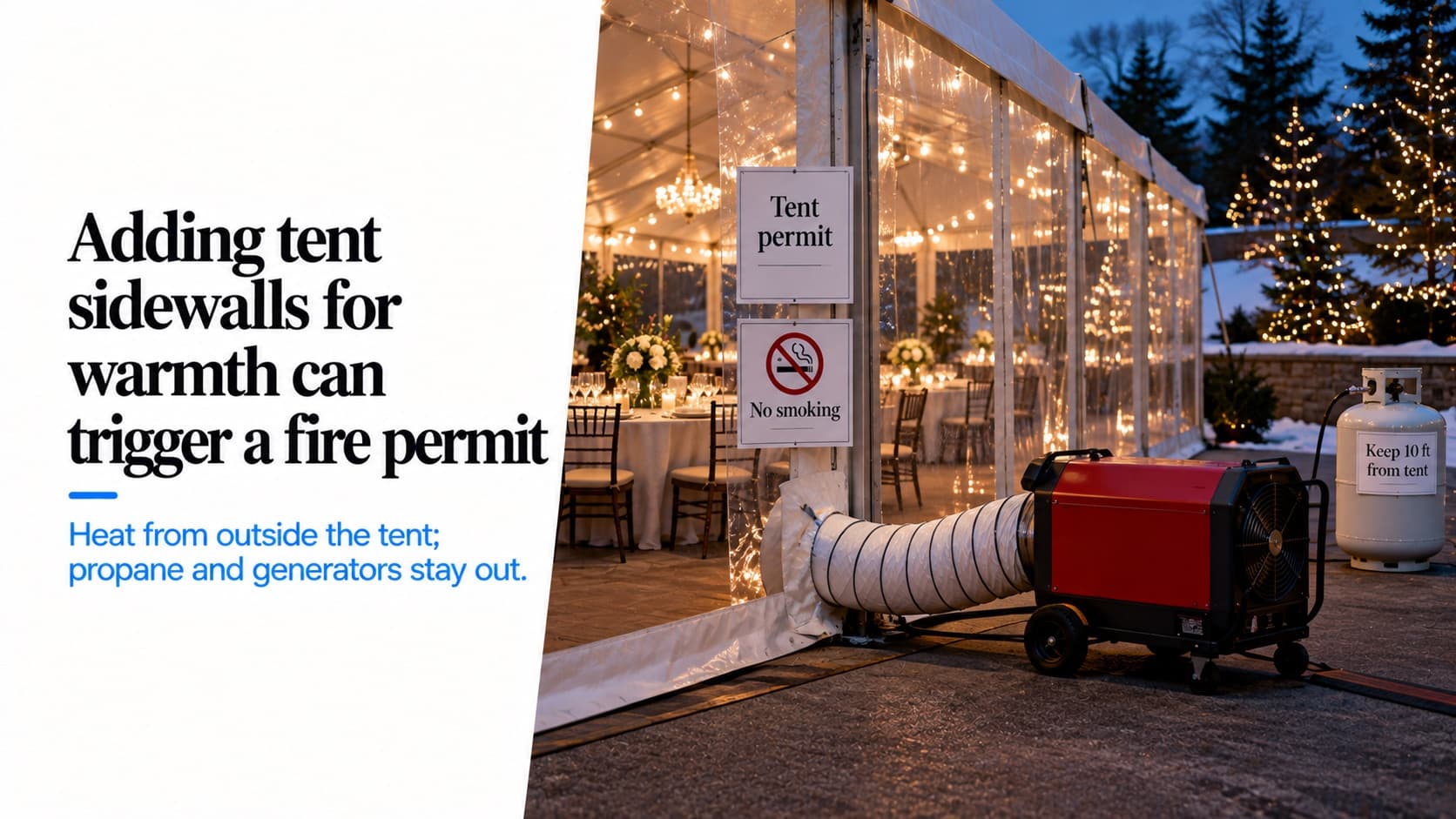
Adding tent sidewalls for warmth can trigger a fire permit
Seattle bans mushroom heaters inside tents but allows heaters blowing in from outside. Denver doubles permit fees inside 14 days; Chicago triples them.

Every October the same thing happens to outdoor events. The tent that worked in June gets sidewalls, a few patio heaters, and maybe a cooking station moved under cover because it's cold. Each of those changes is reasonable, and each one is a fire code question the summer version of the event never had to answer.
I've worked tented events from May to late October for years, and the cold-season ones are where the inspector shows up. Here's what the code actually says, and where your local fire department will differ.
A note before the details: the International Fire Code's tent chapter has been renumbered several times, and your city enforces whichever edition it adopted, with its own amendments. I'm describing the rules, not citing section numbers. Your fire marshal's version controls.
Sidewalls can turn a no-permit tent into a permit tent
The model code requires a permit for tents larger than 400 square feet. It exempts tents "open on all sides" up to 700 square feet, as long as tents placed side by side total no more than 700 and there's 12 feet of clearance around them.
The cold-weather catch is in "open on all sides." Seattle's fire department says it directly: "if you add walls to your tent, then smaller tents will require an SFD permit, too." A 20-by-30 frame tent that needed nothing in September can need a permit in November because you hung walls to keep the wind out.
Local rules move the line in both directions. Denver charges tent fees from 200 square feet. Chicago requires no building permit at 400 square feet or less, but counts tents closer than 12 feet apart as one.
Heaters: what can go inside
This is where most cold-season events get it wrong.
- Mushroom heaters stay outside. Seattle's tents and heaters sheet: mushroom heaters "are allowed 10 feet away from tents, but are prohibited inside tents." California's fire code prohibits outdoor gas-fired heaters inside tents as well.
- Heaters that blow in from outside are the normal solution. Seattle permits "'Salamander' style heaters which blow air in under a tent from the outside." Electric heaters are allowed inside without a separate permit.
- Propane cylinders stay outside, at least 10 feet away for portable containers of 500 gallons or less, secured, with relief valves pointed away from the tent.
- No liquid-fueled equipment in tents. "Flammable-liquid-fueled equipment shall not be used in tents." A kerosene or diesel heater inside is out.
- Vented equipment vents outside, with tent fabric at least 12 inches from any flue, and heating and cooking equipment kept 10 feet from exits.
The reason for all of it is carbon monoxide as much as fire. The Consumer Product Safety Commission's warnings come from camping, not events, so I won't quote its numbers as event data, but the mechanism is the same: an enclosed fabric space, a combustion heater, people who don't notice the symptoms. The CPSC also notes that alcohol "may compromise the ability to recognize symptoms." At a reception, that's everyone.
Cooking, chafers and generators
- Cooking tents with sidewalls have to be at least 20 feet from other tents.
- Outdoor cooking that throws sparks or grease vapor, a grill or a fryer, has to be 20 feet from a tent.
- Open flame inside or within 20 feet of a tent open to the public needs approval. That includes chafing fuel. Denver lists "Candles, Sterno, and open flame" as its own $50 permit.
- Generators go at least 20 feet from the tent and behind a fence or enclosure so guests can't touch them.
For the electrical side of an off-site kitchen, see off-site kitchen logistics.
The paperwork that fails rented tents
Before a permit is issued, the owner files a certificate that the tent fabric, sidewalls, drops and decorations meet the NFPA 701 flame test. Chicago adds an expiration: the certificate must be dated within 360 days if the flame-retardant treatment isn't permanent, or seven years for inherently flame-resistant fabric. An older rental tent with a treated fabric can fail on paperwork before anyone looks at a heater.
Tents with 50 or more occupants need a site and floor plan showing exits, seating, and the location and type of heating and electrical equipment. Every point inside has to be within 100 feet of an exit, and smoking is prohibited inside with posted signs.
Wind and snow
The model code requires tents to be "adequately roped, braced and anchored to withstand the elements," with documentation on request. It sets no wind speed at which you have to evacuate. Those numbers come from tent companies and contracts, and they range from about 18 to 30 miles an hour.
Wind force rises with the square of the speed, so a 40 mph gust pushes on the anchors about 16 times as hard as a 10 mph breeze. That's why the evacuation call has to be made before the weather arrives, not during.
Chicago makes the plan a permit requirement: a written "high winds action plan" that names "the wind speed and time period before arrival of a storm at which the temporary structure must be evacuated," who's watching the weather, and who carries out the evacuation. Seattle adds the cold-season line: tents "should not be occupied during periods of snow or ice accumulation unless designed for full structural loading."
Fees and lead times
| Fire department | Tent fee | Late penalty |
|---|---|---|
| Denver | $100 (200–1,000 sq ft) | Double inside 14 days |
| Chicago | From $325 | Triple inside 14 days |
| Seattle | $362 | +50% if paid inside 30 days |
| Sacramento Metro | $828 (401–1,499 sq ft) | +$165 inside 2 weeks |
Sacramento's tent fee is about eight times Denver's for a similar tent. Denver's heater permit is $75 a single event, and after-hours inspections run $80 an hour with a three- or four-hour minimum. Denver's fee sheet is from 2024, so confirm current amounts.
The table's real message is the lead time. Every department penalizes a late application, and Seattle may not process one filed three business days out.
What I'm not going to give you
Section numbers. They depend on which edition your city adopted.
A wind speed for evacuation. The code doesn't set one; use the tent manufacturer's rating and your rental company's contract.
Heater sizing for a tent. The figures in circulation come from retailers.
Carbon monoxide incident counts at events. I found none.
What to do
- Decide on sidewalls before you apply, because they can change whether you need a permit at all.
- Plan heat from outside the tent — blown-in or electric — unless your fire department approves something else in writing.
- Keep propane, generators and grills at their distances, and fence the generator.
- Ask the rental company for the flame certificate and check its date.
- Write the wind plan with a number and a person, even where it isn't required.
- Apply at least 30 days out.
If the event has a bar, read the holiday party bar post too.
Disclosure: I work at Katalyst, which sells catering software, and I still pick up a handful of events a year. None of this is a software problem. It's a site walk with a tape measure, a week before the permit deadline.
Related Katalyst products
Topics
See how Katalyst handles your service style
A 30-minute walkthrough of the platform, tuned to how your restaurant actually runs.