One hotel contract priced the same shortfall three ways
Published catering policies overset 3–5% and bill the guarantee or the actual count, whichever is greater. A late increase can add up to 15% a head.

Every corporate event I've sold turned on one phone call, about three days out, when the client's coordinator tells you how many people are coming. That number is the guarantee. Most clients think of it as an estimate they're allowed to revise. Every published catering policy I could find treats it as a floor.
I pulled the current written policies of conference centers, universities and convention-center caterers, plus two published hotel group contracts, to see how the guarantee actually works when it's written down. The interesting part isn't the deadline. It's what happens on either side of it.
The guarantee is a floor, never a ceiling
The phrase that appears in almost every policy is some version of "guarantee or actual attendance, whichever is greater." That's Wolfgang Puck Catering at Chicago Booth, and the Atlantic City Convention Center, Red Rocks in Denver and Boston University say the same thing.
Read it as a ratchet. If 180 people come to a 200-person guarantee, the client pays for 200. If 215 come, they pay for 215. The number only moves in one direction once it's given.
MIT's conference center, run by Restaurant Associates, extends the ratchet to clients who never give a number. Miss the deadline and the bill is "the estimated guest count on the BEO or the actual guest count, whichever number is higher." The estimate from the planning call becomes the guarantee by default.
| Venue | Guarantee due | Overset | Late increase |
|---|---|---|---|
| MIT Samberg Center | 72 hours (3 business days) | about 3% | Served count prevails |
| Chicago Booth (Wolfgang Puck) | 3 business days, can't be reduced | 3% | — |
| Atlantic City Convention Center | 3 business days | none stated | 5% surcharge |
| Red Rocks, Denver | 7 business days | 5%, max 50 meals | 10% surcharge above +10%; overset withdrawn |
| Dixie Center, Utah (2026) | 10 business days | — | 10% surcharge above +5% |
| Cherry Creek Innovation Campus | 7 business days | "every effort" | 10–15% per guest above +3% |
The overset is 3 to 5 percent, and big venues cap it
The overset is the food a caterer prepares above the guarantee, in case the count is light. The old industry glossary defines it as covers "paid for by the client only if actually consumed." Every current policy I found sets it at 3% or 5%.
What the percentage hides is the cap. Red Rocks prepares 5% over, "up to 50 meals." The Palm Beach County Convention Center's caterer reportedly caps it at 30. So a 1,000-person gala doesn't get 50 spare plates, it gets 30 to 50 at most, and a planner who counted on "a 5% cushion" for a large room has less than they think.
Raising the count late costs more than setting it high
This is the clause clients don't read and the one I'd point to first.
- Atlantic City: increases inside the guarantee date carry a 5% surcharge.
- Dixie Center: up to 5% over the guarantee at the regular price; "Over 5%... subject to a 10% surcharge."
- Cherry Creek: increases of more than 3% within 48 hours "may be subject to a 10–15% surcharge per guest, if accommodated."
- Red Rocks: increases over 10% carry a 10% surcharge, and a late increase cancels the 5% overset altogether.
So the instinct to give a cautious low number and "add people later" is exactly backwards. Adding is the expensive direction. A client who's genuinely unsure should guarantee the likely number and let the overset absorb the top.
The deadline moved earlier, and it runs in business days
The 2005 edition of the industry's APEX glossary says the final number "is usually required at least 48 hours in advance." No current policy I found is that short. MIT, Booth and Atlantic City want three business days. Boston University wants four full business days. Red Rocks and Cherry Creek want seven, and the Dixie Center wants ten.
Business days counted back from the first function move further than people expect. Seven business days before a Saturday event is the Thursday of the week before, and a Monday holiday pushes it to Wednesday. Put the actual calendar date in the contract, not the rule.
Read every clause that mentions food
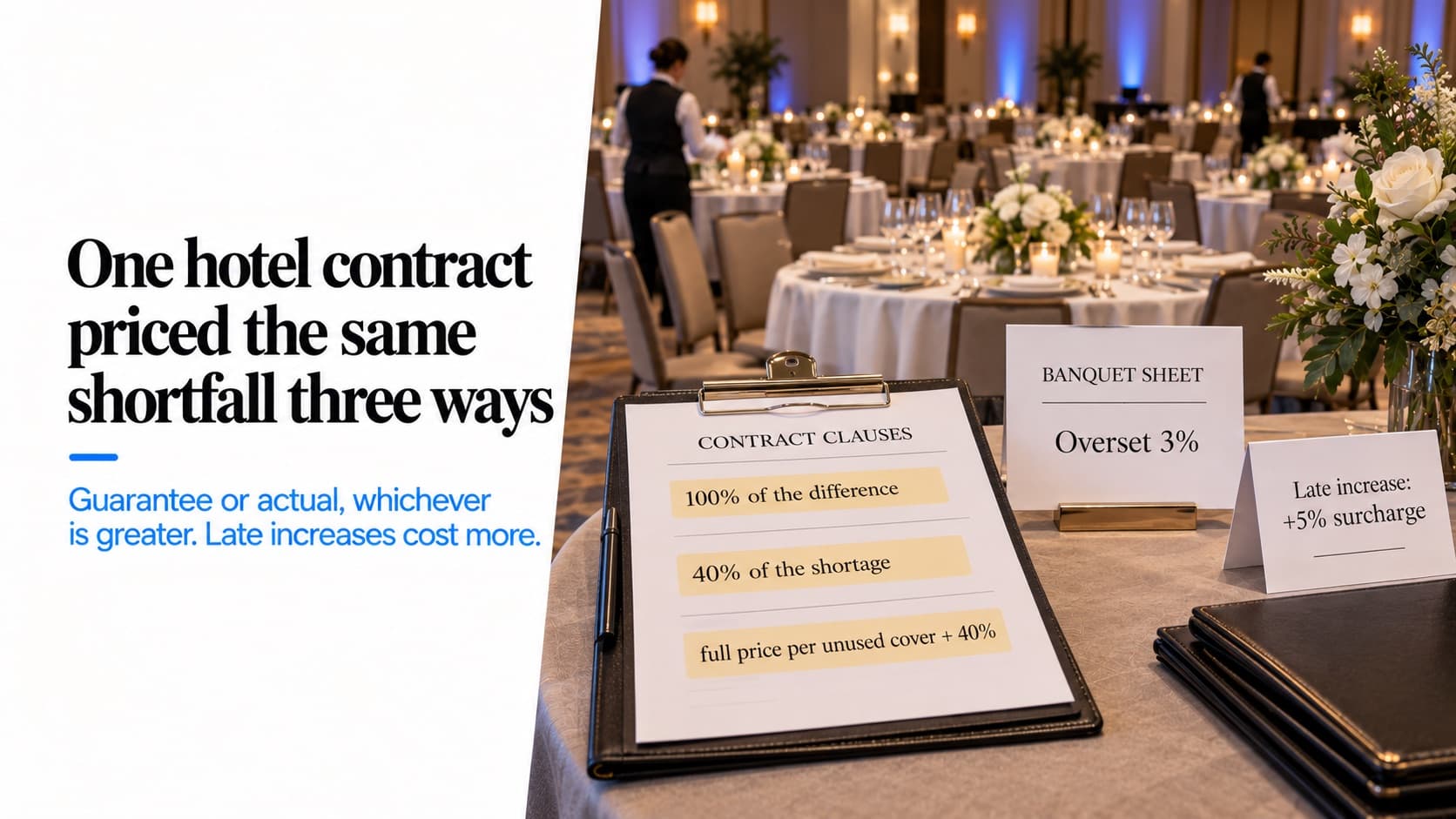
The most useful document I found is a full-service hotel's 2019 group sales agreement, posted publicly by the association that signed it. Its food and beverage minimum was $16,000, plus a 25% house charge and tax. And it priced a food-and-beverage shortfall three different ways:
- The rooms attrition section posts 100% of the difference to the master account.
- The banquet minimum section says the group will "pay Hotel 40% of the shortage."
- The attrition and cancellation section charges the full per-person price of every unused cover at a guaranteed function, plus 40% of the difference in revenue.
And a cancellation at any point between signing and arrival owed 100% of the minimum.
The 40% figure is the hotel estimating its lost profit: food that was never cooked is cost it never paid. The 100% clauses charge lost revenue. Both sat in one contract, under different headings. A client who negotiated the clause labelled "attrition" and skimmed the rest signed all three.
A planner-side template from the American Industrial Hygiene Association shows what the other side asks for: catering damages only when a function shrinks by 20% or more without 30 days' notice, and then 50% of the per-person charge for each cover beyond that 20%.
What the law will and won't do for you
A damages clause is enforceable if it's a reasonable advance estimate of the loss, and void as a penalty if it's unreasonably large. That's the Restatement of Contracts rule most courts follow, and it's why the hotel contract above describes its charges as "a reasonable effort... to establish its loss prospectively."
The surprise is mitigation. Without a damages clause, a hotel or caterer has to try to resell what you cancelled and credit you for it. With a valid damages clause, many courts don't require that at all. Massachusetts's highest court said so in NPS v. Minihane in 2008, and a planner-side attorney put it plainly: there's "no obligation for the hotel to give credit for resold rooms unless you put something in the contract." Jurisdictions differ, so the credit for resale belongs in the contract, not in your expectations.
One timing argument works for both sides. Brown University's procurement guidelines tell its departments that food and beverage cancellation charges shouldn't start until two months out, "since food is ordered or purchased approximately 30 days prior to the event." That's also the honest basis for a caterer's own cancellation scale: charge in step with when you actually commit money.
Who doesn't show up
The only large dataset I could find comes from an event-software company, PheedLoop, so treat it as a vendor's number. Across more than 1,000 events with check-in data, the median no-show rate was about 28% for free events and 17% for paid ones.
The best single illustration is an anecdote, but a clean one. 37signals ran a free breakfast event: 84 registered, 38 came. They added a refundable $100 deposit: 55 registered, 50 came. Fewer sign-ups, more people in the room.
For a caterer this matters in one direction. An internal corporate event is a free event to the people attending it. Expect the gap, and make sure the guarantee clause is the one absorbing it rather than your food cost.
The service charge may not be all labor
While you're reading the policy, read the service charge line. The Atlantic City Convention Center's 23% "management charge" sends 16 points to employees; "the remaining 7% is the sole property" of the caterer or venue and "is not charged in lieu of a tip." That's legal when it's disclosed, and it changes what a client thinks they've paid for. If your own charge isn't all labor, say so on the proposal. The tip-pooling post covers why the distinction matters for payroll too.
What I'm not going to give you
A standard attrition percentage. "Hotels set food-and-beverage attrition at 80 to 90 percent" is everywhere and I couldn't trace it to a document. The real clauses I read used a 15–20% allowance, 40% of the shortfall, or 100% of it.
An industry-average overset. Policies say 3% or 5%. I found no survey.
A corporate-event no-show rate with a method behind it. The figures above are one vendor's data and one anecdote.
What to do
- Put a calendar date on the guarantee, not "72 hours."
- State the overset and its cap in the proposal, so the client knows the cushion is 30 plates, not 5%.
- Price late increases explicitly. If you'll add guests at a surcharge, say how much. If you won't, say that.
- Bill the guarantee or actual, whichever is greater, and say it in those words. Every venue above does.
- Tie your cancellation scale to when you buy, and write it so it reads as an estimate of your loss, not a punishment.
- If the client is the one signing a hotel contract, read every clause that mentions food before they sign.
For how these terms sit inside the rest of a catering contract, see how to price catering orders and private dining minimums and deposits.
Disclosure: I work at Katalyst, which sells catering software that tracks guarantees and final counts. The step that protects you most is a sentence, not software: the date the number is due, and what happens if it moves.
Related Katalyst products
Topics
See how Katalyst handles your service style
A 30-minute walkthrough of the platform, tuned to how your restaurant actually runs.