Donated catering labor carries no charitable deduction
A gala dinner fails the enhanced food-deduction test, but leftovers sent to a food bank can pass. The charity still owes guests the meal's value above $75.

Every fall the asks arrive. A hospital foundation, a school auction, a food bank's own fundraiser. Would you donate the dinner, or do it at cost, for 300 guests in November? And somewhere in the conversation, someone on your side says the same sentence: it's a write-off.
For a caterer it mostly isn't, and the reasons are specific enough to plan around. I've said yes to a lot of these and I'd say yes again. I'd just stop counting the tax deduction as part of the payment.
None of what follows is tax advice. It's the published rule, which your accountant applies to your entity and your year.
Your labor is worth nothing to the IRS
The regulation is one sentence: "No deduction is allowable under section 170 for a contribution of services." The IRS repeats it in Publication 526: "You can't deduct the value of your time or services."
So when you discount the labor on a gala, staff the room for free, or waive the service charge, there is no charitable deduction for the discount. You've simply earned less income that year. What does count is out-of-pocket spending incident to the donated service, which for a caterer is mostly the food.
And your food cost is already deducted
Here's where the "write-off" usually collapses. Ingredients you buy and use in the same year go into cost of goods sold, and the regulations say those costs stay there: the donated food then has no basis left to deduct as a charitable gift. You've already deducted it once, as a business expense. You don't get it twice.
For donated inventory in general, the charitable deduction is limited to basis, which is usually cost. For most caterers that means the charitable side of a donated gala comes to roughly zero, and the real tax effect is the ordinary business deduction you'd have had anyway.
The enhanced food deduction, and why a gala fails it
There is a better rule for food, and it's the one people half-remember. Under section 170(e)(3)(C), any business, not just a C corporation, that donates "apparently wholesome food" can deduct more than cost: cost plus half the markup, capped at twice the cost. The IRS's own example is food worth $1,000 at your selling price with a $200 basis, which yields a $400 deduction. The total is capped at 15% of the business's net income, with a five-year carryover.
The catch is who eats it. The charity must use the food "solely for the care of the ill, the needy, or infants," and must not pass it on "in exchange for money, other property, or services." It has to give you a written statement saying so.
A gala fails both tests. The guests aren't needy, and they paid for tickets. A catered dinner auctioned to the highest bidder fails the same way.
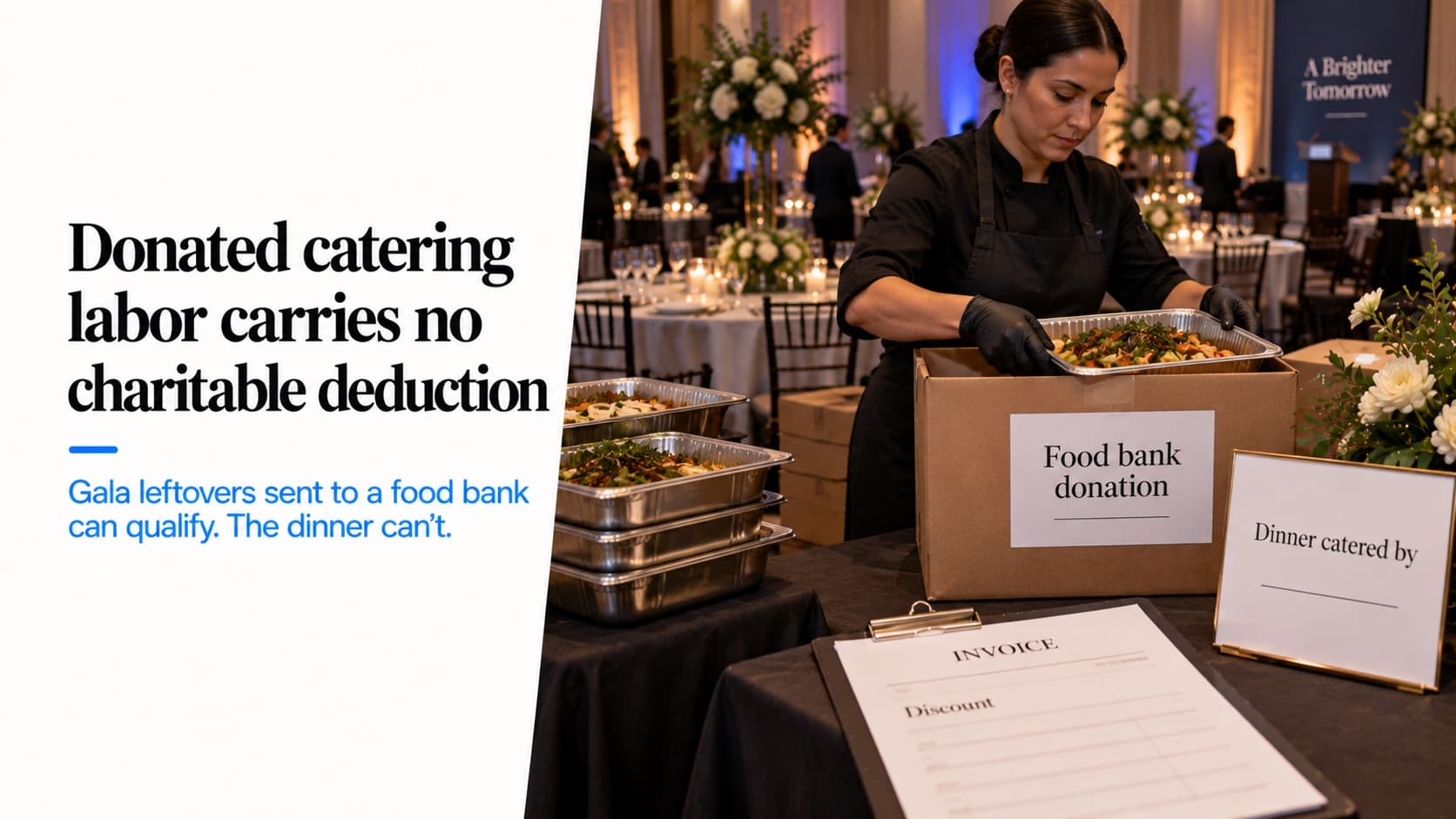
What passes is the food that's left. Packed and delivered to a food bank or shelter the same night, with the written statement, gala leftovers are exactly what the enhanced deduction was written for. The Bill Emerson Good Samaritan Food Donation Act, expanded in 2022, also shields you from liability for food donated in good faith. If you're going to take one tax step on a gala, it's arranging the food-bank pickup before the event.
Free catering doesn't make the ticket fully deductible
This one is the charity's problem, but you can solve it for them. When a guest pays more than $75 for a ticket that includes a meal, the charity has to tell them in writing that only the amount above the meal's value is deductible, with "a good faith estimate" of that value. Miss it and the penalty is $10 per contribution, up to $5,000 per event.
Charities sometimes assume that donated catering means the meal cost them nothing, so the whole ticket is deductible. The IRS addressed that in 1967 and hasn't changed its mind: "The test is not the cost of the event... but the fair market value of the consideration received by the purchaser." A $100 ticket to a dinner worth $40 is a $60 deduction, whoever paid for the food. That's the example in Publication 1771.
So the most useful thing you can hand a gala committee isn't a discount. It's the meal's value per guest, on your letterhead, at your normal menu price. They need that number, and you're the one who can give it.
"Catered by" is fine. "Best in town, 10% off" isn't.
If you're credited as a sponsor, the charity cares whether your donation is a qualified sponsorship or advertising, because advertising income can be taxable to them. The line in the regulations is practical:
- Fine: your name, logo, location, website and "value-neutral descriptions." "Dinner catered by" works.
- Advertising: "qualitative or comparative language, price information," an endorsement or an inducement to buy. "Best catering in the city, 10% off your next event" turns it into an ad.
- Exclusive provider is the trap, not exclusive sponsor. Being the only sponsor in your category is generally fine. An arrangement that bars competing caterers from the venue generally isn't.
Two comp seats at a $500-a-plate dinner can matter too: if the benefits you receive exceed 2% of what you gave, the whole value counts, not just the excess.
What changed for 2026
The 2025 tax law reshaped charitable deductions from this year on, and two pieces reach a caterer's world:
- C corporations now deduct charitable gifts only above 1% of taxable income. On $1 million of taxable income, $30,000 of gifts yields a $20,000 deduction.
- Guests who don't itemize can now deduct up to $1,000, or $2,000 for a joint return, but only of cash gifts. Itemizers lose the first 0.5% of their income, and top-bracket deductions are capped at about 35 cents on the dollar.
For a gala committee, the second point is a selling line: a guest who doesn't itemize can now deduct the cash portion of a ticket above the meal's value. Your meal valuation is what makes that number possible.
Sales tax doesn't take the night off
A nonprofit buyer doesn't automatically mean a tax-free invoice. California has "no general exemption from the tax for sales to or by nonprofit organizations." New York's exempt-organization certificate works only when the certified organization is both the purchaser and the payer of record, and a vendor who accepts a bad certificate owes the tax. The catering sales tax post goes through the states. The short version: get the certificate before the event, and make sure the card that pays belongs to the charity, not a board member.
How I'd structure a gala now
- Invoice at the full menu price and show the discount as its own line. It documents the meal's value for the charity's disclosure.
- Charge your food cost if you can, rather than donating it. The charitable deduction on it is close to nothing.
- Donate your labor if you want to give, knowing it's a gift with no deduction attached.
- Arrange the food-bank pickup for leftovers, and get the written statement.
- Agree on the sponsor wording in advance: name and logo, no prices, no "best."
- Collect the exemption certificate with the deposit.
What I'm not going to give you
A rule on donated gift certificates. A dinner-for-ten certificate for the auction is a common ask, and whether it's deductible at donation, at redemption, or never depends on sources that contradict each other. Ask your accountant before you promise anything.
The 2026 interaction for pass-through owners. How the new 0.5% floor applies to an S corporation owner's share of a food donation isn't settled anywhere I could find.
A verdict on the corporate floor and food donations. The statute can be read to exempt qualifying food-bank donations from the new 1% corporate floor. I found no commentary confirming that reading.
What to do
- Stop counting the deduction as payment for a donated gala.
- Give the charity a per-guest meal value in writing.
- Send leftovers to a food bank with a donee statement.
- Keep sponsor credit value-neutral, and don't accept exclusivity that shuts other caterers out.
- Talk to your accountant before December about the new floors.
For how a discounted event still has to price its staffing, see event staffing ratios and labor per cover.
Disclosure: I work at Katalyst, which sells catering software that prints itemized proposals and invoices, including discount lines. The most valuable thing in this post doesn't need software: tell the charity what the dinner is worth.
Related Katalyst products
See how Katalyst handles your service style
A 30-minute walkthrough of the platform, tuned to how your restaurant actually runs.