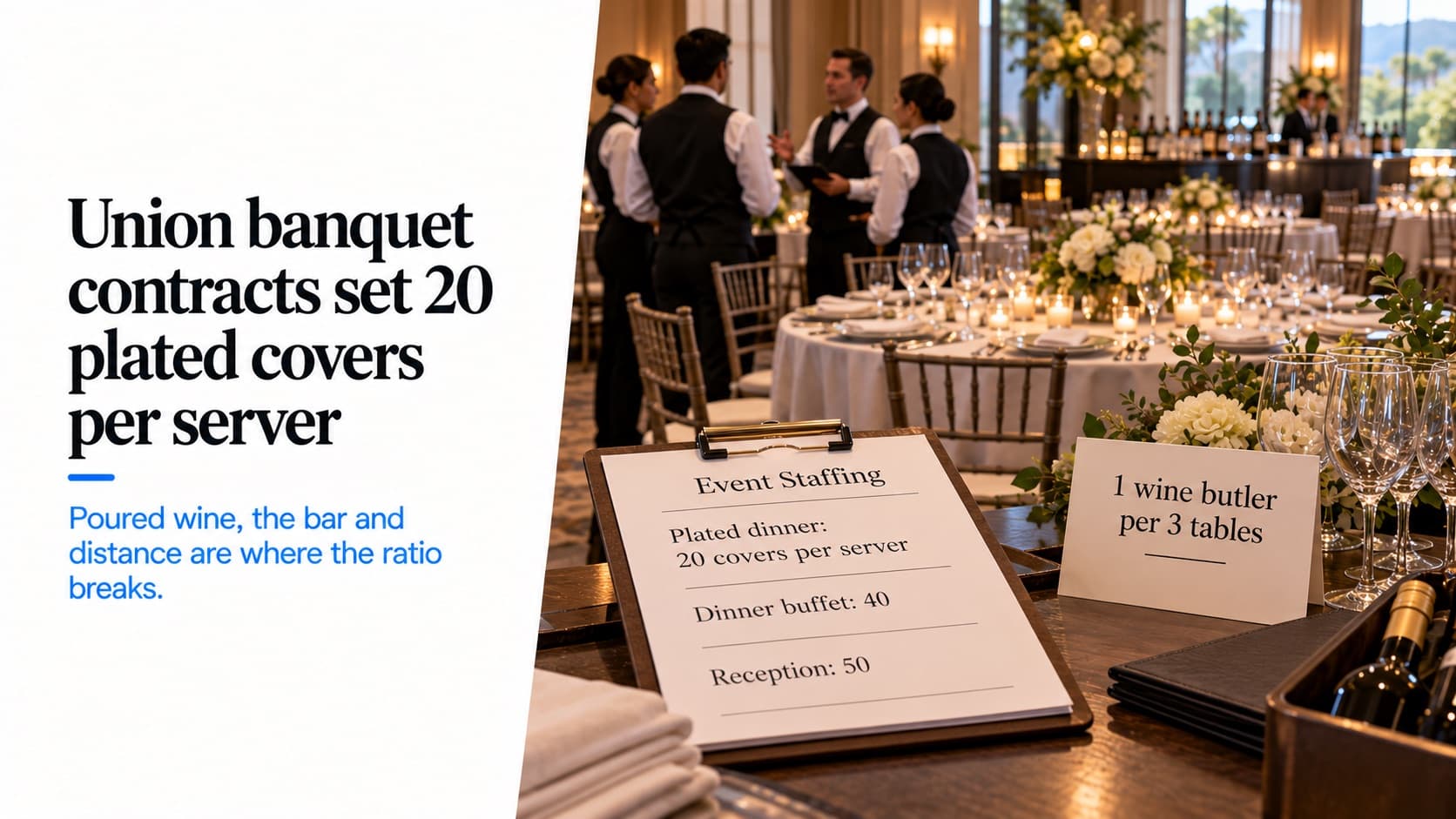
Union banquet contracts set 20 plated covers per server
A lunch-then-dinner double is a California split shift with its own premium. New York guarantees three hours of call-in pay per shift.

The staffing ratio everyone quotes for a catered event is one server per 20 to 25 guests plated, one per 30 to 40 on a buffet. It's even on this blog, in the catering pricing post. It's a fine starting point.
It's also the number that fails first on a real wedding, and the reason is that most of what's written about ratios comes from staffing apps selling you staff. I went looking for sources that don't have that incentive, and the most authoritative ones turned out to be unusual: union contracts, a university conference center, and a hospitality academic.
The ratios with nobody selling anything
Collective bargaining agreements are the closest thing this trade has to a negotiated standard, because both sides had to sign them. One clause, verbatim: "40 covers per team of two for French Service, 40 covers per individual for Buffet Service, and 30 covers per individual for Platter Service." Another sets plated dinner at 20 covers per server, dinner buffet at 40, and stand-alone receptions at 50.
MIT's Samberg Conference Center publishes its standard by role, which is the useful part:
- Plated: one server per table of 8 to 10, plus one wine butler per three tables.
- Buffet: one server per two tables, plus one buffet attendant per 50 guests.
- Receptions: one bartender per 100 guests, one passer per 50, one coat-check attendant per 75.
A hospitality academic's published set gives the range and the reasoning: an industry average of about one server per 32 guests regardless of service style, a full range of 1:8 to 1:40, a minimum of 1:20 for conventional American service, 1:16 for Russian, French or poured-wine service, and one busser per three servers.
Put together, the defensible ranges look like this:
| Role or style | Range | Most common |
|---|---|---|
| Plated | 1:8 to 1:25 | 1:10 to 1:12; 1:20 as the institutional minimum |
| Buffet floor | 1:16 to 1:30 | 1:20 to 1:25, plus attendants |
| Passed hors d'oeuvres | 1:20 to 1:50 | 1:25 |
| Bartenders | 1:30 to 1:100 | depends on the drink menu |
| Bussers | 1 per 2 to 3 servers | |
| Kitchen | 3 per 50 plated guests | the only figure published, by a vendor |
That last row matters. I found exactly one published kitchen ratio for events, and it came from a scheduling vendor. Nobody writes this down, which is why kitchens are the part of an event that gets staffed from memory.
Where the ratio breaks
Poured wine. Moving from preset or bar-served wine to wine poured at the table takes the minimum from 1:20 to 1:16 — 25% more labor on the floor. You can buy that capacity two ways: tighten the server ratio, or add dedicated pourers at about one per three tables. On a long plated dinner I'd take the pourers every time, because a server who's pouring isn't clearing, and clearing is what holds the next course.
The bar. The widest spread of any role, from 1:30 to 1:100, and the spread is almost entirely the drink menu. Beer and wine runs light. A signature cocktail that takes ninety seconds to build runs heavy, and you find out at 7:40 when the line is twelve deep and the room is waiting for toasts. Venues set floors too: one university caterer requires a minimum of two bartenders for any off-premise bar, and runs bars on the premise that sales will reach $150 an hour per bartender.
Distance. One vendor puts a 15% uplift on multi-level venues, long kitchen-to-floor carries and split service zones. I've no source for the 15% and I wouldn't cite it, but the direction is right. A barn with the kitchen a hundred yards from the tent is not the same event as a hotel ballroom with the same guest count.
The head table. A long head table served first, at the same moment, by the same people who also have forty rounds to serve, is where plated ratios quietly stop holding. Staff it as its own station.
More people isn't linearly better
There's one strong study on staffing and service speed, and its finding is worth knowing before you solve every problem with bodies.
Researchers studying a restaurant chain found an inverted U: when a server's workload is light, adding tables makes them work harder; past a threshold, effort drops as load rises. The chain was below saturation, and the researchers estimated it could cut staffing, raise sales about 3%, and lower labor cost about 17%.
That's à la carte service, not a synchronized banquet, so don't borrow the percentages. Borrow the shape: there's a right number, and it isn't "as many as the budget allows."
What a cover actually costs in labor
The Bureau of Labor Statistics' May 2025 occupational wage data, released in May 2026, has a category almost nobody uses: "Food servers, nonrestaurant," median $17.00 an hour. That's the one that covers banquet and catering servers. The restaurant waiter figures skew high because tips skew them — waiters' mean is $19.26 against a median of $16.94.
| Role | Median hourly | Mean hourly |
|---|---|---|
| Food servers, nonrestaurant | $17.00 | $17.37 |
| Bartenders | $16.51 | $19.61 |
| Restaurant cooks | $17.98 | $18.62 |
| Chefs and head cooks | $30.03 | $32.07 |
| Dishwashers | $16.73 | $16.49 |
Then the load on top. Employer FICA is 7.65%. Federal unemployment nets to 0.6% on the first $7,000 of wages, which is $42 per employee per year. State unemployment is where it gets interesting, because it also stops at a wage base. In California it's 1.5% to 6.2% on the first $7,000, plus a 0.1% training tax on the same base.
The consequence is my own arithmetic, so label it that way: because both unemployment taxes stop at $7,000, a seasonal event worker who never earns more than that carries roughly 8% to 14.6% in California statutory burden, while a full-year employee carries about 8% to 8.7%. Same crew, same night, different percentage, depending on whether they're your core staff or your June overflow. Workers' comp comes on top of that. California's average advisory rate is $1.65 per $100 of payroll from September 2026, but that's an all-industry average and excludes insurer expenses, so your actual rate is higher.
A worked example, labeled as arithmetic: 150 guests plated at one server per 10, plus six wine pourers, all on seven-hour shifts at $17.00. That's $2,499 in wages, about $16.66 per cover, rising to roughly $18 to $19 per cover with statutory burden. Before the kitchen, the bar, the captain or the dishwasher.
The rules that cost more than overtime
Federal overtime rarely binds on event staff. Hourly employees at restaurants and bars average 23.9 hours a week, per the Bureau of Labor Statistics, nowhere near forty. One detail does matter: overtime is weekly and can't be averaged across two weeks, so a heavy wedding week followed by a light one is still a heavy week.
What binds is state law, and two states name catering specifically:
California — Wage Order 5 expressly covers "catering, banquet, lunch service, and similar establishments."
- Daily overtime: 1.5x after 8 hours in a day, 2x after 12.
- Split shift: a lunch event, an unpaid gap, then a dinner event is a split shift, and it carries one extra hour at minimum wage — $16.90 in 2026 — for that day.
- Reporting-time pay: send someone home early and you owe half the scheduled shift, at least two hours and at most four.
- Meal period: no work past five hours without a 30-minute meal period, or an hour of pay as a premium. On a ten-hour wedding day this is the one I see missed.
New York — the Hospitality Industry Wage Order names catering and banquet.
- Call-in pay: at least three hours for one shift, six for two, eight for three. Because event staff hours vary week to week, there's no "regularly scheduled shift," so the flat minimums apply.
- Spread of hours: when the day runs more than 10 hours from start to finish, one extra hour at minimum wage — $17.00 in New York City. An 11am load-in to a 10pm strike is an eleven-hour spread.
- Overtime with a tip credit: multiply the full regular rate by 1.5 and then subtract the tip credit. Doing it in the other order is a violation.
The service charge line
If you add a mandatory service charge to the event, it isn't a tip. The federal rule says so directly — "a compulsory charge for service, such as 15 percent of the amount of the bill… is not a tip" — and the IRS treats any part paid to staff as wages. Some venues write their contract language to make the point explicit. One university wedding guide adds "an 18% administrative fee" that "is not intended to be a tip, gratuity or service charge for the benefit of the employees."
The full rules are in the tip pooling post. The staffing point is simpler: the service charge funds labor you already scheduled, and the contract should say what it pays for.
What I'm not going to give you
A kitchen ratio I'd stand behind. One vendor figure exists. Staff your kitchen from your menu and your equipment, not from a ratio.
A multi-level uplift as a rule. Directionally right, not sourced.
Guest-satisfaction numbers by staffing level. Two small banquet studies exist, single-hotel samples, and neither measures a ratio.
What to do before the next event
- Staff by role, not by headcount. Servers, pourers, bartenders, bussers, attendants, kitchen — each with its own ratio.
- Decide how wine is served and staff for it. Poured at the table is 25% more floor labor.
- Set bartenders from the drink menu, not the guest count.
- Staff the head table as its own station.
- Price labor per cover with burden, and use the non-restaurant server wage, not the tipped waiter average.
- Check your state's premiums — split shifts, reporting time, meal periods, spread of hours — before you schedule a double.
- Write down what the service charge pays for.
Disclosure: I work at Katalyst, which sells restaurant and catering software including scheduling, and I've built enough event schedules on the back of a BEO to know that software doesn't choose the ratio. It does make it easier to see, the week after, that the head table got served eight minutes late because nobody was assigned to it.
Related Katalyst products
See how Katalyst handles your service style
A 30-minute walkthrough of the platform, tuned to how your restaurant actually runs.