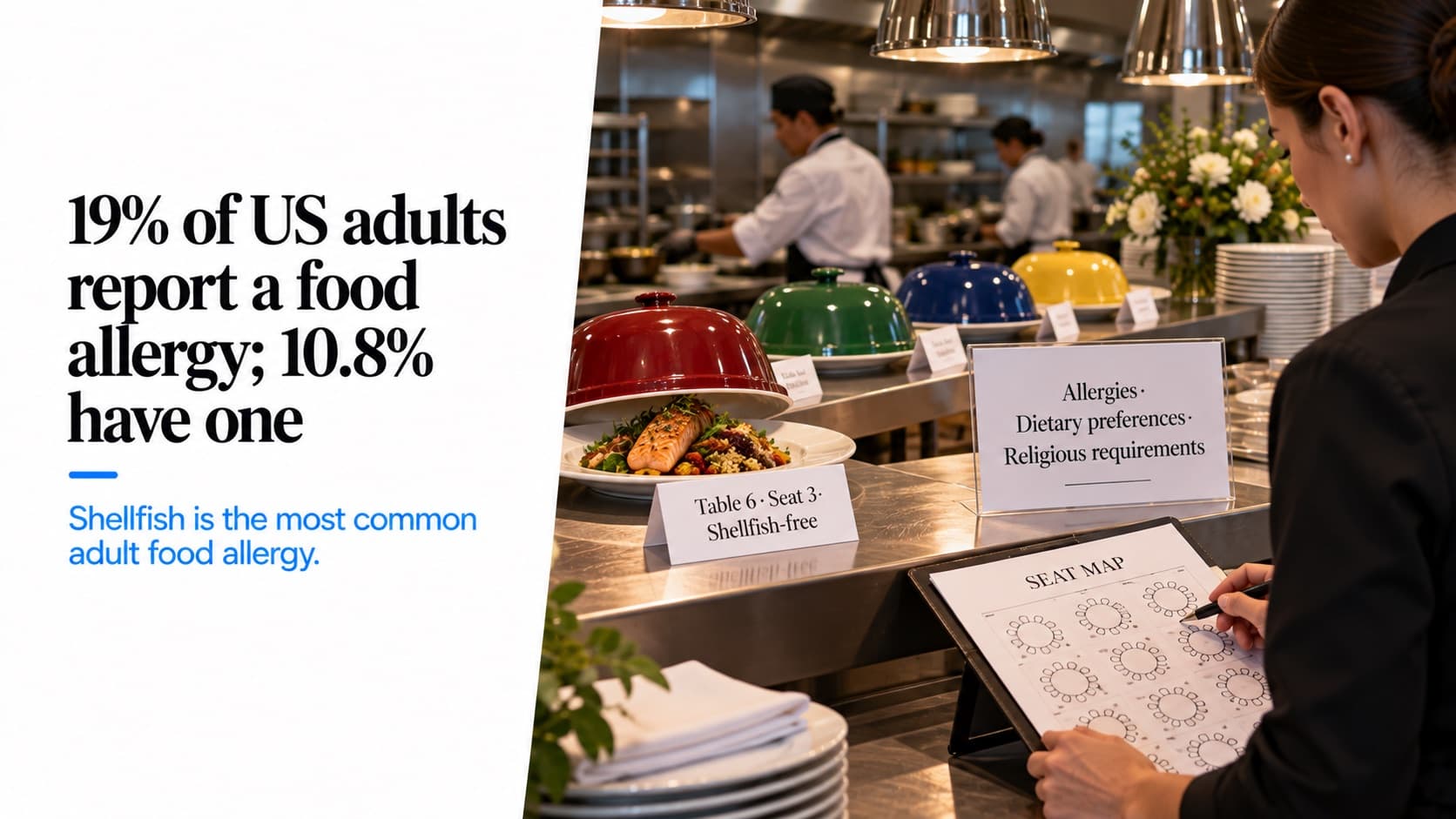
19% of US adults report a food allergy; 10.8% have one
Shellfish is the most common adult food allergy, and nearly half of allergic adults developed theirs as adults. Last year's dietary list is already stale.

The registration list comes back two days before a 400-person dinner, and the dietary column is longer than it was five years ago. Gluten-free, vegan, no shellfish, "allergic to nuts," "no pork," "lactose," a few entries that just say "yes." Every one of those becomes a plate that has to be made separately, carried separately and put in front of the right person.
I can't tell you how many to expect from a source I'd trust; I couldn't find one. What the research does tell you is why the column keeps growing, and why you shouldn't try to sort the real requests from the others.
The numbers behind the column
The largest US study of adult food allergy, by Ruchi Gupta's group in JAMA Network Open in 2019, surveyed more than 40,000 adults:
- 19% said they had a food allergy. 10.8% had a convincing one.
- 51% of those with a convincing allergy had had a severe reaction. Only 24% had a current epinephrine prescription.
- 48% developed at least one allergy as adults.
- The most common adult allergy is shellfish, at 2.9%, ahead of milk (1.9%), peanut (1.8%), tree nuts (1.2%) and fish (0.9%).
Two of those matter for banquets. Shellfish is the most common adult allergy and a staple of upscale menus. And because nearly half of allergic adults develop theirs as adults, last year's list for a repeat event is out of date.
On preferences, Gallup's 2023 survey put vegetarians at 4% and vegans at 1% of US adults, flat for a decade. Celiac disease affects about 2 million Americans by the NIH's estimate, many undiagnosed — not the "1 in 100" that circulates.
Don't sort the requests
At 500 guests, those rates suggest roughly 95 people who'd say they have a food allergy and about 54 who'd have a convincing one. That's my arithmetic, not a measured event count. The gap between the two numbers is real: intolerances, preferences, someone who reacted once.
The kitchen can't tell which is which from a registration form, and neither can I. So every allergen request is handled as an allergy. The cost of over-treating a preference is a separate plate. The cost of the other mistake is an ambulance.
Ask better questions
The most useful change happens before the list arrives. Industry coverage of a hotel-association survey recommended dropping the open free-text box and asking three separate questions, allergens first:
- Allergies, with the nine major allergens as checkboxes and a field for the specific food — "tree nuts: walnuts," not "nuts."
- Dietary preferences: vegetarian, vegan, gluten-free by choice.
- Religious requirements: kosher and halal meals often come from outside suppliers and can need about a week's notice.
The same survey found 79% of planners getting more dietary requests than two years earlier. That's from 2018, and the trend hasn't reversed.
Federal attendees have a new reason to tell you
Since December 2025, a federal traveler who can't eat a meal provided at a conference for medical or religious reasons can claim their full meal allowance without approval, unless the menu was published ahead of time. GSA's example is a conference meal where "no specifics on the meal composition (e.g., meals with common allergens such as nuts) are provided in advance." The per diem post covers the rest. The practical result: send the menu with its allergens to the organizer before registration closes.
What the code requires of your kitchen
The model Food Code makes the person in charge responsible for staff being "properly trained in food safety, including food allergy awareness, as it relates to their assigned duties," and the 2022 edition added written notice of major allergens in unpackaged food, which reaches plated banquet food where it's adopted.
What it doesn't have is a full rule for keeping allergens apart. FDA's own annex says the existing cross-contact provision "falls short of comprehensive allergen cross-contact control." The 2026 Food Code, released last month, revised the definition and added a framework document without a new mandate. The separate boards, dedicated fryers and glove changes good banquet kitchens use come from house policy and training, not the code.
Several states require allergen training. Illinois requires certified food service managers to complete it within 30 days of hire and every three years. Massachusetts, Rhode Island, Michigan and Virginia have their own requirements. The allergen management post covers the restaurant version.
The ADA question
The Justice Department has said that "some individuals with food allergies have a disability" under the ADA. Its 2012 settlement with Lesley University required allergen-free options, pre-ordering and a dedicated prep space, but that obligation came from a mandatory meal plan. The department also said a restaurant "is not required to alter its menu."
A conference where lunch is included in registration and attendees can't realistically eat elsewhere looks more like a meal plan than a restaurant. That's my reading; the guidance doesn't mention events. It's a reason to accommodate requests rather than argue about whether you have to.
Getting the right plate to the right seat
I couldn't find a published planner standard for this, so here's how I do it:
- Every special meal has a name, not just a seat number. A UK university's catering terms require it — names "MUST be supplied," and the team provides "individual, labelled items."
- Seat map before service, checked against the list by the captain.
- Special plates leave the kitchen from a separate pass, with a card or a colored cover, carried by an assigned server.
- Servers confirm quietly — "you asked for the shellfish-free plate?" — and never announce it to the table. Guests shouldn't feel singled out.
- One spare of each special plate, for the guest who didn't register the request.
- Write down the ingredients of every component, so the answer to "what's in the sauce?" doesn't depend on who's working.
What published policies say
University caterers again publish the clearest terms. SIUE accommodates dietary needs with three business days' notice and says "we are unable to guarantee that any menu entrée can be completely free of allergens." The UK university above also makes the booker responsible for supervising the food after delivery — a clear line on who controls cross-contact once the caterer leaves.
What I'm not going to give you
The share of registrants who declare a dietary need. "Over half" is attributed to an industry survey I couldn't find.
A standard surcharge or cap for special meals. The only published charge I found was $2 for gluten-free bread.
Religious-diet prevalence. I didn't find a reliable US figure.
What to do
- Replace the free-text box with three questions, allergens first.
- Treat every allergen request as an allergy.
- Publish the menu with allergens to the organizer before registration closes.
- Put a name on every special plate, and send it from its own pass.
- Train servers to confirm quietly and never guess.
- Don't reuse last year's list.
For boxed lunches with special meals, see the boxed lunch post.
Disclosure: I work at Katalyst, which sells catering software that carries dietary notes from the order to the kitchen. The step that prevents the mistake is still a captain with a seat map, checking names before the plates go out.
Related Katalyst products
See how Katalyst handles your service style
A 30-minute walkthrough of the platform, tuned to how your restaurant actually runs.