Pre-dinner hors d'oeuvre guidelines differ by four times
Brown and Hershey plan 8–10 pieces per person per hour before dinner; a convention-center caterer plans 2–4. In lieu of dinner, sources agree on 12–15.

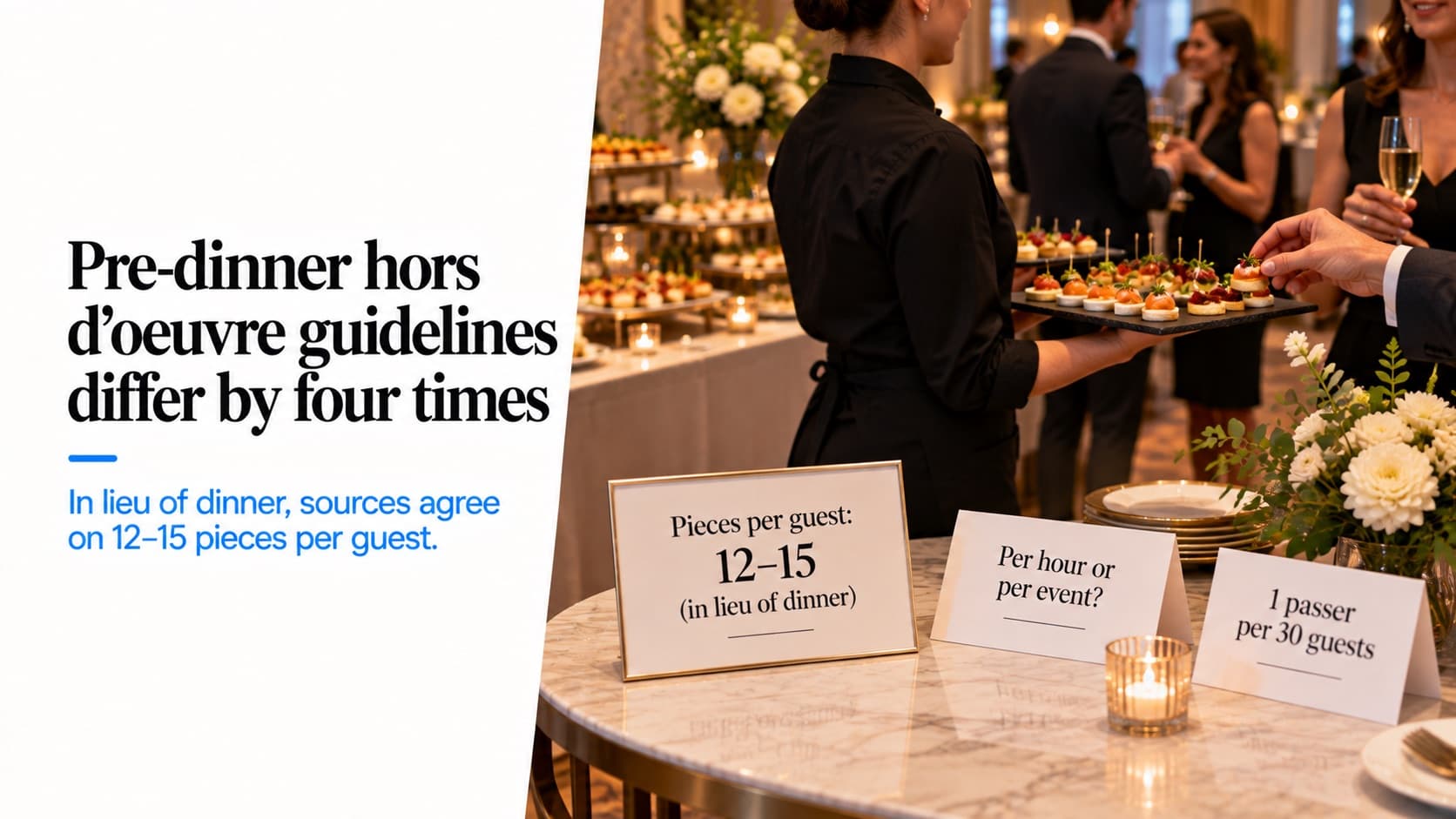
"How many pieces per person?" is the question I get most from clients planning a reception, and the one with the worst published answers. Every caterer has a rule. They don't agree, and half the disagreement is that they aren't measuring the same thing.
I lined up the guidance that venues and university caterers actually publish. Before dinner, it differs by a factor of four. Instead of dinner, it mostly agrees.
What venues publish
| Source | Reception before dinner | Reception instead of dinner | Unit |
|---|---|---|---|
| Brown University Faculty Club | 8–10 | 10–12 | Per person per hour |
| Hershey Lodge | 8–10 | — | Per person per hour |
| University of Kansas | 6–10 first hour, then 4–6 | — | Per person per hour |
| Washington State University | 6–10 first hour, then 4–6 | — | Per person per hour |
| Monona Terrace convention center | 2–4 | 12–15 | Per hour before dinner; per guest instead of dinner |
| Morton Arboretum | 3–5 | 12–14 | Per guest, whole event |
| College unions association (ACUI) | 4–10+ by appetite | 6–16+ by appetite and length | Per guest, whole event |
The low numbers don't come from the venues you'd expect to undersell. The convention-center caterer and the arboretum, both selling the food, publish the lowest pre-dinner figures.
The unit is the trap
Read the last column. Brown's 8–10 is per hour; Morton's 3–5 is for the whole cocktail hour. A two-hour reception at Brown's rate is 16 to 20 pieces a person. At Morton's, it's 3 to 5. Most of the "disagreement" between caterers is one quoting per hour and the other per event.
And the rule you'll see repeated everywhere — "6–8 pieces the first hour, 4–6 after" — doesn't match any source I found. The closest published versions, from Kansas and Washington State, say 6 to 10 the first hour.
Instead of dinner, the sources converge: 12 to 15 pieces a person at Monona Terrace, 12 to 14 at Morton, and 10 to 16 at ACUI depending on appetite and length. If the reception is the meal, plan in that range.
A luxury resort shows how low a package can go. Wynn Las Vegas's package reception includes "five or six selections... one of each per person" — five or six pieces total.
What changes how much people eat
The college unions association's planning sheet is the most useful thing I found, because it lists what moves consumption:
- "Smaller plates or no plates reduce consumption."
- "Passed appetizers reduce consumption."
- "Fewer appetizer stations in a big room reduces consumption."
- "A hosted bar increases consumption as people stay longer."
- "The more options you offer, the more likely people are to take '1 of each.'"
Marquette University's event planners add two more. "Guests tend to eat less when the food is passed versus buffet style," which offsets the labor. And "consumption drops when people don't have 360 degree access to food tables," so put the buffet against a wall.
The open bar point matters for holiday parties. The bar post covers why food on the bar is a safety requirement; it's also why the food runs out sooner than planned.
How many varieties
More varieties don't mean more food per person; they mean people take one of each. Brown caps a reception at six selections plus a crudité, cheese and one specialty item. Wynn's packages are three or five to six. For most receptions of 100 or more, I'd stay at five or six, with one vegetarian and one substantial item.
How it's sold, and the minimums
Menus price by the dozen, by the piece or by the hundred, and each sets a minimum per selection:
- Brown: two dozen per selection.
- Washington State and a Nashville hotel: 30 pieces.
- Morton Arboretum: 50 pieces per selection.
- Hershey Lodge: by the hundred, plus a 23% service charge.
Minimums are why a small reception can't have eight varieties. Fifty guests and a 50-piece minimum per item is one piece of each, per guest.
Passers, space and stations
- Passed service: Carnegie Mellon's policy is one server per 30 guests; a Nashville hotel requires one per 35. Wynn bills a server per 50 guests. That's a billing unit, not a standard.
- Space: ACUI lists 6–7 square feet per person as the bare minimum and 10 or more to circulate. Under 8, the passers can't move.
- Stations: Monona Terrace plans one double-sided buffet per 150 guests. The staffing post covers the rest of the floor.
For a reception that replaces dinner, Marquette plans "anchor foods (such as cheese and vegetables) for one-third of the attendees," action stations for half, and one of each hot item per person.
How I plan it
- Decide first whether dinner follows. That's the biggest number in the calculation.
- Convert every rule to one unit: pieces per guest for the event.
- Before dinner: about 4 to 6 per guest for an hour if passed, more with a hosted bar.
- Instead of dinner: 12 to 15 per guest, with stations doing part of the work.
- Five or six varieties, each meeting the minimum.
- Pass the expensive items and station the cheap ones.
That's my practice, not a published standard.
What I'm not going to give you
Napkin and plate counts. Every figure I found comes from napkin sellers.
"One passer per 50 guests" as a standard. It's one resort's billing unit.
A per-hour rate I'd defend against all of the above. The sources disagree too much for one number.
What to do
- Ask the venue whether its rule is per hour or per event.
- Write the count per guest in the banquet event order.
- Cut plates and pass more if the budget is tight.
- Put the buffet on a wall.
- Plan more food when the bar is hosted.
Disclosure: I work at Katalyst, which sells catering software, and I still pick up a handful of events a year. The count that matters is the one you write down before the event and check against the trays after it. Next year's estimate comes from that.
Related Katalyst products
Topics
See how Katalyst handles your service style
A 30-minute walkthrough of the platform, tuned to how your restaurant actually runs.