A hotel's banquet order said 'keep the glasses filled'
California shields hosts and licensees from overserving claims, yet employers still lose through their employees. In 2013 a court listed the fixes.

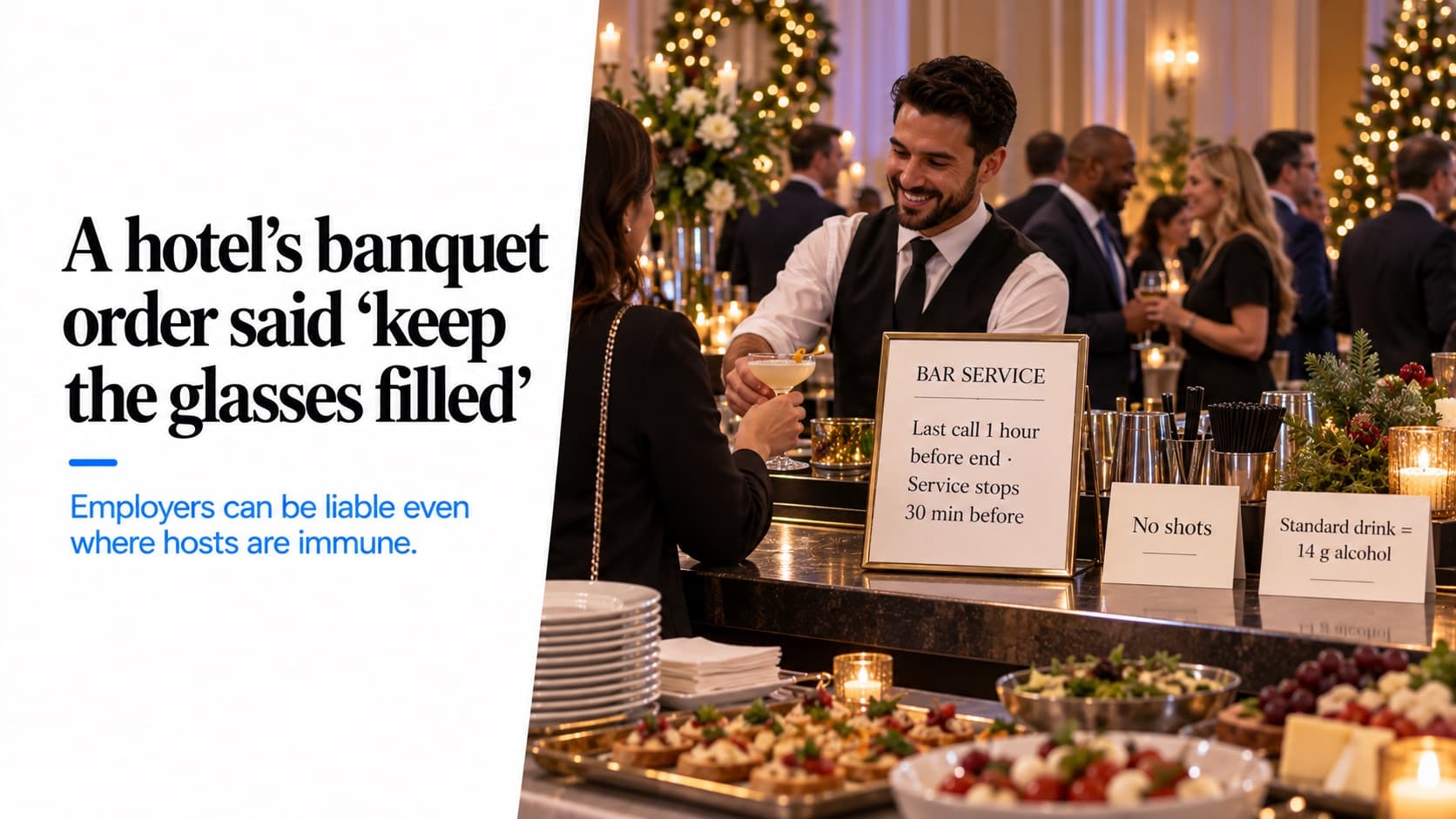
I've run the bar at a lot of company holiday parties, and the conversation with the client is almost always about the package: open bar or drink tickets, beer and wine or full bar, how many hours. It's almost never about who's liable if someone drives home drunk. That's the conversation that matters, and the answer surprises most people: in a lot of states it's the company, not the bar.
None of this is legal advice. It's what the published cases and statutes say, and the practical setup I take from them.
The cases that decided it
The pattern is consistent across forty years of court decisions, and the facts read like a banquet captain's worst night.
- Washington, 1986. Kaiser Aluminum held a long-service banquet at a Red Lion hotel. The banquet order told servers to "keep the glasses filled." An employee had at least ten drinks by the end of dinner, kept drinking for two more hours, and crashed driving to his night shift. The state supreme court set out when a banquet-hosting employer is liable, starting with whether the party served the employer's interest and the employee was expected to be there.
- Indiana, 1988. A company Christmas party with a self-serve bar and a game of "Quarters." The office manager drank six to eight shots of whiskey in about 40 minutes, drove the wrong way on the interstate, and hit someone head-on. The $150,000 judgment against the employer was affirmed. His own auto policy paid $25,000. The company was the deep pocket.
- California, 2013. In Purton v. Marriott, the hotel company's own holiday party had a plan: two drink tickets each, beer and wine only. The bartender, a manager, refilled an employee's flask from a bottle of Jack Daniel's. The employee got home, drove out again twenty minutes later, and killed a man. The court reversed the summary judgment for the employer.
And in Texas, the state supreme court held in 1983 that a supervisor who sent a visibly drunk worker home to drive had exercised control over him, and that the employer owed the public a duty because of it. Sending someone home in their own car isn't stepping away from the risk. It's taking it on.
Host immunity doesn't protect the employer
California has some of the strongest protections in the country. "No social host who furnishes alcoholic beverages to any person may be held legally accountable" for what an adult guest does after drinking, and a licensee who serves an adult isn't civilly liable either. So in California the bar and the host are both shielded.
The employer isn't. In a 1981 case about a Christmas party at a fireworks plant, where employees were paid to attend, the court said its holding was "not based upon" the company's furnishing alcohol at all. The employee was still working. That route — the employer is responsible for what its employee does in the course of the job — doesn't care about social host rules, and it's how Marriott ended up in front of a jury.
Elsewhere, states split on hosts:
- Host liability for serving an adult: New Jersey since 1984, Massachusetts, North Carolina, and Oregon, where the plaintiff has to prove visible intoxication by clear and convincing evidence.
- No host liability for adults: California, Illinois, Texas and Pennsylvania.
The New Jersey case has the detail I tell every client. The hosts said their guest had "two or three drinks of scotch." His blood alcohol after the crash was 0.286, which an expert put at the equivalent of thirteen drinks. What a host believes a guest drank and what the guest drank are not the same number.
The caterer holds the license, and the contract may hand the risk back
When you hire a licensed caterer or a venue bar, they're the licensee, and in most states they carry dram shop exposure for serving a visibly intoxicated guest. Convention center contracts say so plainly. Orlando's caterer is "the sole holder of liquor licenses" and reserves the right to refuse anyone who appears intoxicated.
Then read the next line in Las Vegas's contract: "As a host of all users of your booth or meeting room, you are responsible for the appropriate and lawful consumption of alcohol by your guests." The licensed caterer is serving, and the contract puts host responsibility back on the client. If you're the client, read your bar terms before the party, not after.
Who's allowed to hold the permit
- California: a for-profit company can't get a one-day license. San Francisco's guidance is direct: if the organizer is a for-profit business, you "must hire a company that already has a Caterer's Liquor Permit." A free bar at a closed company party on non-licensed premises may need no license at all, which is exactly when the host is relying on that immunity.
- New York: a caterer's permit goes only to an existing on-premises licensee, for a private indoor event with a guest list, and lasts 24 hours from 8 a.m. After 12 permits at one location in six months, further applications may be denied.
- Texas: a licensed retailer can serve a private event of up to 500 people with less than $10,000 of alcohol under a simple notification.
A cash bar can cost the company its insurance
An ordinary commercial general liability policy covers "host liquor" liability for a business that isn't in the alcohol business, which is why a company picnic is usually covered. Many policies carry an amended exclusion that removes that coverage when alcohol is served "for a charge, whether or not the activity requires a license." A cash bar, or a ticket price that includes drinks, can trigger it.
California's supreme court made a related point in 2014: a host who charged an entrance fee that entitled guests to drink was treated as a seller. Selling drinks at a company party sounds like a way to limit consumption. It can also turn the host into something the law and the insurance policy treat very differently. The insurance post covers exclusions in general.
How I run the bar
The Purton court wrote the list for me. The company "could have lessened this risk in numerous ways such as having a policy prohibiting smuggled alcohol, enforcing its drink ticket policy, serving drinks for only a limited time period and serving food." Here's how that turns into a setup:
- Last call an hour before the end; service stops 30 minutes before. That's the University of Iowa's catering policy, and the reason is physiological: blood alcohol "can continue to rise even when a person stops drinking," according to the National Institute on Alcohol Abuse and Alcoholism. A guest who leaves at the end of the party is driving near their peak.
- Know what a drink is. The federal standard drink is 14 grams of alcohol: 12 ounces of 5% beer, 5 ounces of 12% wine, 1.5 ounces of spirits. A 6-ounce banquet pour is 1.2 drinks. A 10% craft beer is two. California's ABC notes the liver clears roughly one drink an hour, and that coffee doesn't speed it up.
- No shots, no self-serve. A Delaware club's banquet rules forbid shots outright, and the Indiana case turned on a self-serve bar.
- Staff the bar for the menu. Published policies run one bartender per 50 guests for mixed drinks and one per 100 for beer and wine. An understaffed bar doesn't slow drinking. It produces doubles.
- The bartender's refusal stands. Write it into the contract that staff may refuse service, and that "such refusal shall at all times be respected," as the Delaware club's rules put it.
- Food on the bar order. Iowa won't take a bar order without one.
- Trained staff. California requires every on-premises server and manager, caterers included, to be certified within 60 days of hire. In Texas, training is voluntary but it shields the employer: an employee's sale isn't attributed to an employer that requires approved training and doesn't encourage violations.
Price tells you something too. The Delaware club's open bar costs $19 a head for one hour and $25 for two. The first hour costs three times each additional hour, because that's when people drink. Shorter bars aren't proportionally cheaper, and they aren't proportionally safer unless the end is enforced. The pour cost post covers the margin side.
What I'm not going to give you
A count of states with host liability. Sources disagree and I couldn't find a reliable 50-state chart.
Evidence that drink tickets work. I found none. The only hard evidence is Purton, where tickets failed because nobody enforced them.
"Blood alcohol drops 0.015 an hour." It's everywhere online and I couldn't trace it to a federal source.
What to do
- If you're the employer, assume the liability is yours, whatever the state's host rule says.
- Read the bar terms in the venue or caterer contract for who carries host responsibility.
- Don't sell drinks at a company party without checking your policy for the "for a charge" exclusion.
- Set last call an hour before the end and stop service 30 minutes before.
- Staff the bar, ban shots and self-serve, and put food on the order.
- Arrange rides, and don't send anyone home in their own car.
For staffing the rest of the room, see event staffing ratios.
Disclosure: I work at Katalyst, which sells restaurant and catering software, and I still work a handful of events a year, usually behind a bar. Nothing in this post needs software. It needs a bartender who's allowed to say no.
Related Katalyst products
Topics
See how Katalyst handles your service style
A 30-minute walkthrough of the platform, tuned to how your restaurant actually runs.