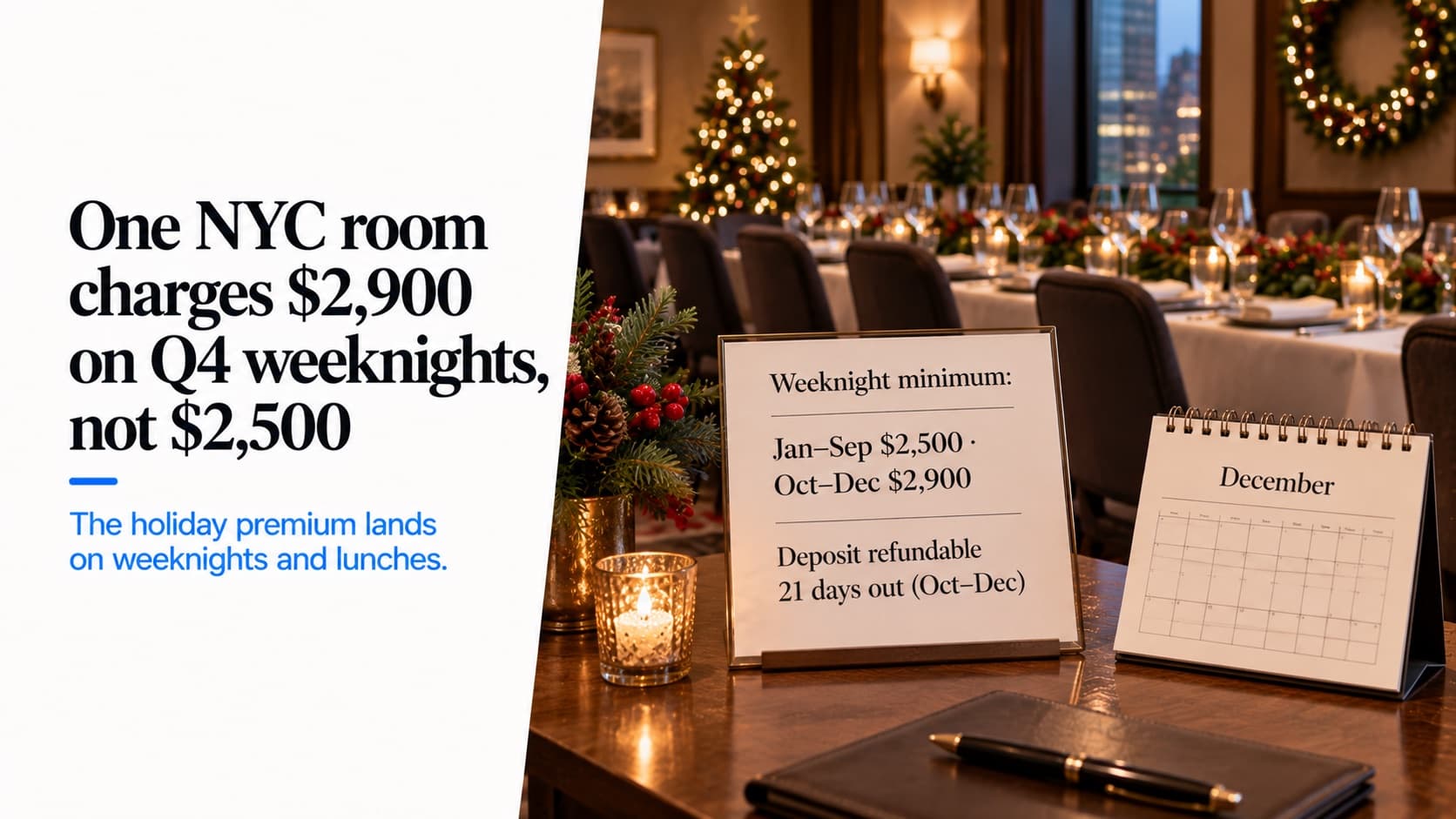
One NYC room charges $2,900 on Q4 weeknights, not $2,500
In 2023, 58% of companies held their holiday party during the workday. Fogo de Chão's holiday contracts had to be signed by October 30.

December gets sold in October. By the time the first office manager calls in November asking about "a Friday in mid-December," the good Fridays are usually gone, and the ones left are priced for the season.
What surprised me, pulling together published holiday terms from restaurants and hotels, is where the holiday premium actually sits. Not on Saturday night. On the weeknight and the lunch, the slots that sit empty the rest of the year.
The parties moved into the workday
The longest-running survey of company holiday parties comes from Challenger, Gray & Christmas, a small sample of HR and business leaders. Its 2023 results are the ones I'd plan around:
- 58% of companies held the party during the workday, up from 48%.
- 32% held it on company premises.
- About 57% served alcohol, down from 63%.
In 2024 the share of companies planning a party held flat at 64%, and 17% planned to cut the budget, up from 8%.
The direction is clear: more parties at lunch, more in the office, fewer evening buyouts. For a caterer that's a different product — a delivered or staffed lunch for 80 on a Thursday at noon — and it's the slot most restaurants don't price for the season at all.
A catering marketplace's 2025 survey of employees says 56% want a Friday and 53% prefer the afternoon. It's a vendor's survey with no published method, but it points the same way.
What published venues charge in the fourth quarter
| Venue | Normal | Holiday | Notes |
|---|---|---|---|
| Hearth, New York (private room) | Weeknight $2,500 | Weeknight $2,900, Oct–Dec | Weekend $4,000 all year |
| Poole's, Raleigh | Sun–Wed $2,000 | Thu $2,500, Fri–Sat $4,000 | 25% deposit; 22% gratuity + 5% admin |
| V's Italiano, Missouri | Dinner $400 | December Fri–Sat $500 | Lunch $300 |
| Prime + Proper, Detroit | — | — | 50% deposit; full minimum owed inside 14 days |
| Bellyard Hotel, Atlanta | — | $8,000 minimum | Book by December 15 |
Hearth's own guide shows the pattern cleanly. The weekend minimum is $4,000 all year, because it's already at peak. The holiday season lifts the weeknight by 16%, from $2,500 to $2,900. An older contract from a Virginia restaurant did the same thing more bluntly: from the week before Thanksgiving through New Year's, $250 was added to every minimum, which doubled the lunch minimum and added a third to a Friday seating.
The cancellation window gets longer
Hearth's deposit is refundable with "14 days" notice from January to September, and "21 days in advance... October-December." The season doesn't only raise the price. It lengthens the period in which the client is committed.
The Detroit steakhouse is the strictest published version I found: a 50% deposit on the minimum plus room fee, refunded 90% at 60 days out, 50% at 30 to 59 days, nothing inside 30. Inside 14 days the client owes the full minimum or the guaranteed count, whichever is greater.
And watch the add-ons. Poole's charges a 22% gratuity and a 5% administrative fee on top of the minimum, plus 3% for card payments. That's about 30% before tax. A client comparing your proposal to a restaurant's minimum is often comparing your all-in price to someone else's base.
When the market signs
I couldn't find independent data on how far ahead companies book. The best public signal is a chain's own deadline. Fogo de Chão's 2026 holiday group offer required agreements signed between August 3 and October 30 for events from November 1 to December 30. The reward, a $100 host card, is redeemable January 3 to March 7, Sunday to Thursday only.
That's a well-built offer. It closes the December book by Halloween, and it uses December's demand to fill the slowest weeknights of the first quarter.
Watch who gets the reward
The Atlanta hotel's holiday offer adds 25,000 loyalty points — to the person who books, not the company paying. That's common in hotels and it can put the coordinator in an awkward spot with their own procurement policy. If you build an incentive, give it to the company: a credit on the invoice, a January event, a free upgrade. The venue lists post covers why undisclosed benefits are a bad look even when they're legal.
A minimum shortfall paid in gift cards
One older contract had a clause I've since borrowed. If a party spent less than the minimum, the difference was paid in the restaurant's own gift cards rather than forfeited. The client gets something for the shortfall, the restaurant keeps the revenue, and the gift cards bring people back in January. The gift card post covers the accounting.
What I'm not going to give you
Booking lead time. "Book 10 to 12 weeks ahead" is supplier advice. I found no survey.
"December minimums run 50 to 100% above January." It's in a lot of guides and I couldn't trace it to anything.
A 2025 Challenger figure. I couldn't find a 2025 edition.
How I'd price December
- Put the premium on weeknights and lunches, where the season creates demand that doesn't exist the rest of the year.
- Lengthen the cancellation window for October through December, and say so in the proposal.
- Sell a workday product: a staffed or delivered lunch with a per-person price, not just an evening minimum.
- Set a signing deadline and use a January credit to fill slow weeks.
- State your add-ons up front so the client compares all-in to all-in.
If alcohol is part of it, read the holiday party bar post first. For deposits and minimums in general, see private dining minimums and deposits.
Disclosure: I work at Katalyst, which sells event and catering software with seasonal pricing and deposit schedules. The decision that earns the most here is when your premium applies, and that one's yours.
Related Katalyst products
See how Katalyst handles your service style
A 30-minute walkthrough of the platform, tuned to how your restaurant actually runs.