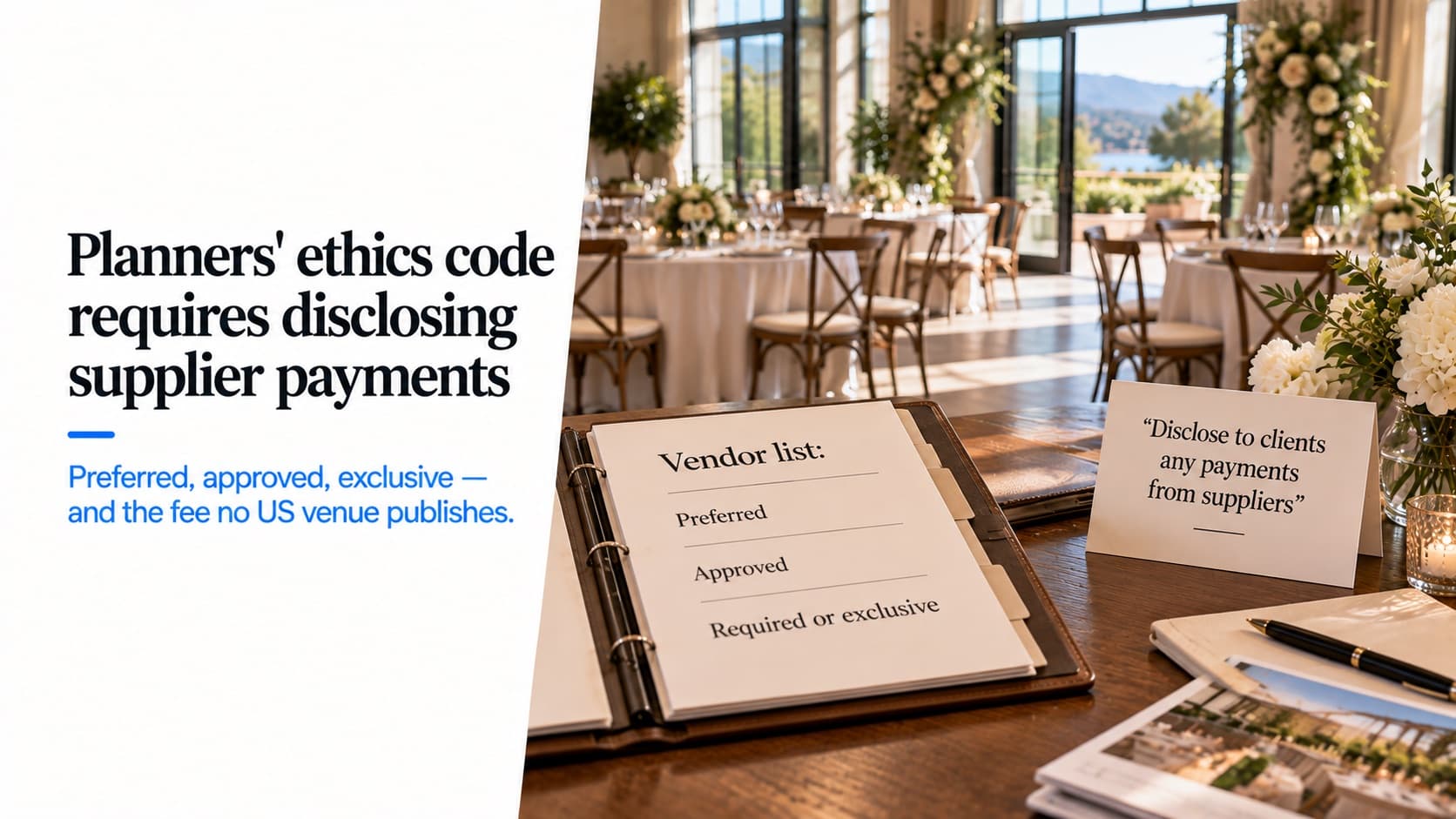
Planners' ethics code requires disclosing supplier payments
Venues sell placement three ways: flat monthly fee, per booking, or performance. Reported outside-caterer buyouts run $500 to $2,000, and none is published.

Every caterer who works weddings eventually has the same conversation with a venue. They'd love to add you to the list. There's a fee, or a percentage, or a monthly rate, and it's rarely written down anywhere you can find it.
I've been on both ends of that call. What follows is what the published documents actually say — and the most useful finding is something I couldn't find at all.
Three tiers, and they are not interchangeable
A Texas venue publishes an unusually candid explainer of its own vendor list, and its definitions are the clearest I've seen:
- Preferred — "recommended, not mandatory." The venue has worked with these vendors; the couple may still bring someone else.
- Approved — the vendor "has met stated venue criteria," which can include insurance, application materials, property training, operational capacity or previous event experience.
- Required or exclusive — "the contract controls the choice. You may have to use the venue's caterer."
Those lists typically hold about six vendors per category. Before you negotiate anything, establish which tier you're being offered, because the economics differ completely.
Three ways venues charge for it
The same venue names the models plainly, and tells couples to ask about them: performance-based (the vendor is evaluated, pays nothing for placement), paid placement (the vendor pays to be included), and per-booking (the venue is compensated when a couple books that vendor). It states outright that "some venues receive referral fees, commissions, or other benefits when couples book listed providers."
A published example of the paid-placement model: Ever After Farms, which runs nine Florida venue locations, sells a Preferred Vendor Program at a monthly flat rate that varies by region and service type, with a three-month minimum because "it can take up to that amount of time for you to experience a full return." Vendors get a listing with a backlink, materials in the tour folders couples take home, and a "Preferred Vendor" seal. Higher-volume locations cost more, an application is required, and paying doesn't guarantee acceptance.
The same model exists off-venue. Directories such as Planning.Wedding sell vendor listings at a flat monthly rate with no commission or per-lead fee, which is the paid-placement model without a venue attached.
The per-booking model is best documented by a Toronto caterer, which calls it a landmark fee: "a percentage of the vendors total invoice that is charged to the client and then remitted back to the venue," running 10–20%. Its useful observation is the inverse relationship. In-house catering: no fee, because the venue and the caterer are the same business. Exclusive caterer: a smaller fee, often none. Preferred: reduced. Outside caterer: the highest. The closer you sit to the list, the smaller the venue's cut.
That term is mostly Canadian; US venues describe the same economics as vendor fees, commissions or outside-caterer fees. Borrow the mechanism, not the price.
The number nobody publishes
Here's the finding. I obtained four complete US catering policies and contracts with exact figures for cake cutting, entrée surcharges, bar setup fees, deposits and guarantees. Real documents, published on the open web, down to $2.50 a head.
I could not find a single US venue publishing its outside-caterer or preferred-list fee.
What circulates comes from couples reporting what they were told: $500 for not using the venue's caterer; a $200 deposit for going off the list; $750 per outside vendor plus 15% of the catering bill; $1,000 to bring in an outside caterer; a $2,000 buyout. The range is real and no single number is representative.
Treat that absence as information. A fee nobody publishes is a fee that's negotiated, and it's priced against how much the venue wants your food in the room. It also means you cannot benchmark it from the internet. You can only ask, in writing, and compare across the venues that will answer.
Commission, referral fee, kickback
The wedding planners' trade association draws the line precisely, and its definitions are worth adopting because they're the vocabulary your clients' planners already use:
- Commission — "you receive a percentage of the sale."
- Referral fee — "you receive a set dollar value for each sale you send to the vendor."
- Kickback — "you receive an amount of money over and above the original cost of the sale." Its worked example: a $5,000 floral contract where the florist still receives $5,000, the referrer gets $500, and the client pays $5,500.
And the rule attached to all three, in the same code of ethics: "Disclose to clients any payments from suppliers." An industry consultant puts the distinction in one line: "The keyword here is undisclosed. If the client does not know about the vendor-to-vendor payment, it's a kickback."
A second association's code goes further on appearances, asking members not to accept gifts or favors "which will impair or appear to influence professional decisions." That's an appearance standard, and it is the one that matters commercially. A couple who discovers later that their venue was paid to recommend you will not parse the difference between a commission and a kickback.
Notably, the planners' association doesn't recommend any of these arrangements. Its advice is to "charge a fair price for your services and let your vendors do the same," because when something goes wrong the client assumes the recommendation was bought.
Is any of it illegal?
Here I have to be careful, because the honest answer is thinner than the internet suggests.
General consumer-protection law plausibly reaches an undisclosed markup. Texas's Deceptive Trade Practices–Consumer Protection Act, for example, reaches failures to disclose information that would have altered a consumer's decision, and it can be enforced by the attorney general, by district attorneys, and by consumers directly, with treble damages available.
But: I found no enforcement action, no state statute specific to wedding or event referral fees, and no reported case, in any state. Two trade associations require disclosure as a matter of ethics. Nobody, as far as the public record shows, has enforced it against a venue or a caterer.
Same for exclusivity. There is no US antitrust case about exclusive wedding-caterer arrangements. A tying claim would require the venue to hold real market power, and one venue among hundreds in a metro almost certainly doesn't. Don't let anyone tell you an exclusivity clause is legally fragile.
What the list actually requires
The gatekeeping is mostly insurance, and the numbers are consistent. The University of Michigan Golf Course requires a certificate of insurance evidencing general liability of $1 million per occurrence and $2 million annual aggregate, naming the venue's governing body as additional insured, with 30 days' written notice of any reduction or cancellation. That matches the market convention insurers describe for caterers seeking venue approval.
Two things caterers routinely miss:
- Standard general liability excludes alcohol claims. Liquor liability is a separate policy or endorsement, and state alcohol regulators typically want proof of it before issuing a catering permit. The insurance comes before the license, not after.
- Additional-insured status is per venue. It's a certificate request, not a one-time purchase, and venues will ask for a current one each season.
Beyond insurance, documented criteria include venue experience and references, demonstrated execution, ongoing client feedback, and state-specific alcohol certification such as TABC in Texas. Approved lists may also require property-specific training and proof of operational capacity.
What I'm not going to give you
A typical commission rate. The figures I can source range from 10% commonly paid for referrals, to planners at 10–30%, to one consultant's first-hand report of venues and planners charging 40%. That last one is an anecdote, not a benchmark.
A share of bookings that comes from venue lists. The figure in circulation is 26% of couples booking a vendor from a preferred or approved list, attributed to The Knot's 2025 study. I could not find it in any document The Knot publishes directly, and its attribution chain is one link long. Use it carefully or not at all.
A verdict on whether to pay. It depends on the venue's volume, the tier, and whether your alternative channels are working.
What to do
- Establish the tier first. Preferred, approved or exclusive.
- Ask which of the three models the venue uses, and get the fee in writing before you quote a single event there.
- Price the fee into your per-head, don't absorb it. A 15% landmark-style fee on catering is a line in your cost stack, the same as labor.
- Prefer a flat referral fee to a percentage where you have the choice. It's easier to disclose and it doesn't grow with the event.
- Disclose it. If a venue or planner is paid for sending you work, the couple should be able to learn that from you without effort.
- Keep the certificate of insurance current, with liquor liability endorsed, and get named-additional-insured certificates issued per venue.
- Track bookings by venue. After a season you'll know which lists earn their fee, which is the only benchmark that matters.
Disclosure: I work at Katalyst, which sells catering software, and tracking booking source by venue is the kind of thing software is good at. The part it can't help with is the conversation where you ask a venue to put its fee in writing. I've never had a venue refuse. I have had several take a week to answer.
Related Katalyst products
See how Katalyst handles your service style
A 30-minute walkthrough of the platform, tuned to how your restaurant actually runs.