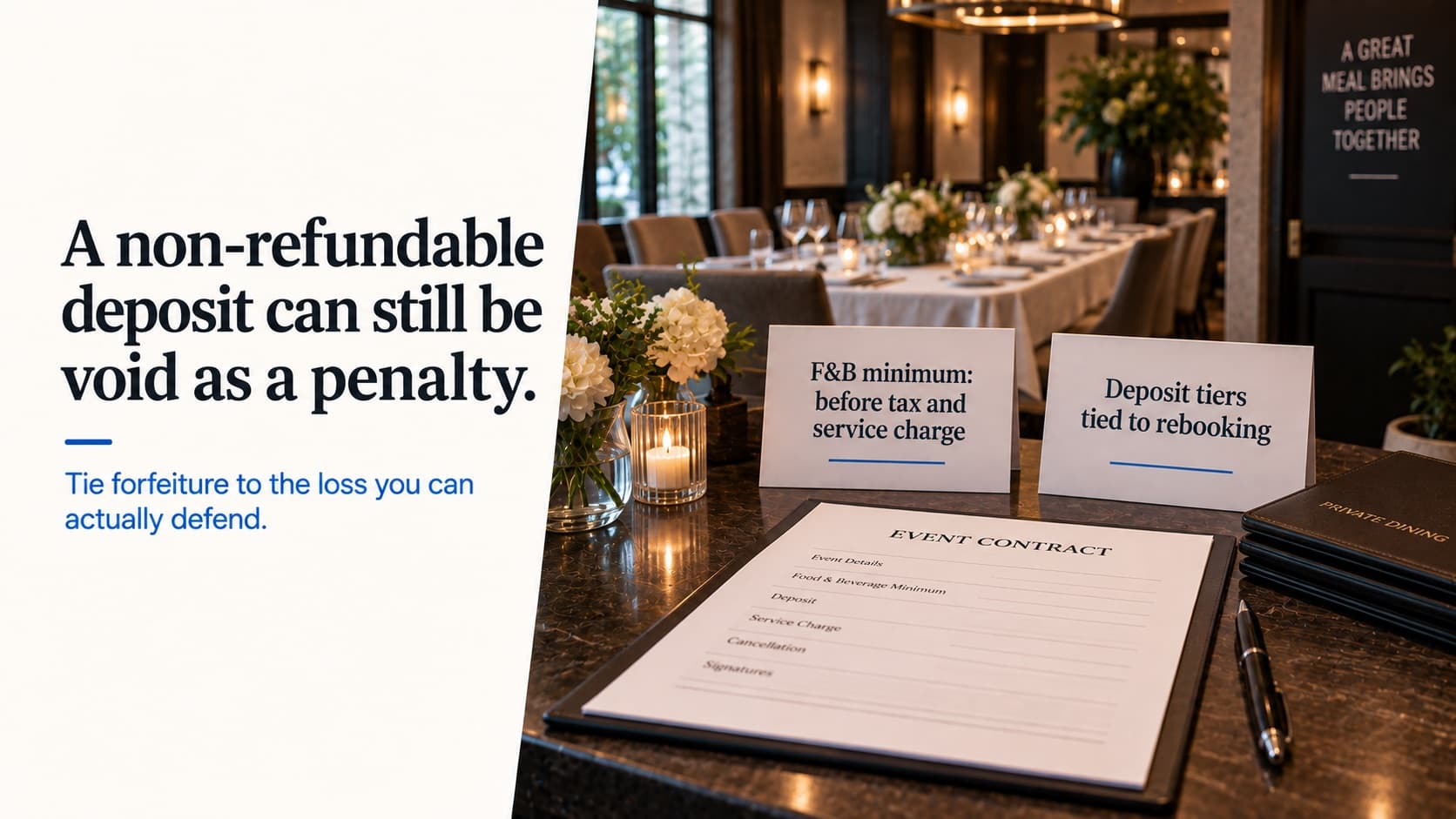
A non-refundable deposit can still be void as a penalty
California judges a birthday dinner's deposit more strictly than a corporate booking's, and taxes a mandatory event service charge even if staff get all of it.

A private dining room is the most predictable revenue a restaurant can book: a known date, a known headcount, money on deposit weeks ahead. Most of the contract that makes it predictable is covered in the catering pricing post: deposit sizes, guaranteed counts, cancellation tiers and why a service charge isn't a tip.
This post is about three things that post doesn't cover, and that matter more for a room inside your restaurant than for food you drop off. How a food-and-beverage minimum actually works. Whether a "non-refundable" deposit is enforceable. And what sales tax does to a mandatory service charge.
How a minimum works
Most restaurants don't rent the room. They set a food-and-beverage minimum: the party can have the room if it spends at least a set amount. It's a better incentive than a room fee, because the guest puts the money into food and drink instead of into rent.
Here's one real contract, from a restaurant in Columbia, South Carolina. It's a single example, not an industry standard, but it shows the parts clearly:
| Term | What the contract says |
|---|---|
| Minimum, smaller room | $1,000 weeknights, $1,500 Friday–Saturday |
| Minimum, larger room | $2,000 weeknights, $3,000 Friday–Saturday |
| What counts toward it | Food and beverage, pre-tax and pre-service charge |
| Service charge | 20%, on top |
| Taxes | 10% sales tax, plus South Carolina's 5% liquor-by-the-drink tax |
| Deposit | 50%, refundable with written notice at least 72 hours out |
| Headcount | Guaranteed number due 72 hours before |
The line that causes arguments is "what counts toward it." If the contract doesn't say, a guest will assume tax and service charge count toward the minimum. On a $1,500 minimum with 20% service and 10% tax, that's a $450 difference in what they think they owe. Say "before tax and service charge" in the contract, the confirmation email and the check.
Two more decisions belong in the contract:
- What happens to a shortfall. If the party spends $1,200 against $1,500, the $300 has to be billed as something. Call it a room fee or a minimum shortfall, and ask your accountant how your state taxes it before you choose.
- Why the minimum is what it is. The room displaces something: regular covers in that space on that night. Set Friday's minimum from what the room earns on a normal Friday, not from what sounds reasonable. That's also the number that makes your deposit defensible, which is the next section.
When "non-refundable" doesn't hold
Most event contracts call the deposit non-refundable. Courts don't take the label at face value.
Under the general rule in US contract law, an amount you keep when the other side cancels is liquidated damages. It's enforceable only if it's reasonable compared with the loss you expected, or actually suffered, and with how hard that loss is to prove. An amount that's unreasonably large is a penalty, and penalties are void.
California writes this into statute, and draws a line that matters for restaurants. Under Civil Code section 1671:
- Business contracts: the clause stands unless it was "unreasonable under the circumstances existing at the time the contract was made." The burden is on the party challenging it.
- Consumer contracts for personal or household purposes: the clause is void unless actual damages would be "impracticable or extremely difficult to fix."
That means the same deposit clause, on the same form, is judged differently depending on who signed it. A company booking a sales dinner is held to the looser standard. A family booking a 60th birthday is held to the stricter one. Other states apply the general penalty rule without California's split, but the direction is the same everywhere: the amount you keep should look like your real loss.
This isn't legal advice, and a contract lawyer in your state should review your form. The practical steps are the same anywhere:
- Tie forfeiture to the date, because your loss depends on whether you can rebook. Losing a Saturday in December with a week's notice costs you more than losing a Tuesday in February with two months.
- Write the reasoning into the contract: that the room is held off the market, that staffing and purchasing are committed, and that the amount estimates those costs.
- Keep the numbers you based it on. If a cancellation is ever disputed, the minimum you set from real Friday revenue is your evidence.
What sales tax does to the service charge
The catering post covers why a mandatory service charge is wages rather than tips. The sales tax side is separate, and it catches restaurants that assume a charge passed to staff isn't their revenue.
- California: mandatory tips, gratuities and service charges are taxable, even if they go to employees. A charge negotiated before an event that includes a meal is mandatory by definition. For caterers the whole bill is taxable, including serving labor.
- New York: a mandatory charge is exempt only if it's stated separately, labeled a gratuity or tip, and paid entirely to employees. A "service charge" that doesn't meet all three is taxed.
Check your own state's rule. Event software and POS setups often mark a service charge as non-taxable by default, and the difference shows up in an audit.
Disclosure. Event service charges typically run 18–25%, and they don't always go to staff. Guests often assume they do. In California, the law covering restaurant fees explicitly includes "a menu or contract for banquet or catering services": the fee has to be shown clearly, with an explanation of its purpose. Wherever you are, say in the contract whether the charge goes to staff. It prevents the most common complaint after the event.
What I'm not going to give you
Benchmarks for private dining revenue, such as share of sales, average event size or spend per guest. The figures that circulate come from market-research summaries without methods, and I couldn't find primary data.
A "standard" deposit percentage. The contracts I saw ranged widely, and the right number is the one you can show reflects your loss.
A ruling on your deposit clause. That's your lawyer's job, with your state's law.
What to do
- Say what counts toward the minimum — before tax and service charge — in the contract, the confirmation and on the check.
- Set minimums by night from what the room earns on that night normally.
- Decide how a shortfall is billed, and check its tax treatment.
- Tier deposit forfeiture by notice period, and write down why each tier reflects your loss.
- Use a separate form for private parties if you're in California, or at least have a lawyer check your form against the consumer standard.
- Set the service charge's tax flag correctly in your POS and event software for your state.
- State where the service charge goes.
Disclosure: I work at Katalyst, which handles reservations, event deposits and invoicing. None of the rules above depend on software. The one step where software matters is number 6: a tax setting chosen once at setup applies to every event you book afterward.
Related Katalyst products
Topics
See how Katalyst handles your service style
A 30-minute walkthrough of the platform, tuned to how your restaurant actually runs.