A catered lunch costs a federal attendee $19, not your price
GSA's meal rates for FY2027, effective October 1, stay at $68 to $92 a day. The conference-planning rules most guides cite were deleted in December 2025.

The federal fiscal year starts today, and with it a new set of per diem rates. If you cater for government agencies, grant-funded programs, defense contractors or the many companies that copy federal travel rules, those rates are the budget you're quoting into whether anyone says so or not.
The headline for 2027 is that the meal money didn't move. The more useful news is that the rules behind it changed last December, and most of what's written about catering to per diem still describes the old ones.
The FY2027 numbers
GSA's rate bulletin raised standard lodging by $3, to $113, and left meals alone: "the standard M&IE rate will remain at $68," with the tiers still running from $68 to $92. Meal money for federal travelers has been flat since fiscal 2025, so every menu increase you've taken since then comes out of the gap between their allowance and your price.
Each daily rate is split into meals, and that split is what matters to a caterer:
| Daily M&IE | Breakfast | Lunch | Dinner | Incidentals |
|---|---|---|---|---|
| $68 (standard) | $16 | $19 | $28 | $5 |
| $74 | $18 | $20 | $31 | $5 |
| $80 | $20 | $22 | $33 | $5 |
| $86 | $22 | $23 | $36 | $5 |
| $92 (NYC, DC, Chicago) | $23 | $26 | $38 | $5 |
On the first and last day of a trip, travelers get 75% of the daily rate.
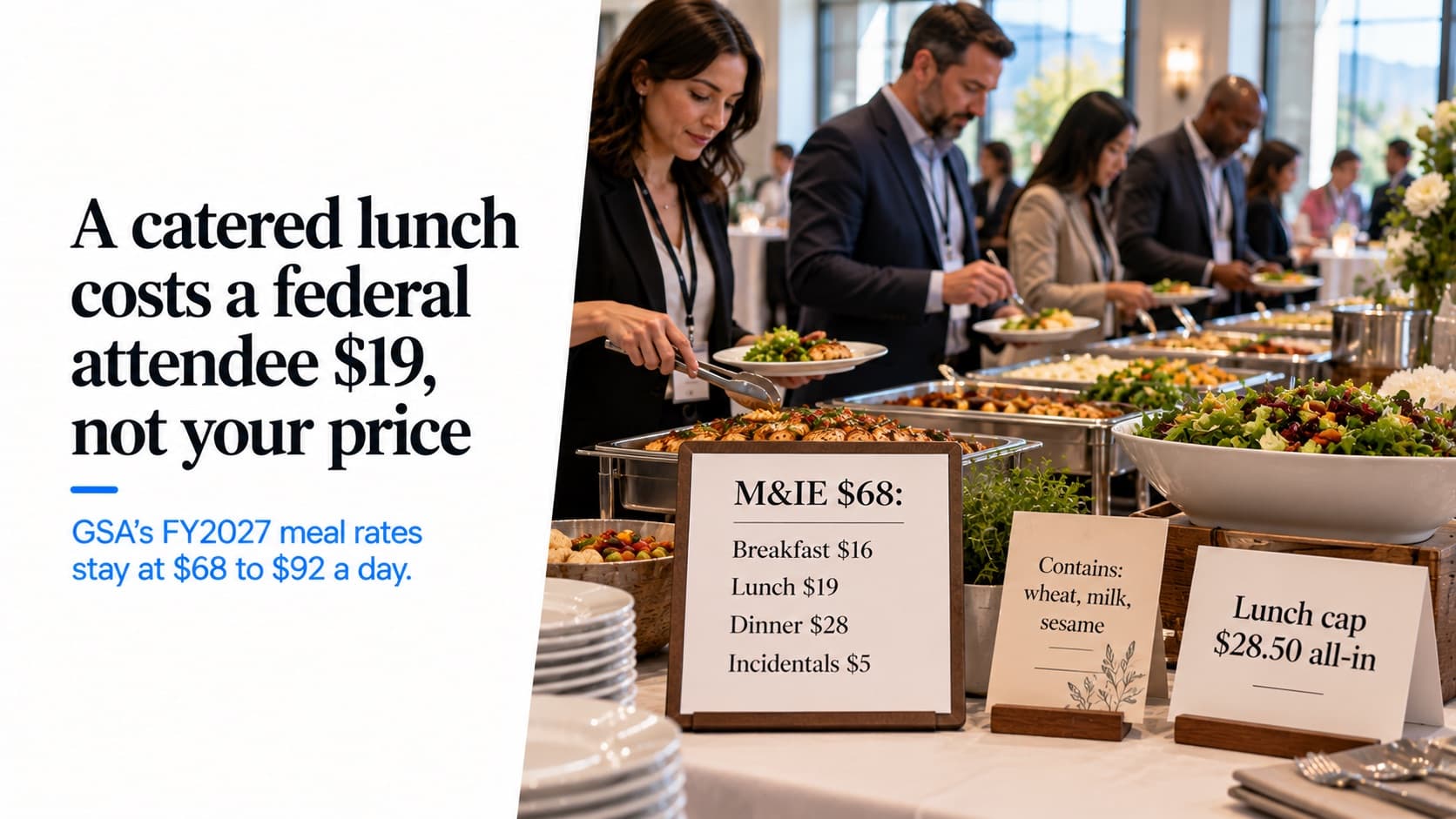
A catered lunch costs the attendee $19, whatever you charge
When a meal is provided at a conference, either by the agency or in the registration fee, the traveler deducts it from their allowance. Since December the rule sits at section 301-11.21, and the deduction is "the appropriate amount shown" on GSA's breakdown — the allocated value, not your price.
At the standard rate, a catered lunch costs a federal attendee $19 of per diem whether you charge the organizer $14 or $40. On the first day of travel, their $51 allowance drops to $32.
So the people eating your lunch don't feel your price at all. The organizer does, and the organizer is working from a different cap.
The rules most guides cite were deleted
GSA rewrote the Federal Travel Regulation effective December 8, 2025. Part 301-74, "Conference Planning," was removed entirely as "guidance, and not regulatory text." That part held the definition of "light refreshments" — coffee, tea, juice, bagels, fruit, cookies — and the rule that refreshments trigger no meal deduction.
Both are gone. The old meal-deduction section, 301-11.18, now covers advance room deposits. An article or a client's checklist that cites "FTR 301-74" is describing rules that no longer exist; each agency now sets its own.
One myth worth retiring while you're at it: the old conference rules never capped a meal at the per diem rate. The caps that exist come from individual agencies and grant programs.
Publish the allergens, keep the deduction
The rewrite added one rule that a caterer can actually use. A traveler who can't eat a provided meal for medical or religious reasons can now claim the full allowance without advance approval, unless they knew the menu ahead of time. GSA's own example: a conference meal where "no specifics on the meal composition (e.g., meals with common allergens such as nuts) are provided in advance."
Put plainly, if the menu and its allergens aren't published to registrants beforehand, any attendee can skip your lunch and claim the money. An organizer paying for 200 lunches has a reason to want that menu sent out early, and you're the one who can write it.
The real caps live in agency and grant policies
The clearest cap I found is the Justice Department's grants food and beverage policy. It's dated 2011 and still published, so confirm it with the program office, but its structure is typical:
- Breaks can't exceed 23% of the local daily rate per attendee per day.
- Meals can't exceed 150% of the meal's allowance per attendee.
- Both caps are all-in, including service charges, taxes and tips.
Applied to the 2027 rates:
| Locality | Breaks per day | Breakfast | Lunch | Dinner |
|---|---|---|---|---|
| Standard ($68) | $15.64 | $24.00 | $28.50 | $42.00 |
| Top tier ($92) | $21.16 | $34.50 | $39.00 | $57.00 |
Because the cap includes your service charge and tax, price backwards. A $28.50 lunch cap with a 22% service charge and 8% tax leaves a menu price of $21.92. The same policy prohibits receptions, says "cash bars are not permitted at federally-funded events," and warns that alcohol "may make the entire event unallowable."
Grants and contractors: food yes, alcohol no
Organizations spending federal grant money follow the Uniform Guidance. Conference meals and refreshments are allowable "unless further restricted" by the award, but "the cost of alcoholic beverages is unallowable." A grantee with no written travel policy has to use the federal rates.
Federal contractors are on the same math: their meal costs are allowable only up to the federal per diem, and entertainment and alcohol are unallowable. The practical step for any of these clients is the same: invoice the bar separately, so it can be paid from money that isn't federal.
And some food simply can't be bought. Federal auditors have held that agencies can't use appropriated funds to feed employees at internal meetings who aren't traveling. If a federal client asks for lunch for its own staff meeting, the question isn't price. It's whether they're allowed to pay you at all.
States and companies use their own tables
Florida's statute pays state travelers $6 for breakfast, $11 for lunch and $19 for dinner — so low that a state employee's allowance will almost never cover a catered meal. California adopted the federal $68. Private companies often use the IRS rates instead, which for this year set the meals portion at $74 and $86 a day, a little more room than a federal traveler has.
What I'm not going to give you
The share of companies that use federal rates. It's often said that many do. I found no survey with a number.
A government-wide meal cap. There isn't one. Each agency sets its own.
The current status of older conference spending memos. Ask the program office what applies to the event.
How I'd build a per diem proposal
- Ask which policy governs the money — agency, grant program, contractor, state or company — before you write a menu.
- Price backwards from the all-in cap, with service charge and tax inside it.
- Put the bar on its own invoice.
- Send the menu and its allergens to the organizer for registrants in advance.
- Keep breaks under the break cap per day, not per break. Two breaks share one allowance.
Disclosure: I work at Katalyst, which sells catering software that prices proposals and splits invoices. Nothing in the rules above needs software; it needs one question at the start of the conversation: whose money is this?
Related Katalyst products
See how Katalyst handles your service style
A 30-minute walkthrough of the platform, tuned to how your restaurant actually runs.