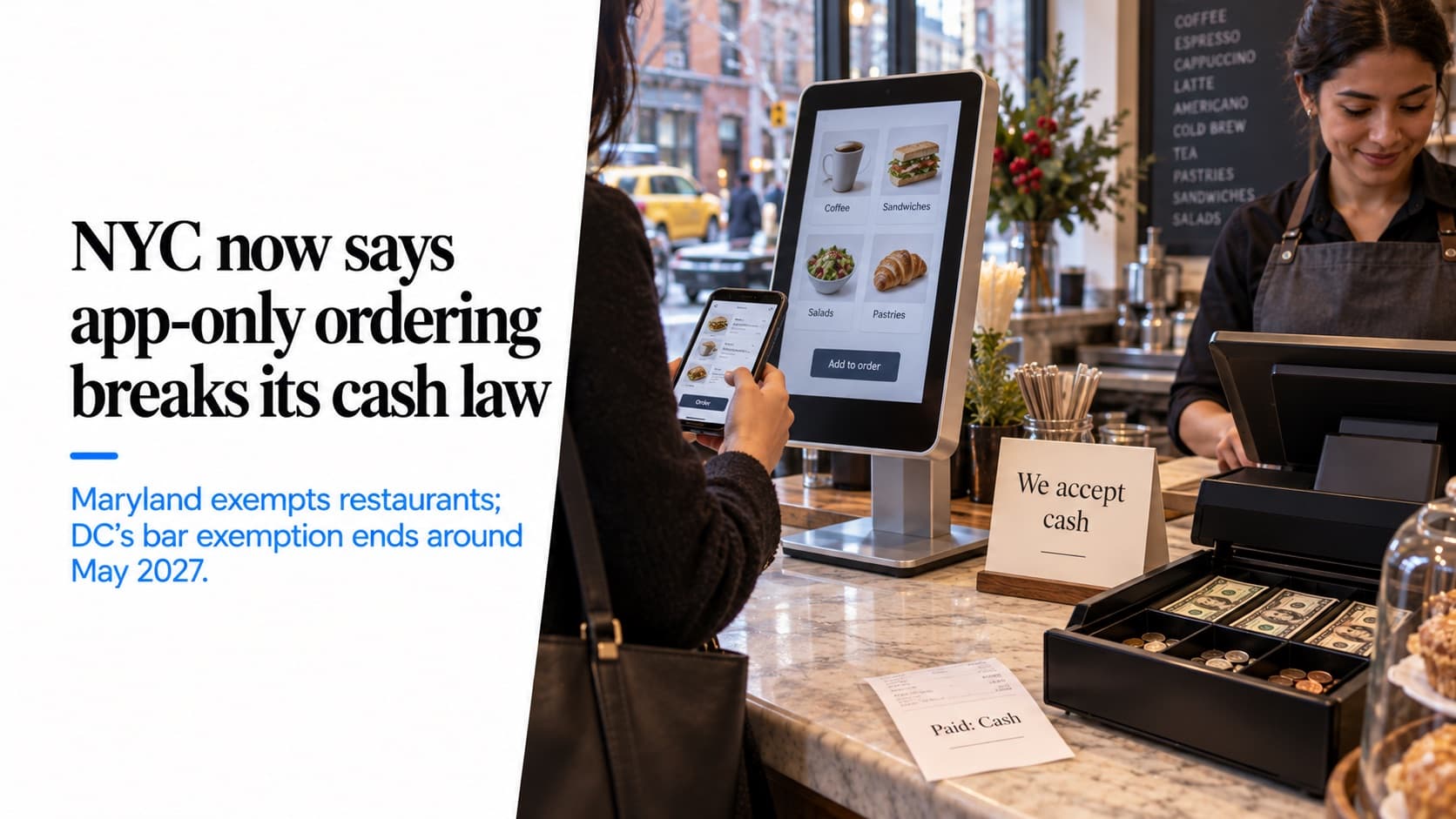
NYC now says app-only ordering breaks its cash law
Maryland's new cash law, effective October 1, exempts sit-down restaurants. DC lets licensed bars and late-night spots refuse cash until about May 2027.

Five years ago the question was whether a restaurant could go cashless. In 2026 it's which of your locations are allowed to. Ten states, if you count Maryland's narrow new law, and a handful of cities now require businesses to take cash, the rules differ on exactly the points a restaurant cares about, and two of them changed in the last three weeks.
The short version: your ordering setup matters more than your concept. Whether a guest pays a person, a kiosk, a QR code or an app decides which side of the law you're on, and the answer flips between jurisdictions.
Where cash is required
| Jurisdiction | Law | Key detail for restaurants | Penalty |
|---|---|---|---|
| Massachusetts | G.L. c.255D §10A (1978) | Retailers can't require credit | — |
| New Jersey | N.J.S.A. 56:8-2.33 (2019) | In-person retail; online and phone exempt | Up to $2,500, then $5,000 |
| Rhode Island | §6-13.1-30 (2019) | Requiring credit is a deceptive practice | — |
| Colorado | HB21-1048 (2021) | Only where a person takes payment | Up to $250 |
| Oregon | ORS 659A.410 (2022) | Cash incentives allowed | Complaint process |
| Connecticut | CGS §21a-434 (expanded 2025) | Exempt where no employee helps with the sale | — |
| Delaware | 6 Del. C. ch. 25H (2022) | Cash payers may be charged less | Up to $1,000–$2,500 |
| Montana | MCA 30-14-228 (2023) | Only where a person takes payment | Up to $100 |
| New York State | GBL §396-ii (March 2026) | No unattended exception | Up to $1,000, then $1,500 |
| Maryland | HB 191 (Oct 1, 2026) | On-premises food and drink sellers exempt | Up to $500, then $1,000 |
| New York City | Admin. Code §20-840 (2020) | App payment on premises now covered | $750–$1,500 |
| Philadelphia | Code §9-1132 (2019) | Online orders paid at pickup covered | — |
| Washington, DC | Code §28-5402 (2025) | Temporary bar and late-night exemption | Consumer-protection law |
| San Francisco | Police Code Art. 55 (2019) | No cash-to-card exception at all | $50 up to $1,000 |
Berkeley and Detroit have their own ordinances too. I found no enacted cash rule for Los Angeles, Seattle, Chicago or Denver; Denver follows Colorado's state law.
New York City: paying through an app on the premises counts
On May 22, 2026, New York City's consumer protection department reversed its earlier reading of the cash law. Its guidance says prior interpretations that "treated some app-based transaction models as exempt... no longer reflect the intended scope," and gives the example directly: a coffee shop that makes customers who come in "complete purchases exclusively through a mobile application, and does not accept cash payment... violates the Cashless Ban."
The test is where the payment happens: app-based ordering "does not relieve a business of its obligation to accept cash where payment for the transaction may occur on premises." The guidance doesn't mention QR codes at the table or self-order kiosks, but the logic reaches them. If your New York City location takes payment only through a phone or a kiosk, the safe reading is that a guest standing in front of you can pay cash. The QR ordering post covers the rest of what changes when you move payment to the table.
The kiosk question has five different answers
This is the part that matters if you're adding self-order kiosks:
- Colorado and Montana apply only where a business "has an individual accepting payment in person." A kiosk-only lane is outside the rule.
- Connecticut exempts locations "where no individual is employed to help a person with the purchase."
- Maryland excludes "a vending machine or kiosk transaction" outright.
- Philadelphia excludes "kiosk vending," with massage chairs as its example. Whether a restaurant ordering kiosk counts hasn't been tested.
- New York City, New York State and San Francisco have no unattended exception. A kiosk that takes only cards needs a cash option nearby.
Online orders are covered when the payment happens at pickup
Every law exempts phone, mail and internet orders, but the edge matters. Philadelphia's regulation says an order placed "over the telephone or internet which the purchaser picks up" is covered unless it was prepaid online. New York City's exemption likewise ends if the order is paid on the premises. If your online ordering lets guests choose "pay at pickup," the counter has to take cash.
Maryland's law mostly skips restaurants
Maryland's new law took effect October 1, and the headlines read as if every store in the state must now take cash for food. It doesn't. It covers in-person sales of "essential consumer goods" under $300 between 6 a.m. and 10 p.m., and it excludes "a merchant that sells to the public primarily food or beverages for on-premises consumption." A grocery is covered. A sit-down restaurant generally isn't. A grab-and-go or counter-service operation should check whether it's "primarily" for on-premises consumption before assuming either way.
DC lets bars and late-night restaurants go cashless, for now
Washington's cash requirement took effect at the start of 2025. A temporary law effective September 25, 2026 now exempts establishments with an on-premises Class C or D liquor license, and restaurants open 24 hours or past 3 a.m. at least two nights a week, as long as a "conspicuous notice" on the door or menu says cash isn't accepted. Temporary means it: it expires after 225 days, around May 2027, unless the Council renews it. If you go cashless under it, put a renewal check on your calendar.
Discounting cash is not the same as surcharging cards
The price rules split in ways that catch multi-state groups:
- Delaware lets a store "charge less to consumers who pay with cash." Oregon allows cash incentives too.
- Philadelphia forbids the reverse: no discount "for payment by means other than cash," and no extra charge for paying cash.
- New York City, New York State and DC ban a higher price for cash.
- Maryland bans a higher cash price "whether or not the difference in price is described as a fee," but allows up to four cents when rounding.
That last clause is the penny problem again: rounding cash totals to the nickel is fine, and the rounding post covers how to do it without shorting the sales tax. Card surcharges are a separate regime, with their own state rules in the surcharging guide.
Cash-to-card machines don't work everywhere
Several laws let you satisfy the rule with a machine that converts cash to a prepaid card. The conditions vary:
- No fee and at most a $1 minimum: New York City, New York State, Colorado, Connecticut and Montana.
- No fee and no minimum: Maryland.
- Free and "easily accessible at the point of purchase": Philadelphia.
- Not allowed as a substitute at all: San Francisco.
Almost everywhere, a broken machine means you take cash and post a sign saying so.
Federal law is still silent
There is no federal requirement that a private business accept cash. The Payment Choice Act, which would require cash for in-person sales up to $500, was introduced in both chambers in 2025 and hasn't left committee in either. It wouldn't preempt stronger state or city rules if it passed.
What I'm not going to give you
A clean count of states. "Ten states" is right only if you count Maryland's narrow law, and the number will change with DC's temporary exemption.
Fines I couldn't confirm. Philadelphia's often-quoted $2,000 maximum and DC's $5 cap on cash-to-card deposits come from secondary sources.
A ruling on restaurant kiosks in Philadelphia. The regulation's "kiosk vending" language has never been applied to a self-order screen that I could find.
What to do
- List your locations by jurisdiction, not by state. A New York City store and an upstate store follow different rules.
- Check every payment path — counter, kiosk, QR, app, pay-at-pickup — against the table above.
- Keep a cash drawer at any location that might need one, and train staff not to say "we're cashless." In New York City a sign or a spoken refusal creates a presumption of violation.
- If you use a cash-to-card machine, confirm it's free and within the local deposit limit.
- In DC, calendar the exemption's expiry before you remove the cash drawer.
Disclosure: I work at Katalyst, whose POS handles cash alongside cards, kiosks and QR payments, so a post arguing that you need a cash option isn't neutral. The rules above are the same whatever system you run.
Related Katalyst products
See how Katalyst handles your service style
A 30-minute walkthrough of the platform, tuned to how your restaurant actually runs.