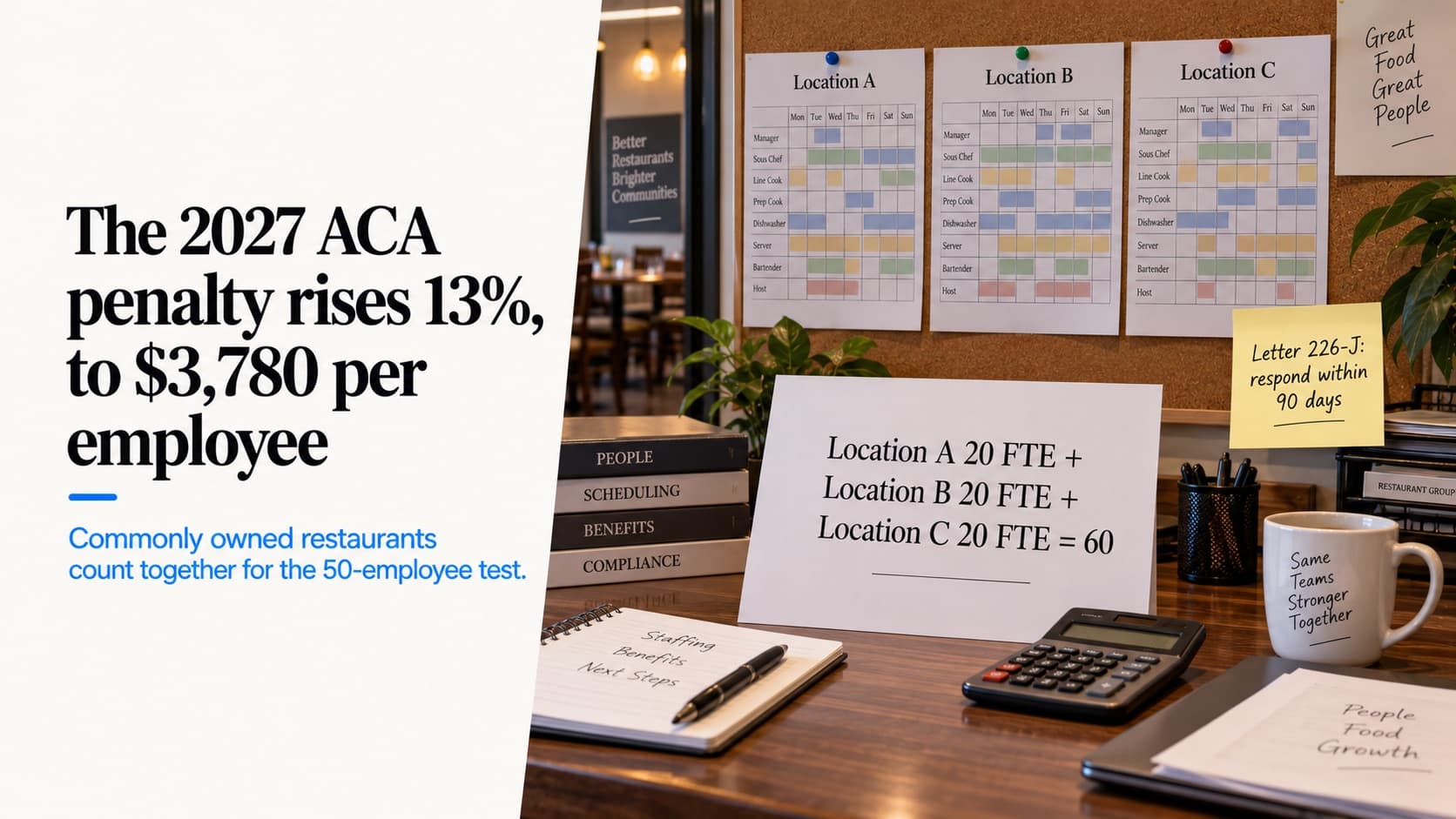
The 2027 ACA penalty rises 13%, to $3,780 per employee
Restaurants under common ownership are counted together for the 50-employee test, and the look-back method can't be used to decide whether you're covered.

The Affordable Care Act's employer mandate is the payroll rule restaurant owners most often believe doesn't apply to them. The usual reasoning goes: most of my staff are part-time, I have three separate LLCs, none of them is near 50 people. Two of those three beliefs are wrong in ways the regulations spell out, and the cost of being wrong is going up.
For 2027 the IRS has set the main penalty at $3,780 per full-time employee, up from $3,340 this year. That's a 13% increase in one year. What follows is the published rule; whether it applies to your group is a question for your benefits adviser.
The 50 includes your part-timers
An employer is covered — an "applicable large employer" — if it averaged at least 50 full-time employees, including full-time equivalents, during the prior calendar year. So your 2026 headcount decides 2027.
Full-time means 30 hours a week, which the rules convert to 130 hours in a month. Part-timers count as equivalents: add up their monthly hours, counting no more than 120 for any one person, and divide by 120.
A restaurant with 40 full-time staff and 30 part-timers averaging 80 hours a month has 2,400 part-time hours, or 20 equivalents. 40 plus 20 is 60. Covered.
Hours of service include paid vacation, sick time and holidays, not just hours on the schedule.
Separate LLCs don't make separate employers
This is the one that catches restaurant groups. Businesses under common ownership, under the controlled-group rules in section 414 of the tax code, are combined for the 50-employee test. Three restaurants in three LLCs with 20 full-time equivalents each are one covered employer with 60.
Each location is then responsible for its own penalty, and the 30-employee reduction in the penalty formula is split among them rather than given to each. If you're growing to multiple locations, the third opening can be the one that crosses the line.
The look-back method doesn't decide whether you're covered
Restaurants with variable schedules usually use the look-back measurement method: measure an employee's hours over a period of up to 12 months, then treat them as full-time or not for a following "stability period" of at least six months. It's the right tool for deciding which employees need an offer of coverage.
It can't be used to decide whether you're a covered employer at all. The IRS says so directly: that test always uses actual monthly counts. An operator who measures everyone over 12 months and concludes they're under 50 may have measured the wrong thing.
Two more rules in the look-back method matter for restaurants:
- You can't assume turnover. In deciding whether a new hire is variable-hour, the employer "may not take into account the likelihood that the employee may terminate employment." A new server isn't variable-hour because servers tend to quit.
- Rehires reset after 13 weeks. An employee who returns after 13 consecutive weeks with no hours can be treated as new.
Two different "seasonal" rules
Articles often merge these, and they work differently:
- The seasonal worker exception applies to the 50-employee test. You aren't covered if you went over 50 for 120 days or less last year and the extra people were seasonal workers. A summer patio crew can keep a 45-employee restaurant out, but only if the peak lasts no more than about four months.
- The seasonal employee rule applies once you're covered. An employee in a position whose customary employment is six months or less can be measured without being offered coverage right away.
What the penalties are
| 2026 | 2027 | |
|---|---|---|
| Penalty A: coverage offered to fewer than 95% of full-time staff | $3,340 per full-time employee, minus 30 | $3,780 |
| Penalty B: coverage offered but unaffordable or below minimum value | $5,010 per employee who gets a subsidy | $5,670 |
| Affordability limit (share of income for employee-only coverage) | 9.96% | 10.22% |
Penalty A applies to the whole full-time workforce, minus 30, if even one full-time employee buys subsidized coverage on an exchange. A group with 80 full-time staff that misses the 95% offer in 2027 owes (80 − 30) × $3,780 = $189,000 for the year.
The 2027 figures are from Rev. Proc. 2026-22 and Rev. Proc. 2026-26.
Affordability for tipped staff
An employer can prove affordability three ways. For tipped servers, the cleanest is the federal poverty line safe harbor: employee-only coverage costing no more than about $135.93 a month in 2027 is affordable for everyone, whatever their wages or tips. Practitioners generally treat the rate-of-pay safe harbor as unavailable for employees paid largely in tips, and the W-2 safe harbor depends on reported tips that vary month to month.
Paperwork got easier, and the clock changed
A 2024 law made two changes most restaurants haven't heard about:
- You no longer have to mail Form 1095-C to every employee if you post a clear notice on your website that it's available on request, and send it within 30 days of a request. Some states with their own insurance mandates may still require mailing.
- You now get 90 days to answer a Letter 226-J, the IRS's proposed penalty notice, instead of 30. The IRS's own question-and-answer page still says 30. The statute says 90.
The same law set a six-year limit on assessing these penalties, but only for returns due after 2024. Tax years 2015 through 2023 have no limitation period at all, so an old reporting error can still produce a letter.
Two federal courts have split on whether the IRS issued these penalties correctly in the first place. One Texas court ordered a refund; a Florida court went the other way, and an appeal is pending. That's a possible refund argument, not a reason to ignore a letter.
What I'm not going to give you
How many penalty letters go to restaurants. I couldn't find IRS data by industry.
An average penalty. The figures in circulation come from compliance vendors.
A blanket "under 50 is safe." It depends on who owns what, and the controlled-group rules are fact-specific.
The 2026 filing deadlines. The instructions for next spring's forms weren't published when I checked.
What to do
- Count 2026 hours now, month by month, including paid leave, and compute equivalents the way the rules describe.
- List every entity you or your partners own. If they're a controlled group, count them together.
- Use the look-back method for who gets offers, not for whether you're covered.
- Price employee-only coverage under the poverty-line limit if you have tipped staff.
- Post the 1095-C notice if you'd rather not mail forms.
- Answer any Letter 226-J within 90 days, and keep your old 1094-C and 1095-C records.
For the labor side of the same headcount, see restaurant labor cost and scheduling that cuts turnover.
Disclosure: I work at Katalyst, whose POS tracks hours by employee and location, which is the raw data this count needs. The judgment calls in this post — ownership, safe harbors, plan design — belong to your benefits adviser.
Topics
See how Katalyst handles your service style
A 30-minute walkthrough of the platform, tuned to how your restaurant actually runs.