Rounding cash to a nickel doesn't round the sales tax owed
Congress hasn't finished its penny bill. Arizona already requires rounding and a posted sign, and cash-discrimination laws make rounding up risky.

The US Mint struck its last circulating penny on November 12, 2025. Pennies are still legal tender, and about 300 billion are still out there, but businesses have reported trouble getting them, and the supply only shrinks from here.
That turns into a register problem quickly. Sales tax produces odd cents on almost every check, so most cash totals end in something other than zero or five. Restaurants have been rounding at the register for months, often without a rule, a setting or a record. This post is about doing it in a way that holds up: what the law says now, what it doesn't settle yet, and the one thing about sales tax that most operators get wrong.
The federal law isn't finished
The Common Cents Act, the bill that would set a national rounding rule, has passed both chambers in different versions and isn't law yet:
- July 14, 2026: the House passed its version.
- August 7: the Senate passed its own version.
- September 14: the House passed a merged bill, H.R. 10167, which went back to the Senate.
As of today the Senate hasn't voted on the merged bill. If it passes as written, it would:
- Permit rounding, not require it. The text says nothing in it requires anyone to round.
- Round symmetrically to the nearest five cents: totals ending in 1, 2, 6 or 7 cents may round down; 3, 4, 8 or 9 may round up. You may always round in the customer's favor.
- Apply to cash only. Cards, checks, gift cards and electronic payments are charged the exact amount.
- Apply to the total including tax, or to the change due, not to each item.
- Let employers round cash wages only upward. If you pay cash tips or wages, that part applies to you.
- Create a safe harbor. Following the federal rule couldn't violate state or local law. That matters a lot for the cash-discrimination laws below, but only after enactment.
The states that already decided
Holland & Knight counted 16 states with rounding laws in effect as of August: Alabama, Arizona, Florida, Georgia, Hawaii, Idaho, Indiana, Kentucky, Maryland, Nebraska, New Mexico, Oregon, Tennessee, Vermont, Virginia and Washington. Missouri's took effect on August 28, Oklahoma's takes effect November 1, and Connecticut's on January 1, 2027. Most use the same symmetric rule and make rounding optional. The exceptions are worth knowing:
- Arizona requires it. Businesses that accept cash but don't use pennies must round the final cash total to the nearest nickel, and must post a sign at the register with the law's exact wording: "Cash transactions are rounded to the nearest five-cent increment pursuant to state law."
- Indiana rounds cash payments of state and local taxes down, and retailers still remit the full tax.
- New York's legislature passed a mandatory version in June. It hadn't been signed when I checked. If it is, rounding takes effect 180 days later.
The sales tax you owe doesn't round
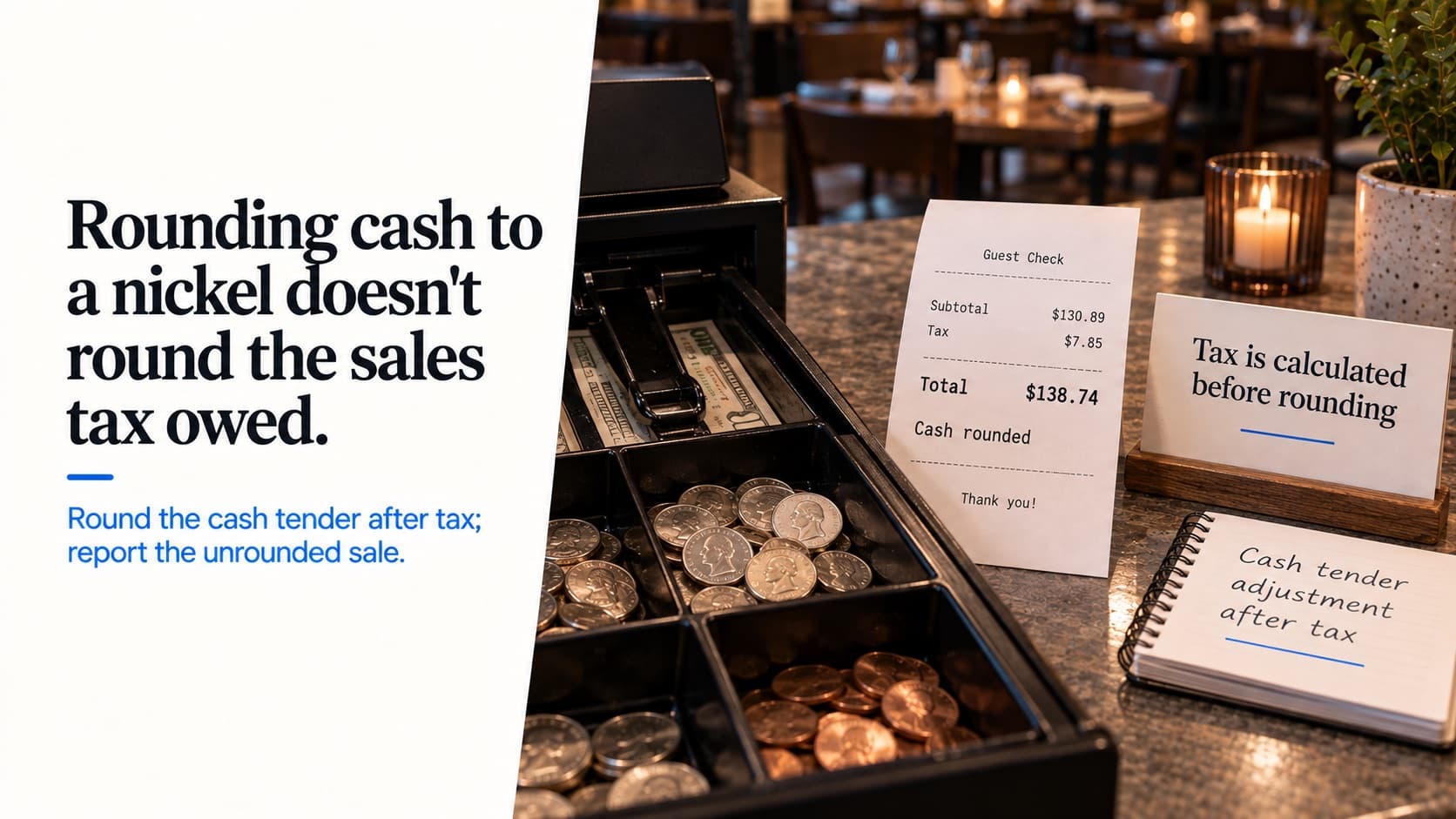
This is the part to get right in your POS. Every state revenue department that has issued guidance says the same thing: sales tax is calculated on the price before rounding.
South Carolina's January 2026 guidance gives a worked example. A sale totaling $138.74 might round to $138.75 or to $138.70 at the register, but the tax due is $7.85 either way. You report and pay the tax on the unrounded sale, and "the sales tax due should not be recalculated based on the rounded amount." Georgia, Florida, North Carolina, Tennessee, Wisconsin, Iowa and the Streamlined Sales Tax group have said the same.
States differ on what the rounding difference itself is:
- New Jersey treats a round-up as business income.
- Washington says it can count toward gross income for its business and occupation tax.
- Texas accepts rounding to the nearest nickel if it's consistent, but says "excessive rounding (such as to the nearest dollar)" becomes part of the taxable sales price.
In practice, that means the rounding has to be a separate adjustment applied at cash tender, after tax, not a change to prices or to the tax line. If your POS rounds by adjusting the tax, your tax reports will be off by a few cents on every cash check, and an auditor will notice the pattern. The other settings that cause tax reporting errors are in the sales tax post.
Rounding up can break cash-discrimination laws
Several states and cities ban refusing cash or charging cash customers more than card customers: New York City, Philadelphia, San Francisco, Washington DC, Miami and Seattle among cities, and New Jersey, Massachusetts, Connecticut, Delaware, Michigan and Oregon among states.
Rounding a cash total up by two cents charges the cash customer two cents more than a card customer would pay. Until the federal safe harbor is law, that's a risk under those rules, and some carry per-violation penalties. Connecticut's consumer protection department advised businesses to round down for exactly this reason. Oregon and Connecticut have since amended their laws so that rounding doesn't count as discrimination.
Holland & Knight lists rounding every cash total down as one compliant option, at a cost of up to four cents per transaction. For a restaurant with 200 cash checks a day, that averages about two cents a check, or roughly $1,460 a year. That's a small price for removing the question, and in a city with a cash-discrimination law I'd pay it until the federal bill is signed.
What I'm not going to give you
The full state count. One tracker counts 20 states with laws enacted; the sources don't agree on which states make up the twentieth. Check your own state's status.
A prediction on the Senate vote. A vote was expected in September. Until it happens, the federal rule and its safe harbor don't exist.
A penalty figure for your city. Cash-discrimination penalties vary by jurisdiction, and I didn't find current figures I could confirm for each one.
What to do
- Pick a rule and write it down. Symmetric rounding where your state allows it, round-down wherever a cash-discrimination law applies.
- Set rounding as a cash-tender adjustment in your POS, applied after tax. Card, gift card and other tenders should never round.
- Check your tax report after a week of cash sales. Tax collected should match tax on the unrounded totals exactly.
- Post the sign if you're in Arizona, using the statutory wording, and consider a simple notice anywhere else.
- Round cash wages and tip-outs only upward if you pay them in cash.
- Tell your staff. A server who rounds up at the table in a city that bans charging cash payers more is making your compliance decision for you.
Disclosure: I work at Katalyst, and our POS handles cash rounding as a tender adjustment. Step 3 works on any system, and it's the one I'd do this week. If the tax report and the unrounded totals don't match, your rounding is sitting in the wrong place.
Related Katalyst products
See how Katalyst handles your service style
A 30-minute walkthrough of the platform, tuned to how your restaurant actually runs.