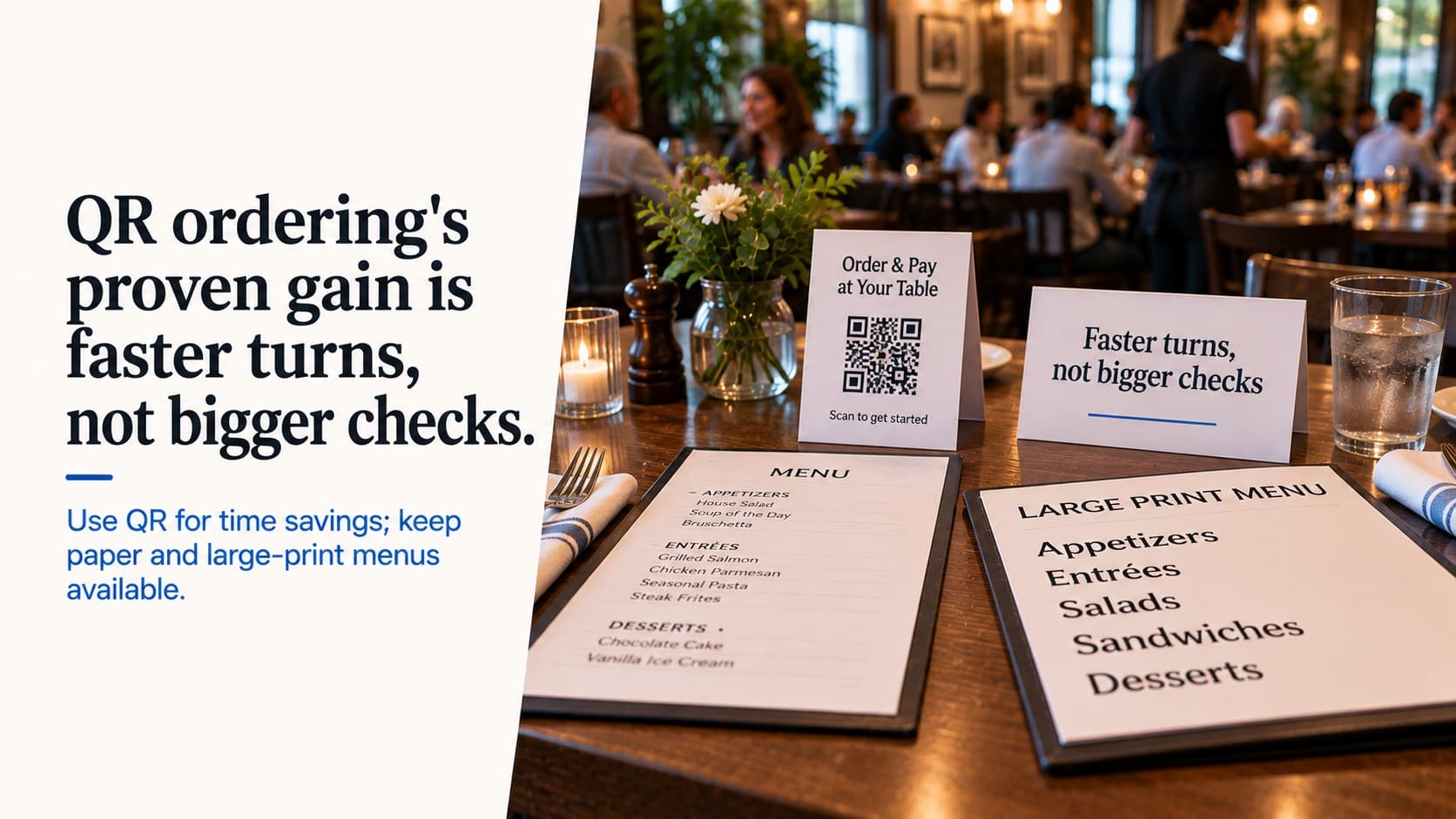
QR ordering's proven gain is faster turns, not bigger checks
65% of diners have used QR menus, yet 58% want paper back. Only 16% of Boomers would pay by QR code, and the ADA still requires an alternative.

Vendors selling order-and-pay at the table quote big numbers. Square cites 42% higher average tickets with open tabs. me&u cites tips up more than 30%. Sunday cites checks up 10–20%. None of them publishes a method, and all of them sell the product.
There is one large independent study of tabletop ordering in a full-service restaurant, and its main finding isn't about the check. It's about time. That matters, because it tells you which restaurants the technology pays off for, and it isn't all of them.
What the independent research found
Two researchers, Tom Tan and Serguei Netessine, studied about 2.6 million transactions at a casual-dining chain that rolled out tabletop tablets restaurant by restaurant. The staggered rollout let them compare stores with tablets against stores still waiting for them.
| Measure | Effect of tabletop ordering |
|---|---|
| Sales per check | Small increase: +2.91% in the working paper, about +1% in coverage of the published version |
| Meal duration | −9.74% |
| Sales per minute of table time | +10.77% |
The check barely moved. The table turned faster. Most of the revenue gain came from seating the next party sooner, not from each party spending more. Two more details from the study are worth knowing: servers still took the main order, with guests using the tablet for add-ons and payment, and the biggest improvement came at tables served by the weakest servers.
Other research points the same way with caveats. A University of Hamburg study found kiosk orders 14–16% larger than counter orders, which is why the kiosk post treats check lift as real for counter service. A kiosk replaces a cashier who might not upsell; a QR code at a full-service table replaces or supplements a server who might. A 2024 study of more than 23,000 orders found digital orders slightly more indulgent, strongest at dinner, so desserts and add-ons may lift a little. None of it supports a 42% ticket increase at the table.
So the business case depends on having a wait
If the gain is faster turns, it's only worth money when there's someone waiting for the table.
- A restaurant with a wait on Friday and Saturday gets real revenue from shorter meals: more covers from the same seats.
- A restaurant with empty tables at 8pm gets a slightly faster meal and nothing else. Nobody is waiting to use the time you saved.
The other gain is labor. Guests who reorder drinks and pay without flagging a server free up server time. That's worth money if you'd schedule fewer people, or if servers use the time to cover more tables. It's worth nothing if the same staff stand around.
What guests actually say
The survey data is clearer than the sales data, and less flattering:
- The National Restaurant Association's 2024 technology survey: 59% of table-service guests would open a menu by QR code, 48% would order by QR code, and 46% would pay that way. More, 65%, would pay on a tabletop tablet.
- By age, paying by QR code: 58% of Gen Z, 65% of Millennials, 52% of Gen X and 16% of Baby Boomers.
- Ipsos, July 2025: 65% of diners have used QR menus, up from 42% in 2022. And 58% would like to go back to paper menus.
Usage is rising while enthusiasm isn't. Guests use QR codes because restaurants put them on the table, not because they asked for them. If your dining room skews older, a QR-only table is asking your most reliable guests to do something most of them would rather not.
Tips: don't bank the vendor number
Pay-at-the-table moves the tip prompt from the server's handheld to the guest's phone, with nobody standing there. What that does to tips isn't well measured. The vendor claims are high; I found no independent study.
What is measured is how guests feel about tip prompts. Pew's 2023 survey of nearly 12,000 adults found 40% oppose businesses suggesting tip amounts, such as on a checkout screen, against 24% in favor. At sit-down restaurants, 92% of Americans still tip always or often.
Your tips are part of your servers' pay, and in some states part of your tip credit arithmetic. Track tip percentage by payment channel for the first month. If QR-paid checks tip less, your servers will notice before you do.
The ADA still applies to the menu
The Justice Department's ADA guide for businesses gives a simple example of reaching guests who can't read a menu: a server "can read it to a patron." That principle doesn't disappear when the menu moves to a phone. A QR-only table still needs an effective alternative for guests who are blind or have low vision, or who don't carry a smartphone. The practical version is a few paper menus, including a large-print one, and staff who offer to take the order.
The ordering page itself is a web page, too, and accessibility claims against restaurant websites are common. If your vendor's page doesn't work with a screen reader, that's your problem as much as theirs.
Guest data
A QR ordering page collects names, phone numbers and card details. California's privacy law applies to businesses with more than $26.6 million in annual revenue, among other thresholds, so most independent restaurants fall below it. Your QR vendor may not. Read what the vendor does with your guests' data, and whether you can export it.
What I'm not going to give you
A check-size lift to put in a forecast. The independent figure is somewhere between flat and 3%. Plan on flat and treat anything more as upside.
A tip effect. Not measured independently.
A universal answer. The research says QR ordering pays where tables turn and labor is the constraint. That's a description of some restaurants, not all of them.
What to do
- Decide what you're buying. Faster turns, fewer server hours, or easier bar reorders. Each implies a different setup.
- Consider a hybrid. The study's restaurants kept servers taking the main order. QR for drink reorders, add-ons and payment keeps the hospitality and captures most of the time saved.
- Measure before and after: average meal duration, covers per seat on your busiest nights, check average, and tip percentage by payment method.
- Keep paper menus, including large print, and make sure staff offer them.
- Test with your oldest regulars, not your staff. If they can't pay without help, the table isn't saving anyone time.
- Read the vendor's data terms before guest information starts flowing through them.
Disclosure: I work at Katalyst, which sells mobile order and pay at the table. Our own product page says "faster turns, higher tips." The research supports the first half. For the second, I couldn't find independent evidence either way, so measure it in your own restaurant.
Related Katalyst products
Topics
See how Katalyst handles your service style
A 30-minute walkthrough of the platform, tuned to how your restaurant actually runs.