The IRS uses your year-end count if your books do
The 2026 small-business threshold is $32 million in average receipts. Texas now exempts $125,000 of inventory and equipment per location on January 1.

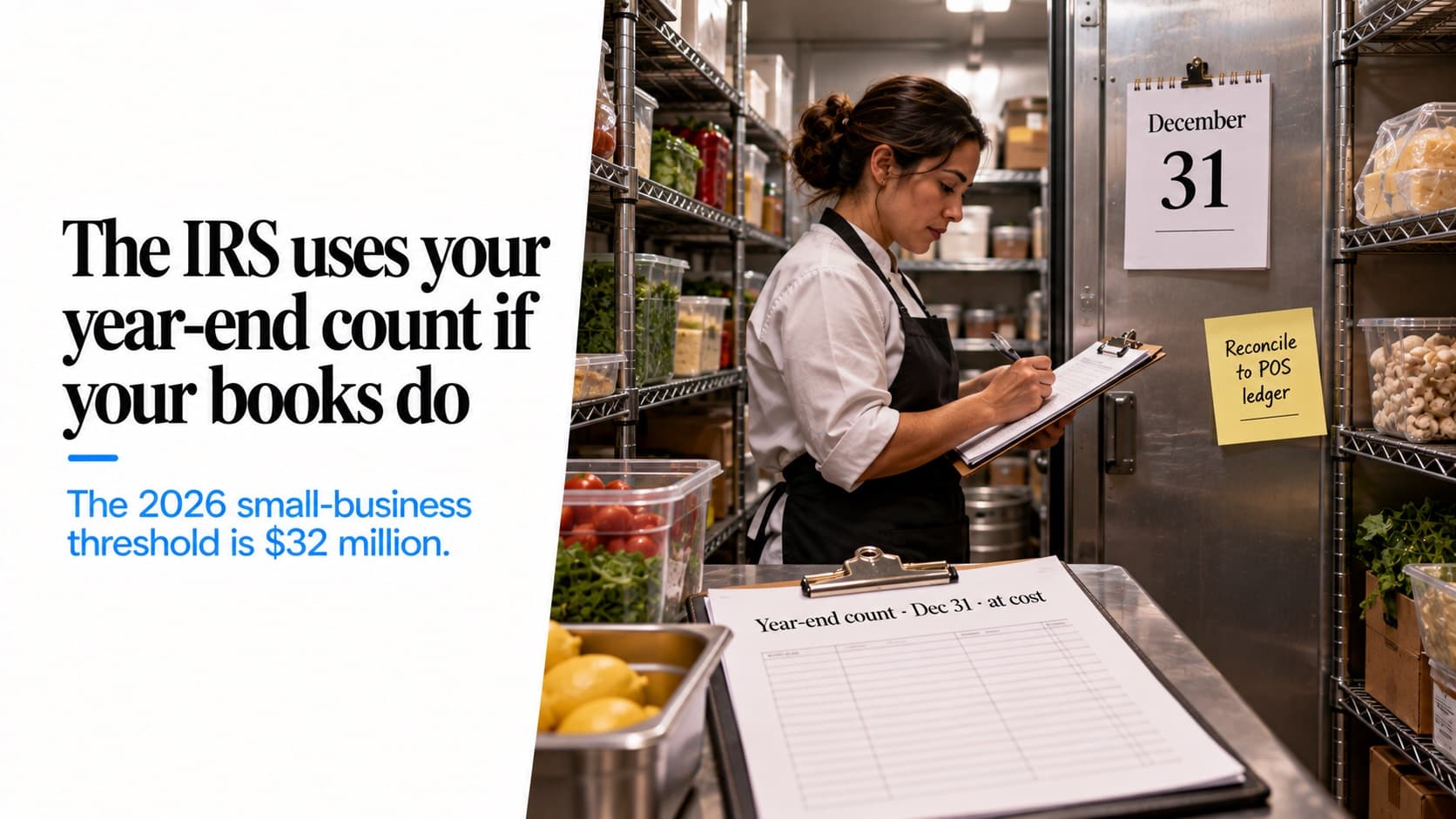
Most restaurants count inventory on December 31 because they always have. Since 2018, small businesses haven't strictly had to — the tax law lets them skip the formal inventory rules. That's led a lot of owners to a comfortable conclusion: skip the count and expense everything.
The regulations say it isn't that simple. Whether your count matters for tax depends on whether your books use it, and the IRS's own examples include a restaurant-style POS. None of this is tax advice; it's the published rule, applied to a restaurant.
Who gets the small-business rules
For tax years beginning in 2026, a business qualifies if its average annual gross receipts for the prior three years don't exceed $32,000,000, per Rev. Proc. 2025-32. Related businesses under common control are added together, so a group with one LLC per location tests as one.
Passing the test unlocks three things at once: the cash method, the relaxed inventory rules in section 471(c), and an exemption from the cost-capitalization rules that would otherwise apply.
One trap for restaurants with investors. A partnership or LLC that allocates more than 35% of its losses to passive members is a "tax shelter" for that year and loses these exceptions. An opening year with silent partners can be exactly that year.
Two methods, and neither is a write-off
A qualifying business can choose one of two methods.
Treat inventory as materials and supplies. You deduct the cost in the year it's used or the year you pay for it, whichever is later — and food is "used" when it's served. So a December stock-up of wine still in the cellar on December 31 isn't deductible that year. You still need to know what's on hand.
Follow your books. Your tax method is "the method of accounting used for inventory in the taxpayer's books and records." If your books expense everything, so can your return. If your books carry inventory, your return does too.
Your count governs if your books use it
The regulation's examples are unusually concrete:
- A liquor store whose bookkeeping software expenses everything, but which takes a December 31 count and reports inventory to a lender, "must use the physical inventory count."
- The same store, with a count that's never used in its books and never shown to a creditor, can expense everything.
- A count used only for internal reports to shareholders still counts: those reports "are part of" the books.
- A business with "a point-of-sale computer system that tracks acquisition costs and inventory levels," reconciled to physical counts, "must use the physical inventory count and ledger to determine its ending inventory."
The line isn't whether you count. It's whether the count shows up anywhere: a P&L for the bank, a food cost report to partners, a POS inventory ledger you reconcile. Most restaurants that track food cost seriously have an inventory method for tax whether they meant to or not.
What the count does to the numbers
Take a restaurant with $1.2 million in sales, $30,000 of inventory on January 1 and $360,000 of food and beverage purchases.
- With $40,000 counted on December 31, cost of goods sold is $350,000 — a food and beverage cost of 29.2%.
- Expense everything, with ending inventory at zero, and cost of goods sold is $390,000 — 32.5% — and taxable income is $40,000 lower.
At a 24% rate that's about $9,600 of tax deferred, not saved. Next year starts with zero inventory, and next year's cost of goods sold is $40,000 lower.
Errors work the same way. A $10,000 overcount raises this year's income and lowers next year's, and it moves this year's food cost by 0.83 points on $1.2 million of sales — enough to invent a problem in a monthly review. The food cost post covers the formula, and the POS-to-ledger post covers the bookkeeping.
Spoilage and write-downs
Food thrown out before the count simply isn't in ending inventory; its cost lands in cost of goods sold. Writing down something you still have is stricter. Damaged or unsalable goods can be valued at their selling price only if you actually offer them at that price "during a period ending not later than 30 days after inventory date." A write-down without a real offer doesn't hold up.
Whatever method you use, use it consistently. The regulations give "greater weight" to consistency than to the method itself, and changing methods needs IRS consent.
January 1 is also a property tax date
In some states, inventory on hand at the start of the year is taxed as business property. The most recent Tax Foundation list, based on 2020 data, has nine states taxing inventory fully: Arkansas, Kentucky, Louisiana, Maryland, Mississippi, Oklahoma, Texas, Virginia and West Virginia.
Texas changed this year. Its new law exempts $125,000 of business personal property per location from January 1, 2026, and the $125,000 covers equipment and inventory together. A small café is likely exempt. A full kitchen with $150,000 of equipment still pays on its January 1 inventory. Louisiana voters rejected letting parishes exempt inventory again in May.
In those states, the December 31 count serves two returns: the federal ending inventory and the January 1 property rendition. Running stock low into New Year's lowers both.
How to count
This is practice, not law:
- Count after the last service and before the first delivery of the new year.
- Include food, beverage, and packaging if your books carry packaging as inventory. Smallwares and chemicals are usually supplies.
- Value at cost, by latest invoice or first-in-first-out, and use the same basis every year.
- Reconcile to your POS inventory if you keep one. The regulation's own example makes that ledger part of your books.
What I'm not going to give you
A current list of states that tax inventory. The best one is six years old, and Texas has changed since.
The form number for changing methods. Ask your accountant; it's in the current IRS procedure for automatic changes.
"No count means zero inventory." That's only true if nothing in your books shows inventory.
What to do
- Check whether you're under $32 million, counting every related entity.
- Look at where your count goes. If it's on a bank package, an investor report or a POS ledger, your tax return follows it.
- Count the same way every year, at cost.
- Offer damaged stock for sale within 30 days if you want to write it down.
- In inventory-tax states, plan your December ordering around the January 1 assessment.
Disclosure: I work at Katalyst, whose POS tracks inventory levels — which, per the regulation's own example, can make it part of your books. That's a reason to keep it accurate, not a reason to avoid it.
Topics
See how Katalyst handles your service style
A 30-minute walkthrough of the platform, tuned to how your restaurant actually runs.