Restaurants can still deduct 100% of shift meals in 2026
The IRS calls a shift meal the employer's convenience; the Labor Department calls it the employee's benefit. California credits up to $11.28 for dinner.

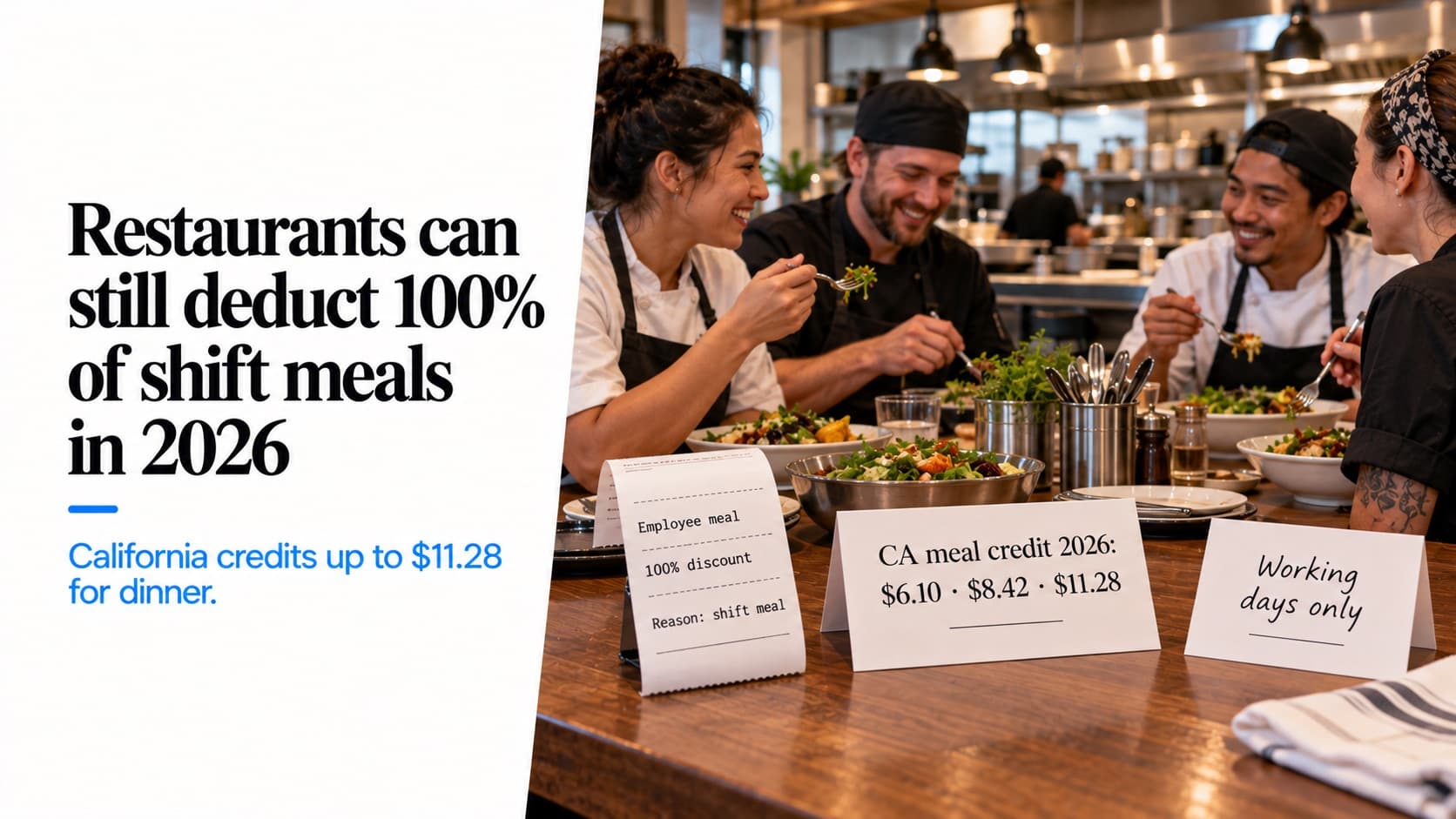
Starting this year, most employers can no longer deduct the cost of meals they provide on site. You've probably seen the headline. It's true for the office cafeteria and the catered team lunch. It isn't true for a restaurant feeding its own staff from its own kitchen.
Shift meals sit at an odd intersection of tax law, wage law and sales tax, and each treats the same plate of food differently. None of this is tax advice; it's the published rule.
The deduction survives for restaurants
Section 274(o) of the tax code, as amended in 2025, disallows the deduction for on-site employee meals from 2026 — "except in the case of an expense described in subsection (e)(8)," which covers goods sold to customers for full value.
A 2020 regulation applies that exception to restaurants directly. A "restaurant or catering business may deduct 100 percent of its costs for food or beverage items, purchased in connection with preparing and providing meals to its paying customers, which are also consumed at the worksite by employees." Its example is a restaurant that feeds its staff "before, during, and after their shifts for no consideration." Fully deductible.
The IRS's 2026 fringe benefits guide confirms the law "created specific, limited exceptions ... for meals provided by restaurants." Two edge cases aren't tested: meals for a restaurant group's corporate office staff, and staff meals bought in from outside, like a pizza delivery.
For your staff, the meal isn't income
The tax regulations treat a meal given to a food service employee "for each meal period in which the employee works" as furnished for the employer's convenience — "irrespective of whether the meal is furnished during, immediately before, or immediately after the working hours." That keeps it out of income and out of Social Security and Medicare wages.
Two limits:
- Days off don't count. A meal on a non-working day is income.
- Discounts have a cap. An employee discount on goods is tax-free only up to your gross profit percentage. A discount deeper than your margin is wages on the excess. That's my reading of how the rule applies to restaurant food.
The same meal, opposite labels
Here's the odd part. The Labor Department, for minimum-wage purposes, says "meals are always regarded as primarily for the benefit and convenience of the employee" — the opposite of the IRS. That's what lets an employer credit the meal toward the minimum wage, at "not more than the actual cost to the employer," with no profit.
The rule also says the employee's acceptance must be voluntary. But in a 1997 opinion letter the Labor Department said it "no longer enforces the 'voluntary' provision with respect to meal credits," after several appeals courts rejected it. The courts are split, so check your circuit.
Both labels work in the employer's favor. Neither is a reason to skip the paperwork.
State meal credits for 2026
States cap the credit, and some add conditions:
| State | Breakfast | Lunch | Dinner | Conditions |
|---|---|---|---|---|
| California | $6.10 | $8.42 | $11.28 | Voluntary written agreement required |
| New York City, Long Island, Westchester | $4.05 per meal (food service) | Max two meals a day | ||
| Rest of New York | $4.10 per meal (food service) | Max two meals a day |
California's matters more than it looks, because California allows no tip credit; the meal credit is the only in-kind offset against its minimum wage. In New York, the upstate credit is higher than New York City's, and a "meal" must include an item from four food groups — a slice of pizza from the line likely doesn't qualify. For the wage rates these credits offset, see the January 2027 minimum wage post.
Sales tax on staff meals
California's rule is a good example of how this works. A restaurant "must include its receipts from the sales of meals to employees" in taxable sales, but only when there's a specific charge: the employee pays, the value is deducted from wages, it's credited toward the minimum wage, or the employee can take cash instead. A free meal with no charge isn't a sale; the restaurant is the consumer.
So a 50% staff discount rung through the POS is a taxable sale at the discounted price. A 100% comp isn't. And a meal credited toward wages creates taxable receipts even though no money crossed the counter.
How to ring it in the POS
- Use a dedicated "employee meal" discount reason, not a void or a general comp. Voids lose the inventory record.
- Attach the meal to the employee who ate it.
- Track cost, not menu price, if you take a meal credit — the credit is capped at cost.
- Separate full comps from partial discounts, because sales tax treats them differently.
Comps without reasons are also where theft hides, as the POS fraud post shows.
What I'm not going to give you
What shift meals cost as a share of sales. I couldn't find a source I'd stand behind.
Other states' meal credits or sales tax rules. I've covered California and New York.
A ruling on bought-in staff meals. The regulation covers food from your own kitchen.
What to do
- Keep deducting shift meals from your own kitchen, and ask your accountant about any bought-in meals.
- Feed staff on working days if you want the meal excluded.
- Cap discounts at your margin.
- Get a written agreement before taking a meal credit in California.
- Set up the discount reason in your POS this week.
Disclosure: I work at Katalyst, whose POS records discounts by reason and employee. The rule that matters is older than any POS: a shift meal is deductible, excluded and creditable only if you can show what it was.
Topics
See how Katalyst handles your service style
A 30-minute walkthrough of the platform, tuned to how your restaurant actually runs.