The new federal hemp cap is 0.4 mg of THC per can
The deadline moved to December 11, and synthetic cannabinoids lose hemp status November 12. A state hemp licence does not protect a bar from federal law.

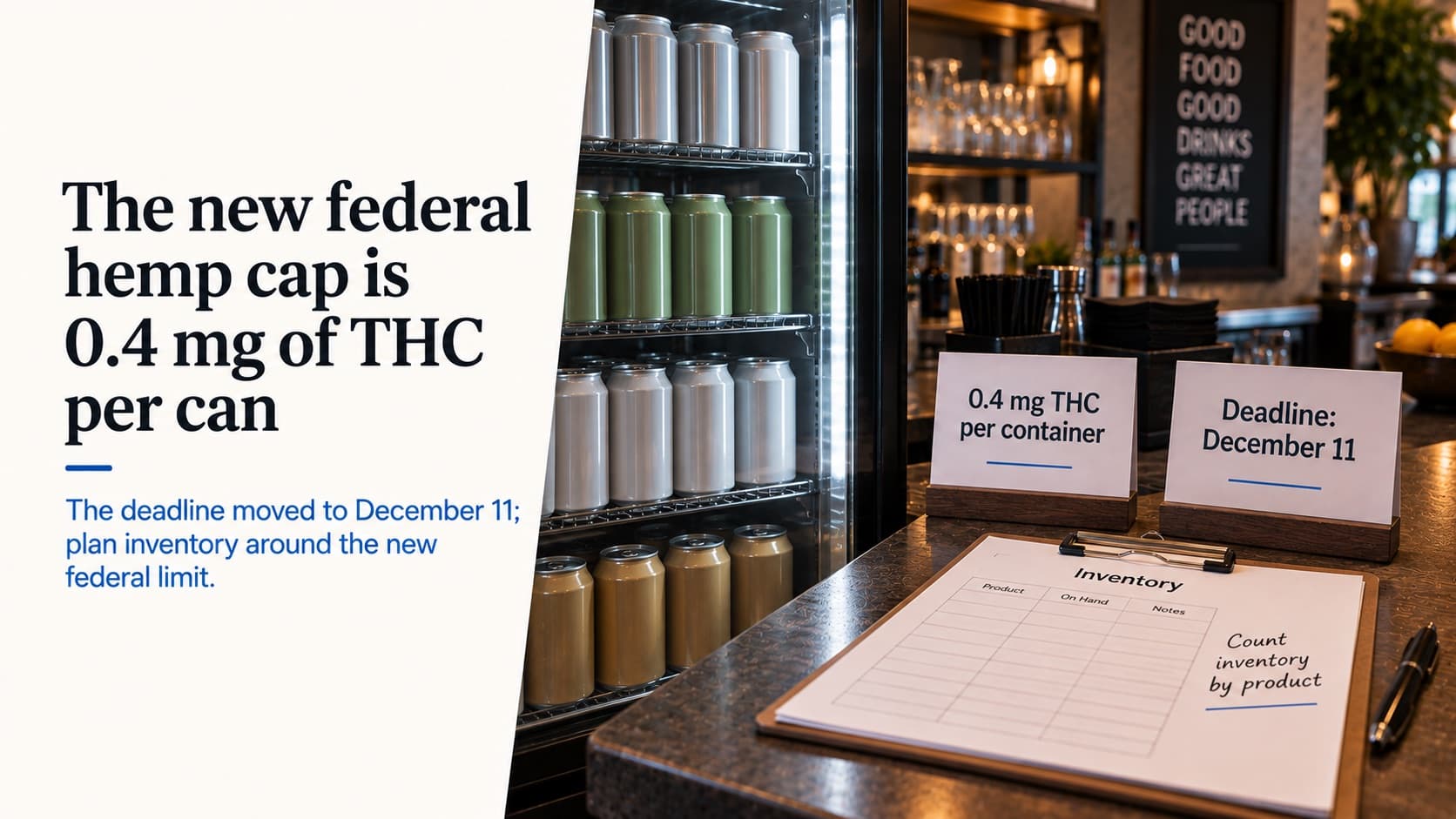
If your bar sells THC seltzers, the number to know is 0.4 milligrams. That's the most total THC a finished hemp product can contain per container under the new federal definition of hemp. The typical hemp beverage on a cooler shelf carries somewhere between 2.5 and 10 mg. A "microdose" 2 mg can is five times over. A 10 mg can, the most Minnesota allows per container, is 25 times over.
So this isn't a labeling change or a potency tweak. For drinks sold to have an effect, it removes the category from federal law's definition of hemp. Everything else in this post follows from that.
What changed, and when
The change came in Public Law 119-37, the continuing resolution that ended the shutdown on November 12, 2025. Buried in its agriculture appropriations, Division B, Section 781 rewrites the federal definition of hemp:
- Total THC counts, including THCA. The old 0.3% limit measured only delta-9 THC, which is how most intoxicating hemp products got through. The new limit is 0.3% total THC by dry weight.
- A per-container cap on finished products: 0.4 mg of total THC, plus other cannabinoids with similar effects, measured per innermost retail package.
- Synthesized cannabinoids are out. Anything "not capable of being naturally produced" by the plant, or manufactured outside it, is no longer hemp. That covers most delta-8, HHC and THC-O.
The law originally took effect 365 days after signing: November 12, 2026. On September 2, 2026, a new stopgap funding law moved the date to December 11, 2026, with one carve-out. Synthetic and converted cannabinoids still lose hemp status on November 12. If you stock delta-8 anything, your date didn't move.
Why a state licence doesn't cover you
Several states have built real regulatory systems around hemp THC drinks, and bars are central to them:
- Minnesota lets a hemp retailer that also holds a liquor on-sale licence get an on-site consumption endorsement, so bars pour THC drinks next to beer. State law caps beverages far above the new federal limit.
- Tennessee moved hemp-derived cannabinoid products under its Alcoholic Beverage Commission on January 1, 2026, with three-tier licensing and sale limited to 21+ venues and alcohol licensees.
- Texas requires its liquor licensees to check ID and refuse hemp sales to anyone under 21, on pain of losing the liquor licence.
None of that changes what happens on December 11. A product outside the federal hemp definition is marijuana under the Controlled Substances Act. A state licence doesn't make a federally controlled substance legal, any more than a state cannabis licence does. Minnesota can keep licensing the endorsement; the drink in the can is what changed status.
Nothing in the law grandfathers existing inventory either. A case of 10 mg seltzers that's legal on December 10 is, federally, a case of marijuana on December 11.
The realistic risk is your liquor licence
Federal enforcement is the question everyone asks, and the honest answer is that nobody knows. The Congressional Research Service wrote that it "is unclear if and how federal agencies will enforce." No single agency is named. DEA handles controlled substances and FDA handles food and beverages, and neither has said what it will do.
For a bar, though, the agency that matters most is closer to home. Your state liquor regulator decides whether you keep your licence, and several have already drawn lines that don't depend on federal action:
- California bars alcohol licensees from selling cannabis products on the premises, and prohibits any alcoholic beverage containing THC or cannabinoids "regardless of source." Since January 2026, THC in food and beverages is banned outright.
- Minnesota prohibits selling hemp products "designed or reasonably expected to be mixed with an alcoholic beverage," even under the endorsement.
- Federally, the Alcohol and Tobacco Tax and Trade Bureau won't approve formulas or labels for alcohol beverages containing THC.
A THC cocktail on a menu is already a liquor-licence problem in those places, independent of December 11. A licence is usually the most valuable intangible a bar owns, and in quota states it's a separately priced asset. That's the exposure I'd manage first.
Don't plan on a rescue
There are bills to replace the ban with a regulatory framework. One proposes a full framework with a 21+ age limit, another would regulate hemp beverages like alcohol, and a third covers packaging and testing. As of early September, all of them were still in committee with no vote scheduled.
The broader vehicle hasn't helped. The House passed a 2026 Farm Bill in April that keeps the ban; amendments to soften it were withdrawn. The Senate Agriculture Committee failed to advance its version 10–11 in August.
The December delay was a month. Plan your inventory as if that month is all there is, and treat anything that passes later as upside.
What I'm not going to give you
Legal advice on your specific product. Whether a given drink fits depends on its lab results, its packaging and your state. Ask your distributor for the certificate of analysis, and ask a lawyer who practices before your liquor regulator.
A prediction about federal enforcement. See above. "Nobody has said" is the accurate answer.
Vote counts on the September delay. I saw figures reported but couldn't confirm them against the congressional record, so they're not here.
What to do before December 11
- Count what you have by product, milligrams per container and manufacturer. Separate anything synthetic or converted, since its deadline is November 12.
- Ask your distributor about returns now. Buyback terms are much easier to get in September than in December, when every account calls at once.
- Stop reordering anything above 0.4 mg per container. Set your par levels so the shelf is empty by the deadline, not full of stock you can't sell.
- Remove the items from your POS and menus on the date, including online ordering and any delivery app menus. A product that's still orderable online on December 12 is still being sold.
- Check your liquor regulator's guidance if you've ever mixed or co-sold THC with alcohol. In California and Minnesota that line is already drawn.
- Replace the margin, not just the item. THC drinks often carried better margins than beer. A non-alcoholic program priced with the same discipline as the rest of the bar is the natural substitute; the pour-cost post has the method.
Disclosure: I work at Katalyst, which sells POS software to bars. Nothing here depends on your system. The one POS-specific step is number 4. Items stay orderable on every channel until someone turns them off, and delivery menus are the ones people forget.
Topics
See how Katalyst handles your service style
A 30-minute walkthrough of the platform, tuned to how your restaurant actually runs.