Food service drew 21% of 2025's web accessibility lawsuits
An overlay widget didn't prevent about 1,400 of them, and the FTC fined accessiBe $1 million. A restaurant can't use the online-only defense.

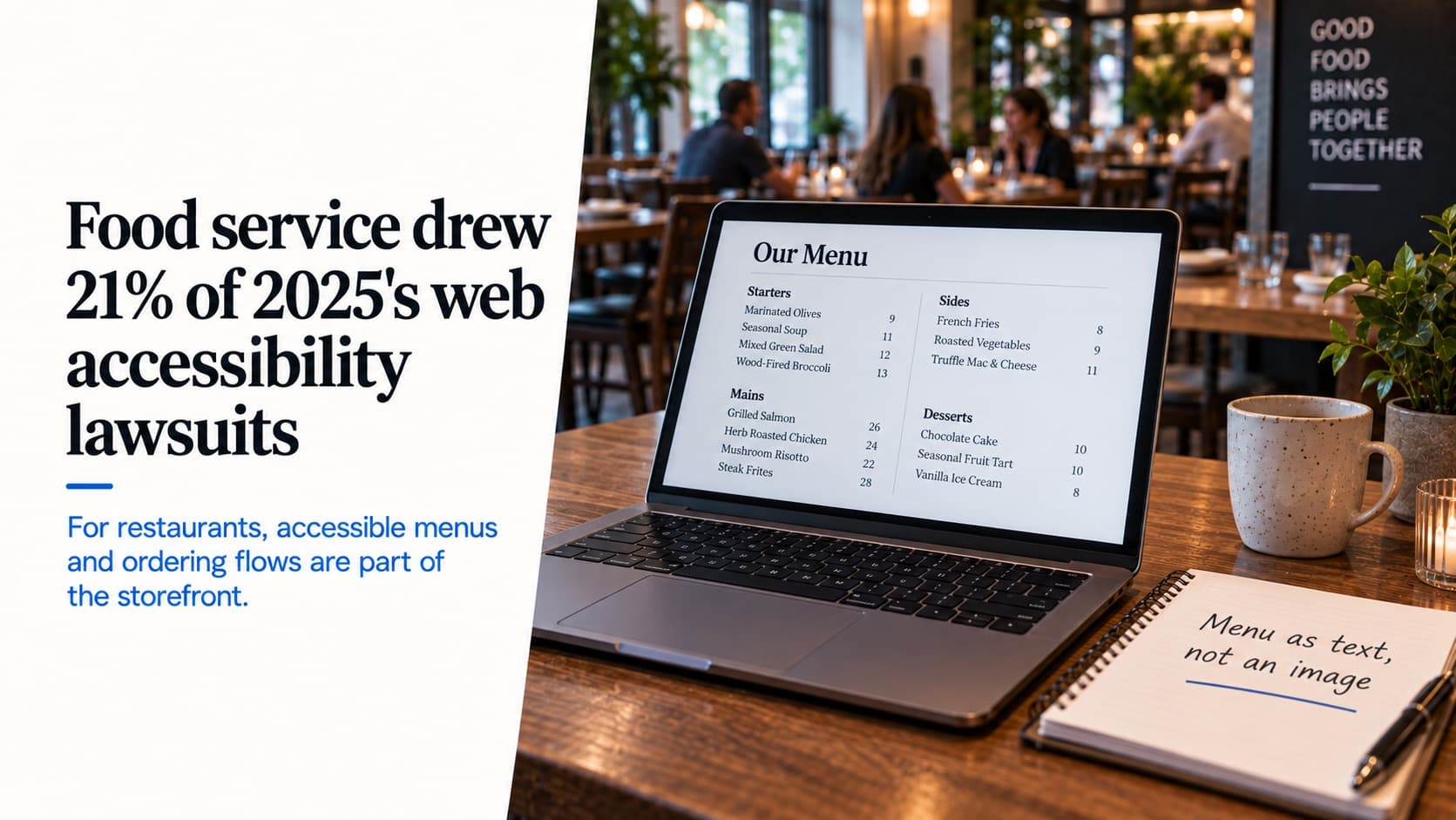
UsableNet, which tracks digital accessibility litigation, counted 5,114 lawsuits over inaccessible websites and apps in 2025, filed in federal courts and in New York and California state courts. Food service was 21% of them, second only to e-commerce. That's roughly 1,070 suits against restaurants and food businesses in one year.
Two more figures from the same report change how to think about the risk. 64% of defendants had less than $25 million in annual revenue, so this isn't a big-chain problem. And 45% of federal cases named a company that had already been sued before. Settling one demand letter doesn't fix the site, and an unfixed site gets found again.
Why a restaurant can't argue its website isn't covered
The Americans with Disabilities Act's rules for businesses cover "places of public accommodation," and the law was written before websites existed. Some courts have held that a business existing only online isn't covered. Restaurants don't get that argument.
- Robles v. Domino's (2019). A blind customer couldn't order pizza through Domino's website and app with a screen reader. The federal appeals court for the western states held that the ADA covers a website connected to a physical place of business. The Supreme Court declined to hear Domino's appeal.
- Thurston v. Midvale (2019). A California appeals court applied the same reasoning to a restaurant whose online menu and reservation system didn't work with a screen reader.
The rulings in the other direction, including two federal decisions in New York in 2024 and 2025, concern stand-alone websites with no physical location. If you have a dining room, your website's connection to it is exactly what these cases turn on. The menu and the reservation flow are the two things courts have already said count.
Where the suits are filed, and why California looks quiet
Seyfarth Shaw's count of federal website suits in 2025 was 3,117. By state: New York 1,021, Florida 961, Illinois 585, and California four.
California isn't safe; its suits go to state court. Its civil rights statute, the Unruh Act, makes every ADA violation a state violation too, with a minimum of $4,000 per offense plus attorney's fees. That minimum is why plaintiffs there prefer state court. New York complaints typically stack federal, state and city human rights claims in one filing.
What gets flagged
Plaintiffs' firms find sites with automated scanners, so the barriers that show up in complaints are the ones a scanner finds. WebAIM runs the same kind of scan across the home pages of the top million websites each year. Its 2026 results show what's most common:
| Failure | Share of home pages |
|---|---|
| Low-contrast text | 83.9% |
| Images without alt text | 53.1% |
| Form fields without labels | 51.0% |
| Empty links | 46.3% |
| Empty buttons | 30.6% |
For restaurants, add the two things from the Thurston case: a menu that exists only as an image, which a screen reader can't read, and a reservation or ordering flow that can't be completed with a keyboard. A menu posted as a scanned image or a PDF of a photo fails the first test before anyone looks at anything else.
An overlay widget isn't a defense
Accessibility overlays are the scripts that add a toolbar to your site and promise compliance with one line of code. UsableNet's monthly counts show suits against sites that already had an overlay installed throughout 2025. Added up, that's about 1,400 suits, or roughly 28% of the year's total. The report's own summary: "Accessibility widgets did not slow litigation in 2025."
In April 2025 the Federal Trade Commission finalized an order requiring accessiBe, one of the largest overlay vendors, to pay $1 million. The order bars it from claiming its automated product can make a site compliant unless it can prove it.
Third-party ordering and reservation widgets
Most restaurant sites embed someone else's ordering or reservation system. If that embedded tool can't be used with a screen reader, a guest can't order or book, and the complaint names the restaurant whose site they were on.
The same applies to a QR code on the table: the page it opens is a web page, and the QR ordering post covers what the ADA expects when the menu lives on a phone.
I didn't find an appellate ruling that divides the liability between a restaurant and the vendor behind its embed. The ADA's regulations bar discrimination "through contractual, licensing, or other arrangements," which is the obvious hook, and the practical reading is that outsourcing the ordering flow doesn't outsource the responsibility. Ask vendors for an accessibility conformance report, often called a VPAT, and test their widget yourself.
There's still no federal rule for businesses
There is no Justice Department regulation setting a technical standard for business websites. Its 2022 guidance says the ADA applies to businesses open to the public and points to the Web Content Accessibility Guidelines as a reference, without adopting them.
The 2024 rule requiring WCAG 2.1 AA covers state and local governments only, and in April 2026 its deadlines were pushed back a year, to 2027 and 2028. In October 2025 the Department said it would re-examine its ADA regulations on no set timetable. Courts and settlements still use WCAG 2.1 AA as the working standard, and it's the one to build to.
What I'm not going to give you
Settlement amounts. Settlements are confidential. The ranges that circulate, usually $5,000–$25,000 for a small business plus defense costs, come from accessibility vendors. They may be right; I can't check them.
A verdict on your site. A scanner catches roughly the issues in the table above. It can't tell you whether a blind guest can finish an order. Only a test with a screen reader shows that.
The "most-sued industry" claim. You'll see restaurants described that way. UsableNet's data puts e-commerce far ahead, at about 70%.
What to do
- Put your menu on the page as text, not as an image or a PDF. This is the single most restaurant-specific fix.
- Run a free scanner such as WAVE on your home page, menu and ordering pages, and fix the contrast, alt text, labels and empty buttons it finds.
- Try to order and book using only a keyboard. Tab through the whole flow. If you get stuck, so will a screen reader user.
- Ask your ordering and reservation vendors for their accessibility conformance report, and whether they'll fix issues on their embed.
- Don't buy an overlay as a substitute for fixing the site.
- Add an accessibility statement with a phone number and email, so a guest who hits a problem can still order.
- If a demand letter arrives, call a lawyer and fix the site. Given how many suits hit repeat defendants, a settlement without remediation is a down payment on the next one.
Disclosure: I work at Katalyst, and we build restaurant ordering pages, so accessibility is our problem as well as yours. Hold your vendors to step 4, us included.
See how Katalyst handles your service style
A 30-minute walkthrough of the platform, tuned to how your restaurant actually runs.