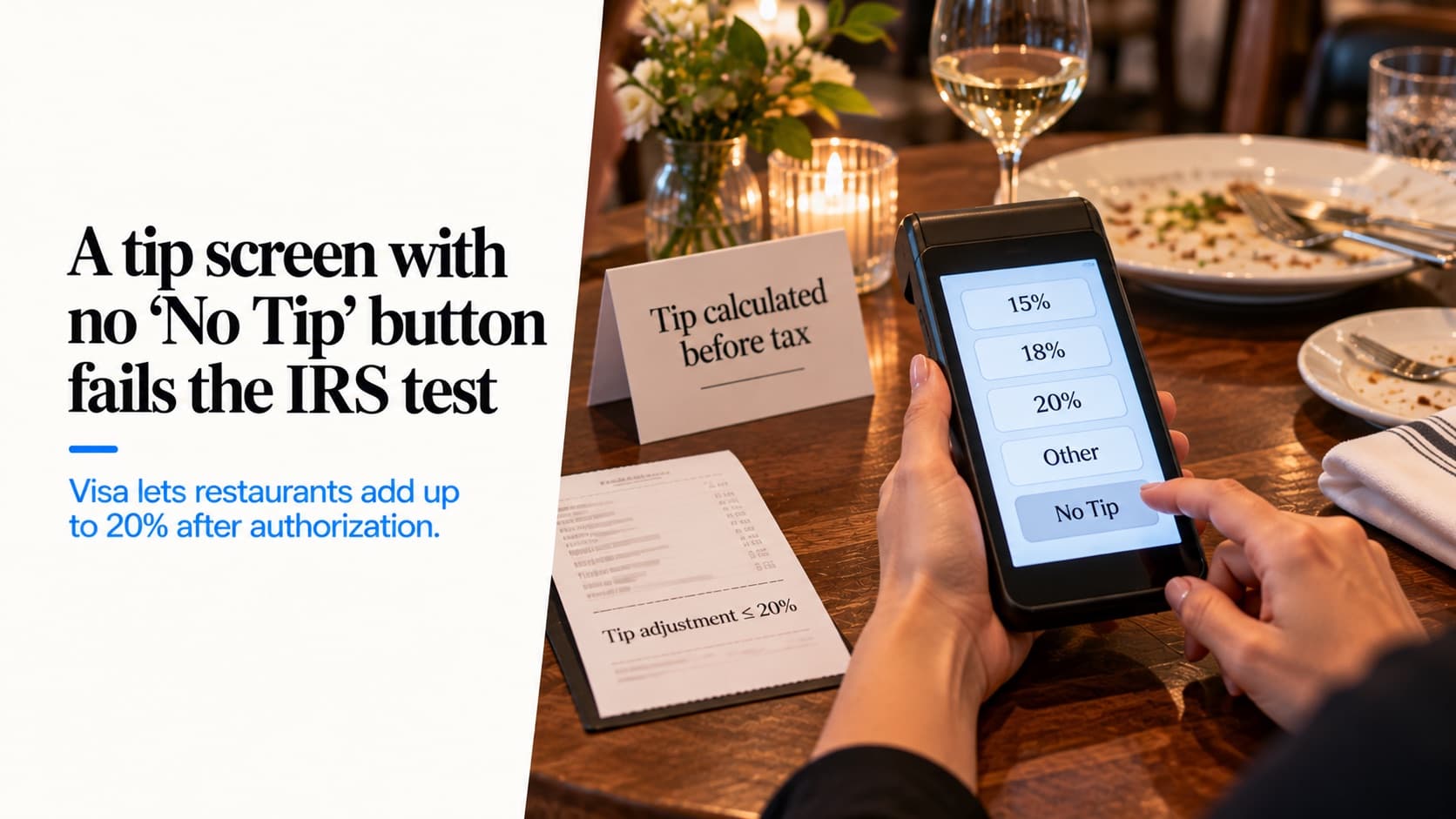
A tip screen with no 'No Tip' button fails the IRS test
Visa lets restaurants add up to 20% after authorization. In a 2021 study, asking for a tip before service lowered tips and customers' plans to return.

The tip screen is the one POS setting most owners never touched after installation. The vendor's defaults went in on day one — usually 18, 20 and 25% — and the screen has been turning toward customers ever since.
This year it stopped being just a hospitality question. The IRS's final rules on the new tips deduction describe tip screens by name, and the card networks have long had rules about what happens to a tip after the card is charged. Here's what the screen should look like, and why.
The IRS now has an opinion about your screen
The final regulations, TD 10044, say an amount is a qualified tip only if the customer can "disregard or modify" it, "including to zero." The examples are about POS screens:
- A handheld screen offering 15%, 18%, 20%, "other" and "no tip": the 18% the customer picks is a qualified tip.
- A screen offering only 15%, 18% and 20%, with a selection required: the 15% the customer picks is not a qualified tip.
- On that same screen, a customer who picks 18%: only the extra 3% counts.
A slider with a minimum floor works the same way: only the amount above the floor qualifies. The forced part looks like a service charge, which is paid as wages — no FICA tip credit, and no tips deduction for your staff on that money. The no-tax-on-tips post covers what that means for W-2s.
The fix is one button: a visible "No Tip" or a custom field that accepts zero.
Washington adds a sales tax version
Washington's Department of Revenue treats a tip on a device as voluntary, and free of sales tax, only if the screen defaults to blank or to "$0 value for the gratuity that the customer can freely adjust after the meal or service is provided." Otherwise it assumes the charge is mandatory and taxable. The catering sales tax post covers the rest of that rule.
What higher defaults do
The research is thinner than the opinions:
- New York taxis. A 2014 study of more than 13 million rides found default suggestions "have a large impact on tip amounts," but that more riders left no tip when shown higher options. A later working paper argued that the no-tip effect came from screen layout, not the percentages.
- A laundry delivery app. A 2021 field experiment with nearly 95,000 orders found higher recommended tips raised tips with no detectable effect on satisfaction, repeat orders or bill size.
Neither is a restaurant. What they suggest is that the numbers matter less than the design, and that a higher default isn't automatically punished.
Timing matters more than the percentages
A 2021 study in the Journal of Service Research, across food and beauty services, found that asking for a tip before the service lowered the tip itself, customers' intentions to return, and their online ratings. Customers read it as manipulation.
That's the counter-service problem. The screen asks for a tip before the food exists. For table service, the tip comes after the meal and none of this applies.
What customers say
Pew's 2023 survey found 72% of Americans think tipping is expected in more places than five years ago, and 40% oppose businesses suggesting tip amounts on a screen or bill. Only 12% said they always or often tip at fast-casual restaurants. A 2025 Bankrate survey found 38% are annoyed by pre-entered tip screens. These are attitudes, not behavior, but they explain the complaints.
Before tax or after
No law I found sets the base. It's a setting:
- Toast calculates tips before tax by default. Its suggested amounts on receipts use the price before discounts, so a comped or discounted check still suggests a tip on the full price.
- Square lets the seller choose. Its "smart tip" amounts switch to dollar amounts — $1, $2, $3 — on checks under $10, and percentages above.
Pre-tax is the usual expectation. Whether to tip on the pre-discount price is a hospitality choice, but you should make it on purpose.
The 20% rule on adjusting tips
This is the part almost nobody knows. Visa allows restaurants, bars and fast-food merchants to "add up to 20% to the authorization amount with no liability for authorization-related disputes," and says they "must not add an estimated tip amount" to the authorization.
Mastercard's rule, as documented by a major processor, is stricter: on chip-and-PIN, contactless and online transactions, "any gratuity must be included in the authorization request," with a 20% tolerance for restaurants and fast food. Bars aren't in that exception.
So a 25% tip written on a paper slip after the card was tapped is above the tolerance, and the excess can be disputed unless you run a new authorization. A tip chosen on the screen before the payment is authorized avoids the problem entirely.
What I'd set
- A "No Tip" button on the first screen, not behind "other."
- Tips calculated on the pre-tax amount.
- Dollar options on small checks — under $10.
- For table service, tip at payment after the meal, on the screen.
- For counter service, ask whether you need a prompt at all, or move it after the order is handed over.
- Tip before authorization on contactless and chip payments.
What I'm not going to give you
"Tip screens raise tips by X%." The figures in circulation come from POS vendors' own data.
The share of customers who press "skip." I found no dataset.
Mastercard's online tolerance. One processor's page says 30%, another says 20%. I'd assume 20% until your acquirer says otherwise.
What to do
- Open your tip settings today and check for a zero option.
- Check the tax base and discount base.
- Move tips onto the screen before authorization where you can.
- Retrain staff not to accept handwritten tips above 20%.
Disclosure: I work at Katalyst. Our guest-facing checkout shows preset percentages, a Custom Tip button and a No Tip button on the same screen, which by the rule above is the version that keeps tips as tips.
Related Katalyst products
See how Katalyst handles your service style
A 30-minute walkthrough of the platform, tuned to how your restaurant actually runs.