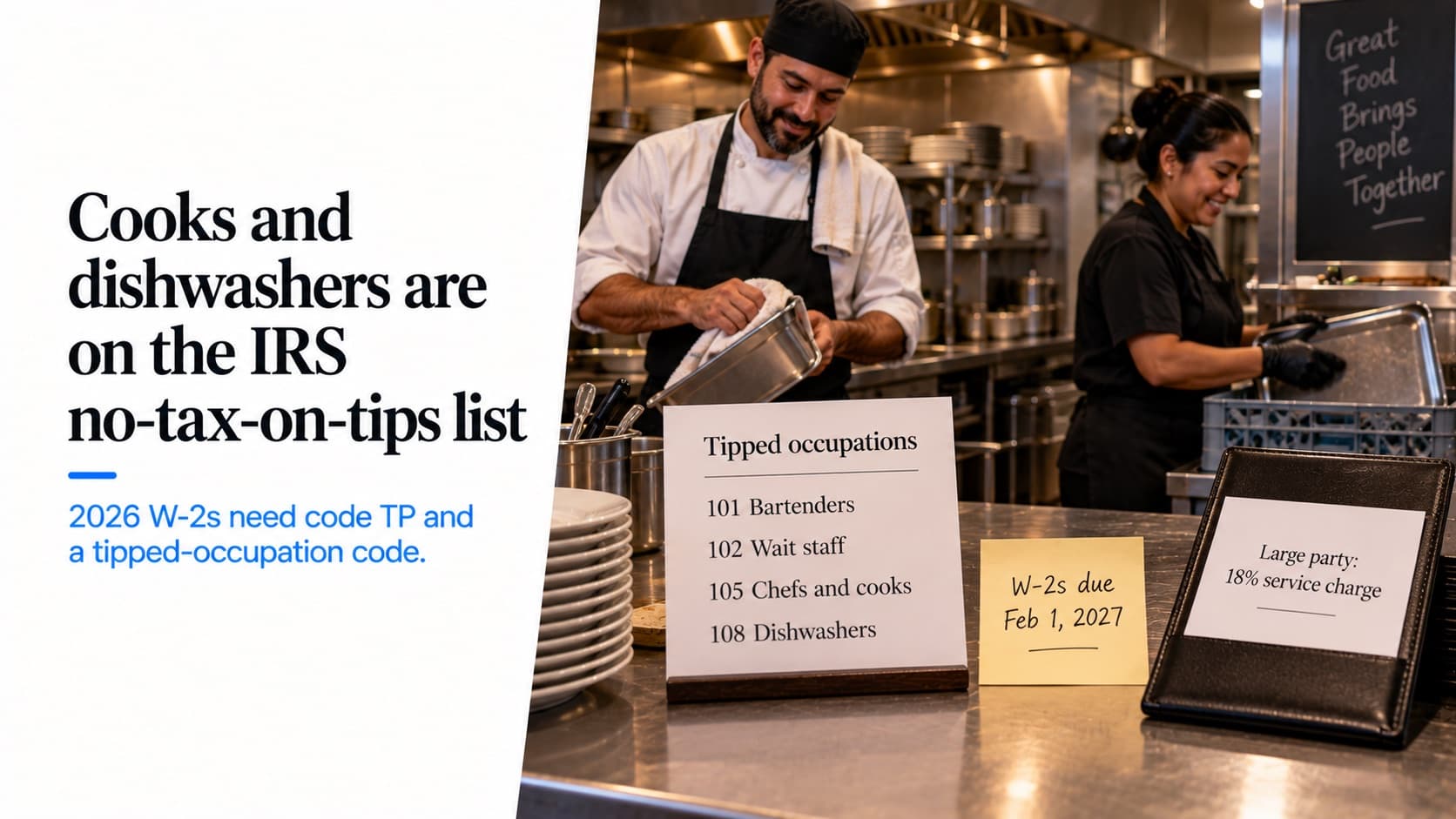
Cooks and dishwashers are on the IRS no-tax-on-tips list
2026 W-2s, due February 1, 2027, must show total reported tips under code TP plus a tipped-occupation code. An auto-gratuity guests can't remove isn't a tip.

The "no tax on tips" deduction has been law since July 2025, and most of what's been written about it is aimed at servers wondering what they'll save. For an operator the question is narrower and has a deadline: what your payroll has to do differently for the 2026 Forms W-2, which go out by February 1, 2027.
The final regulations came out in April. Three things in them matter more to a restaurant than the headline: who's on the occupation list, what happens to an automatic service charge, and the new boxes on the W-2. None of this is tax advice for your business; it's the published rule.
What your staff actually get
The deduction, in section 224, is capped at $25,000 a year and covers tax years 2025 through 2028. It's a deduction, not an exclusion: tips still show up as wages on the W-2, and the worker claims the deduction on a new Schedule 1-A without needing to itemize. Married people filing separately can't take it, and it requires a Social Security number.
The phase-out is widely misread. Above $150,000 of income ($300,000 joint), the cap shrinks by $100 for every $1,000. The tips don't. A server with $12,000 in tips and $200,000 of household income has a cap of $20,000 and still deducts all $12,000.
The detail that helps you most: the deduction only reaches tips that were reported — on a W-2, a 1099, or the worker's own Form 4137. Unreported cash tips get nothing. For the first time, your staff have a tax reason to declare every tip.
The kitchen is on the list
The Treasury's final list of tipped occupations has about 70 entries, each with a three-digit code. The food and beverage group is codes 101 to 110:
| Code | Occupation |
|---|---|
| 101 | Bartenders |
| 102 | Wait staff |
| 103 | Food and beverage servers, non-restaurant |
| 104 | Dining room and cafeteria attendants, bartender helpers |
| 105 | Chefs and cooks |
| 106 | Food preparation workers |
| 107 | Fast food and counter workers |
| 108 | Dishwashers |
| 109 | Host staff |
| 110 | Bakers |
Most coverage describes this as a servers-and-bartenders deduction. It isn't. A cook or dishwasher who gets a share of a tip pool can deduct it, because tip-sharing arrangements count, and so can counter staff tipped through the screen at the register. Managers and supervisors are the exception: tips they receive through a pool don't qualify, and under federal wage law they shouldn't be in the pool anyway. The tip-pooling post covers who can share.
An auto-gratuity guests can't remove isn't a tip
The IRS's own example is the automatic 18% charge on a large party. If it's "added with no option for the customer to disregard or modify it," the amounts paid to staff from it "are not qualified tips." They're wages.
The final rule loosened this from the draft. A charge counts as voluntary if the guest can reduce it to zero — a tip slider that goes to $0, an "other" field — and anything a guest adds on top of a mandatory charge is a voluntary tip.
So converting tips into a mandatory service charge now costs twice. Service charges are wages, so you lose the federal FICA tip credit on them, and your staff lose the deduction on that money. If you use automatic gratuities for large parties, decide deliberately whether guests can remove them, and say so on the check.
What changes on the 2026 W-2
The 2026 W-2 instructions add three items:
- Box 12, code TP: the "total amount of cash tips reported to the employer." Note what that is: every reported tip, cash and card. You don't screen tips for eligibility. The worker does that on their return.
- Box 14b: up to two tipped-occupation codes. "If any tips were received in a nonqualifying occupation, then '000' must be input as one of the occupation code(s)." A server who also takes pool shares as a shift lead may need a second code.
- Box 12, code TT: qualified overtime, and only the half in time-and-a-half.
For 2025, the IRS waived penalties for employers who couldn't report these separately. That relief "applies only for taxable year 2025." I found no extension to 2026. Plan as if the full information-return penalties apply to the W-2s you send in January.
Payroll taxes don't change
The deduction is an income tax change for the worker. Tips are still subject to income tax withholding and to both halves of Social Security and Medicare when they reach $20 a month. The employer's FICA tip credit under section 45B still applies to tips above $5.15 an hour; the 2025 law extended it to beauty businesses and left restaurants where they were.
Overtime has its own trap
The companion overtime deduction, capped at $12,500, covers only the federally required half-time premium for hours over 40 in a week. California's daily overtime, double time and seventh-day premiums don't count, because the IRS says payments "in excess of the FLSA-required premium are not" qualified. Code TT should carry the federal half only.
States are split
The deduction is federal. Each state with an income tax decides whether to follow it, and the trackers disagree on the count. California, New York and Illinois are the states most often listed as not conforming. The nine states with no wage income tax aren't affected. Check your own state's revenue department rather than any national map.
What I'm not going to give you
An average saving per server. Every number in circulation comes from a calculator that assumes a bracket and an income.
A list of conforming states. The trackers disagree, and some states' figures don't reconcile.
Penalty relief for 2026. I couldn't find any.
What to do before January
- Map every POS charge type to "tip" or "service charge." A charge guests can't reduce is a service charge.
- Give every tipped job code an occupation code in payroll, including cooks, prep, counter staff, dishwashers and bakers if they share tips.
- Move manager pool shares out of tip earnings codes.
- Clean up tip declarations now. Box 12 TP is built from what staff reported to you, so the 2026 records have to be complete.
- Code only the federal half-time premium as qualified overtime.
- Tell your staff to report every tip. For once, it's in their interest.
For the state-level fights over the tip credit itself, see the tip credit post.
Disclosure: I work at Katalyst, whose POS separates tips from service charges and passes declared tips to payroll. The decision that matters most here — whether your large-party charge can be removed — is a policy choice, not a software setting.
Related Katalyst products
See how Katalyst handles your service style
A 30-minute walkthrough of the platform, tuned to how your restaurant actually runs.