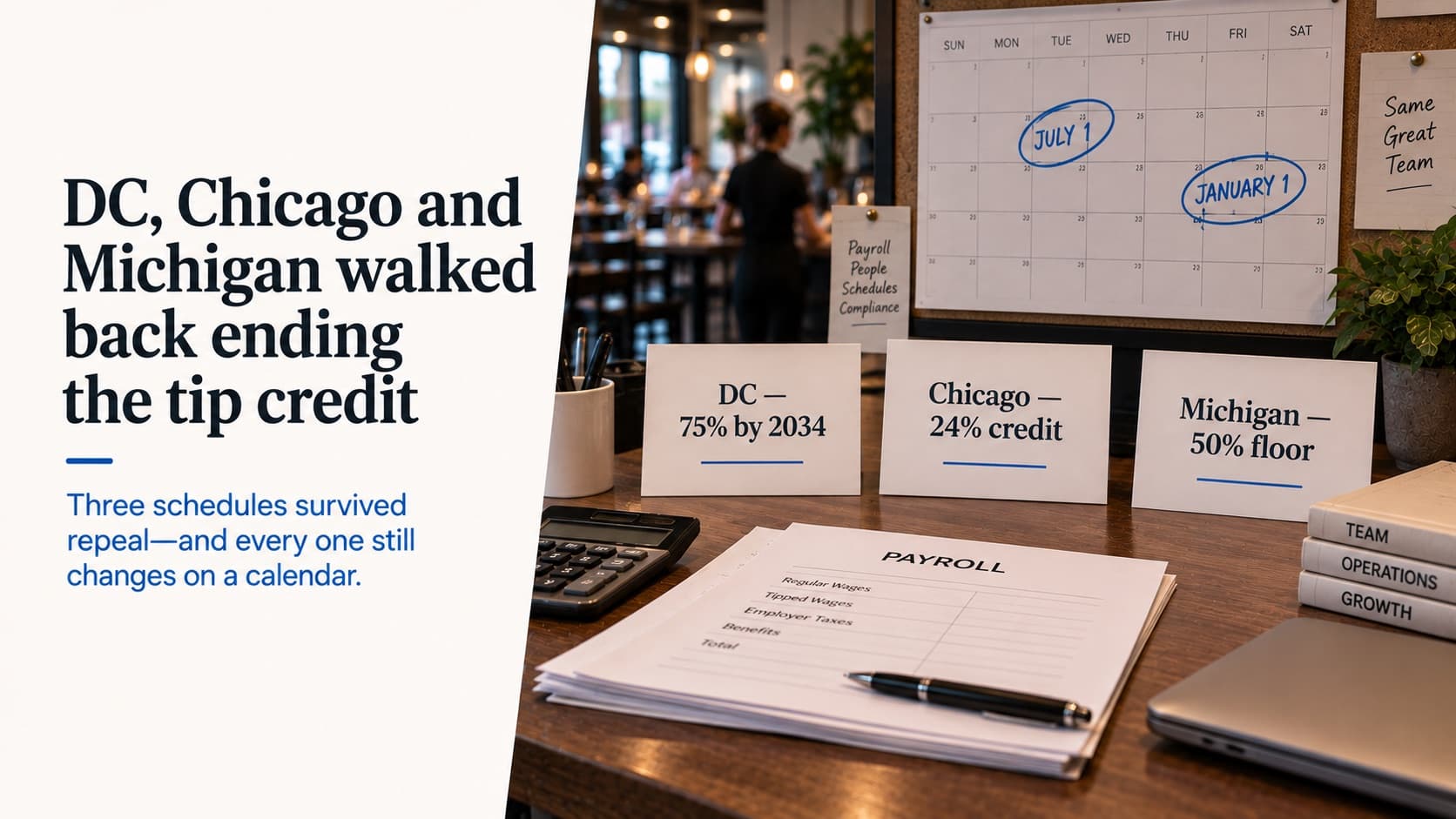
DC, Chicago and Michigan walked back ending the tip credit
DC now caps tipped pay at 75% of the minimum by 2034. Chicago holds a 24% credit until 2028, then ends it in 2030 or 2033 depending on employer size.

Between 2022 and 2024, ending the tip credit looked like the direction of travel. Washington, DC voters passed Initiative 82 with about 74% of the vote. Chicago's council passed a five-year phaseout. Michigan's Supreme Court revived a schedule that would have eliminated the credit by 2030. If you were opening a restaurant, it was reasonable to plan for a future where every server earns the full minimum wage before tips.
By September 2026, all three had been scaled back. None of them went back to where they started, either. What replaced repeal in each case is a tipped wage set as a percentage of the minimum, indexed and stepping up on a schedule. That's harder to plan for than either extreme, because the number changes every year on a date you need to know.
What passed, and what it became
| Where | What was passed | What it is now | Tipped wage today |
|---|---|---|---|
| Washington, DC | Initiative 82 (2022): full minimum wage for tipped workers by 2027 | 2025 amendment: 56% of the minimum from July 2026, 60% from 2028, then +5 points every two years to a permanent 75% cap in 2034 | $10.30 on an $18.40 minimum |
| Chicago | 2023 ordinance: credit phased out by July 2028 | May 20, 2026 (49–1): two-year pause at a 24% credit; full elimination in 2030 for employers with more than 21 employees, 2033 for smaller ones | $12.96 on a $17.05 minimum |
| Michigan | 2024 court ruling: credit eliminated by 2030 | SB 8 (Feb 2025): tipped wage 40% in 2026, rising 2 points a year to a permanent 50% from 2031 | 40% of $13.73 |
The routes were different. DC's council froze the tipped wage at $10 in June 2025 when it was due to rise to $12, then voted 7–5 in July to amend the initiative rather than repeal it, which is what Mayor Bowser had proposed. Chicago's council voted 30–18 in March 2026 to repeal the phaseout outright; the mayor vetoed it, the override failed, and the two-year pause was the compromise. Michigan's legislature passed its fix days before the court's schedule was due to take effect.
The outcome is the same shape in all three places: a tip credit that survives, gets smaller on a schedule, and in DC and Michigan never reaches zero.
Voters rejected changes in both directions
Two 2024 ballot measures are worth reading together.
Massachusetts Question 5 would have raised the tipped wage to the full minimum. It lost 64.1% to 35.9%. The state's tipped rate is still $6.75 on a $15.00 minimum, unchanged since January 2023.
Arizona Proposition 138 went the other way. Backed by restaurant groups, it would have let employers pay tipped workers 25% below the minimum wage, as long as wages plus tips cleared the minimum plus $2. It lost by roughly three to one.
Neither electorate wanted to move the tip credit much in either direction. That's a useful thing to know before you assume your state is next.
Where there's no tip credit at all
The federal floor is unchanged: a $2.13 cash wage and a maximum $5.12 tip credit on the $7.25 minimum. The Department of Labor's current table lists the states that require the full state minimum wage before tips:
- Alaska, California, Minnesota, Nevada, Oregon, Washington — no tip credit.
- Montana — no tip credit, but the minimum itself depends on business size: $10.85 for businesses with more than $110,000 in annual sales, $4.00 below that.
- Hawaii — technically a tip credit, but only $1.25, and only if wages plus tips exceed the minimum by at least $7.00.
Illinois still allows a credit of up to 40% statewide. A bill to eliminate it hasn't passed, so Chicago's schedule applies only inside the city.
The evidence fight, fairly
Everyone involved has numbers, and very few of them are neutral.
On the restaurant side, the Employment Policies Institute, which is industry-aligned, reported DC full-service restaurant employment down 3.5% between May 2023 and May 2024 against a 0.7% fall across the metro area. The National Restaurant Association and a DC restaurant coalition have published other job-loss figures that don't agree with each other. The Restaurant Association Metropolitan Washington counted 102 closures in 2025, up about 39% on the year, and then 43% fewer closures in the first half of 2026, which it attributes to the pause.
On the other side, the Economic Policy Institute and worker groups argue there's no evidence the policy harmed the industry.
Here's what I'd weigh. DC's restaurants spent 2025 absorbing federal layoffs, a government shutdown and tariffs at the same time as the wage steps. Nobody has published a study that separates those effects. Anyone who tells you exactly how many jobs I-82 cost, or saved, is quoting an advocacy group.
The service-charge detour
Many DC restaurants responded to I-82 by adding mandatory service charges, some at 20–22%. I couldn't find a neutral count of how many. The practice outlived the policy change, and it carries consequences worth restating in one line each:
- A mandatory service charge is wages, not tips, for payroll tax purposes.
- The federal tip deduction applies only to voluntary tips, so service charge income doesn't qualify for it.
- In some states, California among them, the charge is subject to sales tax even when it goes to staff.
The tip pooling post has the full rules.
What I'm not going to give you
A prediction for your state. The pattern in the last four years is retreat from full repeal, but DC organizers are already collecting signatures for a 2027 measure that would raise the minimum to $25 and bring tipped pay up to match it. Direction can change in one election.
A job-loss number. See above.
The exact Chicago small-employer bracket. Reports of the May ordinance describe it as 3–21 employees. Chicago's minimum wage rules normally start at four. Check the ordinance text before you rely on your headcount.
What to do
- Put the rate change dates in your calendar. DC and Chicago adjust on July 1, Michigan on January 1 from 2027. The tipped wage in your payroll system has to change on those dates, not when someone notices.
- Recalculate the credit as a percentage, not a dollar amount. Chicago's 24% credit held, but the tipped wage still rose from $12.62 to $12.96 because the minimum it's a percentage of went up.
- Reissue the tip credit notice when the rate changes. The notice has to come before the credit, which I went through in the first-hires post.
- If you use a service charge, run it as a service charge. Wages through payroll, sales tax where it applies, and disclosed wherever the price appears.
- Model the 2030 step now if you're in Chicago with more than 21 employees. That's inside the term of a lease you might sign this year.
Disclosure: I work at Katalyst, and our POS handles tipped wage rates, service charges and tip reporting. None of the rules above depend on which system you use. What they depend on is someone owning the calendar of rate changes, and that's worth deciding before July.
Topics
See how Katalyst handles your service style
A 30-minute walkthrough of the platform, tuned to how your restaurant actually runs.