Nobody under 18 may clean the slicer, not just run it
Late I-9 Section 1 or Section 2 became a substantive violation in March 2026, at $288 to $2,861 per form. The correction window is gone.

Hiring your first employee creates a set of obligations that attach before their first shift, and two of them have changed recently in ways that remove the margin for error a new operator would normally rely on.
This is not a comprehensive employment law guide, and I'm not a lawyer. It's the short list of things that are cheap to get right on day one and expensive to fix afterwards — in one case, no longer fixable at all.
The I-9, and the window that closed
Form I-9 is required for every employee of every US employer hired after November 1986. There is no size exemption. Your first hire triggers it exactly as your hundredth does.
The timing is specific:
- Section 1 — completed by the employee — no later than their first day of employment.
- Section 2 — your verification of their documents — within three business days of the start date.
Here's what changed. As of 16 March 2026, ICE's updated I-9 Inspection Fact Sheet reclassifies failure to ensure timely preparation of Section 1 and timely completion of Section 2 as a substantive violation.
Previously, some timing errors were treated as technical violations with a correction period — you could fix them when they were found. That correction window is gone. A late Section 2 is now a substantive finding on inspection, not a paperwork item to tidy up.
Penalties under the current schedule run $288 to $2,861 per form for paperwork violations. Multiply by headcount and by turnover, which in a restaurant is the multiplier that hurts — every leaver and every replacement is another form, and the forms persist as records long after the person has gone.
Two practical rules that cost nothing:
Make Section 1 part of the offer acceptance, not the first shift. If it's completed before they arrive, the day-one deadline can't be missed by a manager who got busy.
Put Section 2 on a three-business-day calendar reminder, owned by a named person. The most common failure isn't ignorance of the rule; it's a manager who intended to do it Thursday.
Nobody under 18 may clean the slicer
Restaurants are one of the largest employers of teenagers in the country, and the federal restrictions are more specific than most operators realise. Two rules in particular catch people.
Under 18 — not under 16 — for power-driven meat processing machines. Employees under eighteen may not operate, clean, set up, adjust or repair power-driven meat processing equipment, and that includes deli slicers.
Read the verbs. Cleaning is explicitly covered. So the classic closing assignment — the seventeen-year-old breaking down and washing the slicer at the end of the night — is a federal child labour violation, and it's one nearly every deli, sandwich shop and pizzeria I've ever been in commits routinely without knowing.
For 14- and 15-year-olds, cooking is sharply limited. Baking is prohibited outright. They may not operate NEICO broilers, rotisseries, pressure cookers, fryolators, high-speed ovens or rapid toasters. Limited cooking is permitted on electric or gas grills that don't involve open flames, and on certain automatic-basket deep fryers, subject to further conditions.
The distinction between "certain automatic-basket deep fryers" and "a fryolator" is not intuitive, and it's the kind of line that gets crossed in a rush. Federal enforcement in this area has been active — one publicised action involved fifteen-year-olds working the fryer at a fast-food operator.
Civil money penalties run up to $15,625 per minor employee affected, with higher exposure for repeat violations or where a minor is seriously injured. Note the unit: per minor, not per violation.
And states layer their own rules on top — hour restrictions on school nights, break requirements, work permits. The federal floor is the floor.
What to do: write down, per station, which tasks a 14–15, a 16–17 and an 18+ employee may perform, and post it where the closing checklist lives. The reason this fails is never policy. It's that the closing manager doesn't know the slicer rule.
The tip credit notice comes before the credit
If you intend to take a tip credit, the notice obligation runs before you take it — you cannot apply the credit retroactively to a period where the employee wasn't properly informed. Get the notice acknowledged in writing as part of onboarding paperwork, alongside the I-9.
The full mechanics — who may share a pool, why service charges are not tips, what the 2025 tip deduction did and didn't do — are in the tip pooling post, and the accounting consequences of getting the tip-versus-service-charge distinction wrong are in the POS-to-GL post.
Workers' compensation: check your state, not an article
Requirements vary enormously — some states require coverage from the first employee, others set a threshold, and a few treat certain categories differently. I went looking for a state-by-state table I could stand behind and didn't find one current enough to publish.
So the honest instruction is the boring one: call your state's workers' compensation agency, or ask your insurance broker in writing, before your first employee starts. Operating uninsured where coverage is required is among the more serious exposures available to a small employer, and it's frequently a personal one.
While you're talking to the broker, the exclusions that matter for restaurants specifically are in the insurance post — particularly the ones around wage-and-hour claims, which your EPLI probably doesn't cover.
Why this is worth an afternoon
Every item above shares a structure: the obligation attaches at hire, the cost of compliance is close to zero, and the cost of discovery is disproportionate. Add the FLSA point from the entity structure post — that individual liability for wage-and-hour violations follows operational control rather than ownership — and the exposure isn't abstract. It's yours personally.
The onboarding that actually reduces turnover is a different subject, and I covered it in the onboarding post. This is just the paperwork underneath it.
Before your first employee starts
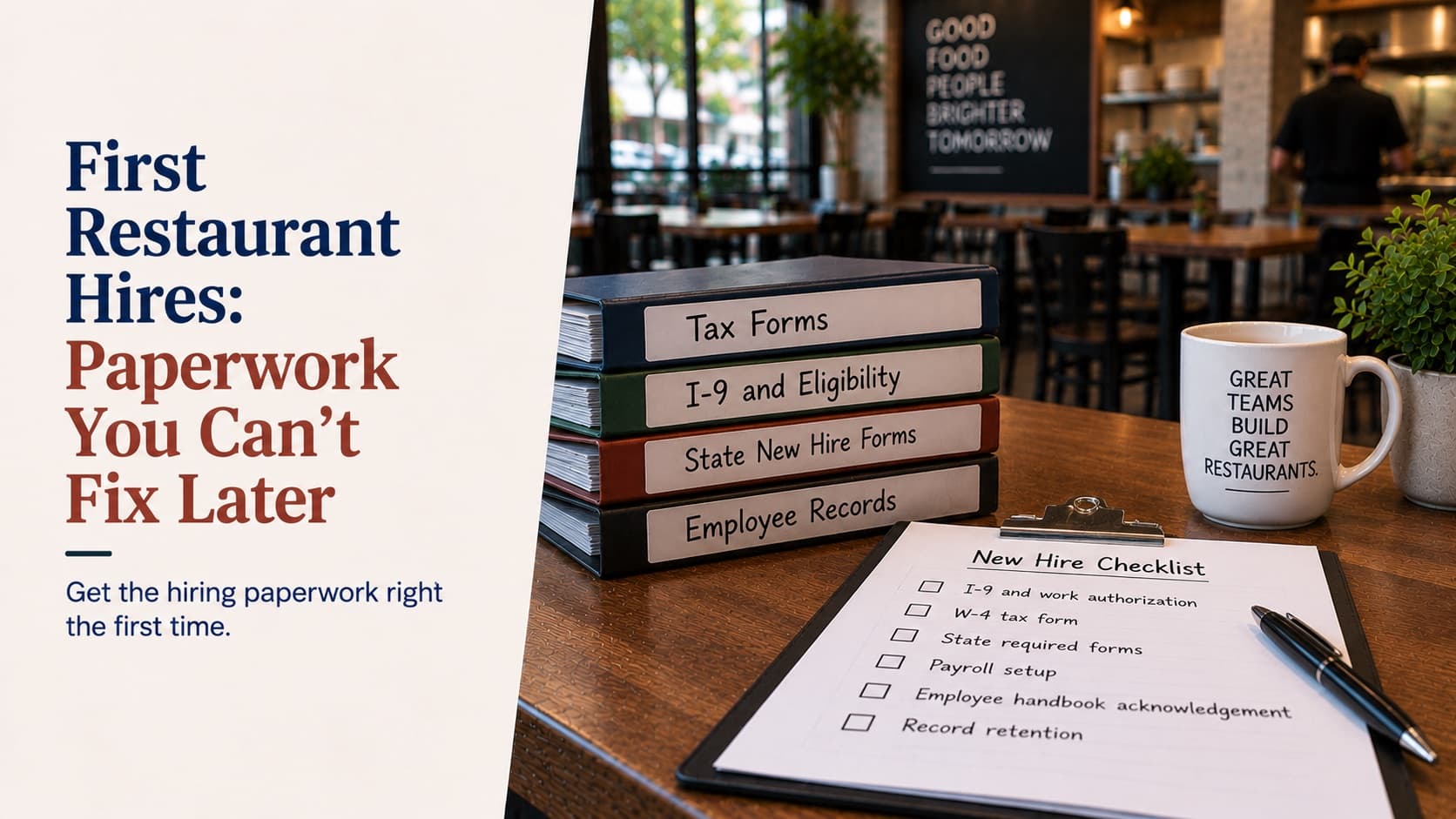
- Section 1 of the I-9 completed at offer acceptance, Section 2 on a three-business-day reminder owned by a named person.
- A written task matrix by age, posted where closing tasks are assigned, with the slicer rule called out explicitly.
- Tip credit notice acknowledged in writing if you're taking the credit, before the first tipped shift.
- Workers' compensation confirmed in writing by your broker or your state agency.
- Required labour posters up — federal and state.
Disclosure: I work at Katalyst. Nothing here is solved by buying a POS, and the two most consequential items — the I-9 timing and the age task matrix — are a calendar reminder and a laminated sheet. I'd rather say that than manufacture a product angle for a post about paperwork.
Topics
See how Katalyst handles your service style
A 30-minute walkthrough of the platform, tuned to how your restaurant actually runs.